

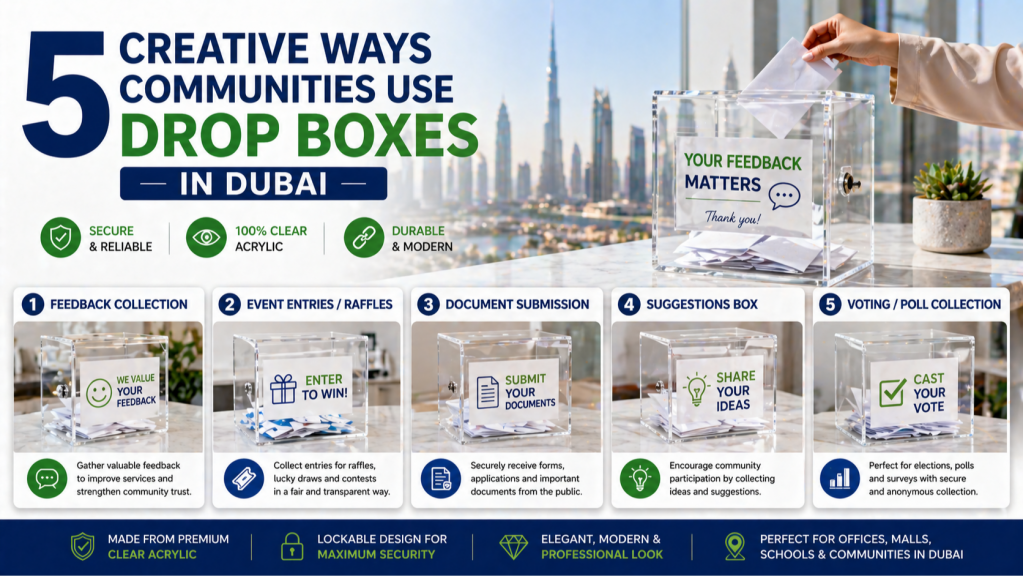
Walking through your Dubai apartment lobby on a Thursday evening, arms full of grocery bags, you notice a neatly labeled green drop box near the mailroom. It reads: "Diwali Donation Drive, Drop sweets, snacks, and dry goods here." You've walked past something like it dozens of times without stopping. A quiet box. A simple slot. And yet it represents something genuinely meaningful about how communities in the UAE show up for each other.
These unassuming collection points serve a wider range of purposes than most residents realize. Not to be confused with the Dropbox app (a cloud storage service for file sync and backup), a physical drop box in a UAE community setting is a hands-on giving tool, from charity drives timed to festivals and corporate giving campaigns to building admin submissions. This article walks through five genuinely creative ways communities across Dubai and the wider UAE are using them right now.
Why drop boxes have become a fixture in UAE community spaces
The UAE's unique community culture creates the right environment
UAE residential compounds and high-rise towers are unusually well-suited to drop box initiatives. Dense expat populations share lobbies, gyms, rooftop pools, and mail rooms every single day. Active building WhatsApp groups make announcements fast, and organized community management teams mean there's usually someone coordinating logistics. When a community manager posts "drop box going up in the lobby tomorrow," word spreads to residents within hours. That kind of infrastructure is hard to replicate in more dispersed suburban settings where neighbors may rarely cross paths.
From suggestion boxes to collection hubs: how the concept evolved
Not long ago, the drop box in a UAE building lobby served a single purpose: a slot for tenant feedback slips or key deposits for weekend maintenance visits. Building management offices and owners' associations began recognizing that these same collection points could serve tenant engagement goals far beyond admin. Charity organizations like Emirates Red Crescent and Beit Al Khair Society were already placing donation bins in shopping malls and near mosques. Bringing a version of that model into residential buildings, with community backing, was a natural next step.
1. Seasonal donation drop boxes in residential buildings
How apartment communities organize collection logistics
The setup is straightforward, and that's exactly why it works. A building management office designates a corner near the lobby or mailroom, places a clearly labeled collection box, and sends an announcement via the building's WhatsApp group. Drives often run for around two weeks, giving residents enough time to gather items without letting momentum fade. At the end of the window, a charity partner collects the contents directly. In Dubai, organizations like Emirates Red Crescent, Al Ihsan Charitable Society, and Dar Al Ber run active community collection programs, particularly during Ramadan, and some partner with residential buildings for coordinated drives.
What residents actually donate and what makes the biggest impact
Clean clothing, canned goods, and hygiene kits are among the most common donations. Themed, needs-based drives reliably outperform generic ones. A drive that asks specifically for "men's work clothing sizes L and XL for labor camp distribution" generates more targeted and useful donations than a general clothing box. The same applies to food: a specific list posted on the building WhatsApp group drives both participation and quality. The more clearly you frame the need, the more residents feel their contribution actually matters.
2. Festival charity hamper collections during Diwali, Pongal, and Eid
How Indian expat communities turn festivals into giving moments
For many South Indian and Tamil families living in Dubai and Sharjah, festivals like Diwali and Pongal carry a tradition of giving alongside celebration. Some community associations and temple committees organize charity hamper drives timed to these occasions, placing drop boxes in apartment lobbies, community halls, and temple premises where residents can drop off packed hampers or individual items that organizers then assemble. The logic is simple: if you're already buying sweets and gifts for your family, picking up a few extra items for someone who won't have that table this season takes minimal effort. When giving is tied to something residents already feel, participation follows naturally. Community stories about passing on festive gifts illustrate how these drives extend through neighborhoods and workplaces during the season in practice.
Building a hamper that actually feels meaningful
The most appreciated charity hampers in these drives tend to be culturally specific rather than generic. When a Tamil family in Deira receives a hamper that includes traditional sweets, a familiar homemade-style snack, an Ayurvedic care product, and pantry staples that feel like home, the impact is different from a standard grocery assortment. Sandhai.ae makes it practical to source these items without spending a weekend driving across Dubai. With authentic South Indian and Tamil products, UAE-wide delivery, and cash-on-delivery options, anyone coordinating a festive charity drive can put together a culturally meaningful hamper without the usual logistical headache. If you're organizing a Pongal or Diwali drive this year, that's the sourcing problem solved before it starts.
3. Document submission and building management paperwork drops
How UAE residential communities use drop boxes to cut through admin friction
Here's a use case that rarely makes headlines but solves a real daily frustration. Building management offices typically operate during working hours. Most residents in full-time employment can't visit the front desk between 9am and 5pm on a Tuesday, that's the gap a document drop box fills directly. Some UAE buildings keep a clearly labeled slot near the security desk for tenants to submit maintenance request forms, lease renewal paperwork, parking permit applications, and NOC requests. You seal your envelope, drop it in, and the office processes it the next morning. No waiting, no rescheduling.
Security, confidentiality, and what to watch out for
Always use a sealed envelope when submitting any document that includes personal details. Write your unit number, name, and a contact number on the outside so the management team can reach you quickly. For anything sensitive, passport copies or financial documentation, ask in advance whether the building has a receipt process or a digital acknowledgment system. Never drop original documents you can't replace; send a clear photocopy and keep the original yourself. If you're unsure whether a building's drop process is secure, it's worth asking the front desk before you submit.
4. Corporate CSR and workplace giving campaigns
How Dubai offices run charity collections at their desks
Some mid-to-large UAE companies with active CSR mandates use the physical drop box as a practical anchor for company-wide giving campaigns. Drives range from Ramadan food packs for blue-collar workers to back-to-school stationery collections and book donation initiatives. A well-documented example is Etisalat's Ramadan initiative, in which medicine collection boxes were placed across its office buildings to gather unused medications for low-income patients via Al Ihsan Charitable Society. The box sat in the lobby. Employees and visitors contributed without filling a form or scheduling a pickup. It was visible, frictionless, and effective. For HR teams and CSR coordinators, the physical drop box often outperforms campaigns that exist entirely in email threads and Slack channels.
Why the physical drop box works better than a digital pledge system
When an employee walks past a box that's half-full by Wednesday morning, they're more likely to contribute before Friday. The visible progress signals that colleagues are already participating, which removes the hesitation of going first. A filling box creates social proof in a way no email survey can. If you're an office manager or CSR lead planning a giving campaign, place the collection box somewhere with genuine foot traffic, near the coffee machine or the elevator bank, not a back corner or the HR floor.
5. School supply and toy donation points in neighbourhoods
How UAE schools and parent communities run student-led drives
Some schools in Dubai and Sharjah run stationery, toy, and book donation drives timed to the start of a new academic term or a charitable occasion in the school calendar, with drop boxes placed in school lobbies or parent waiting areas. What sets these drives apart is student involvement: when children participate in sorting and delivering collected items rather than watching adults manage the process, the habit forms differently. A student who helped sort donated backpacks and hand them to a classmate in need carries that experience forward. These drives tend to generate strong parent participation because the connection between donor and recipient feels immediate and local.
Neighbourhood drop points that extend the reach
The most effective drives don't stop at the school gate. Drop box points placed in mosques, community centers, and retail locations in high-footfall neighborhoods draw contributions from residents who have no direct connection to a particular school or corporate network. A parent who spots a clearly labeled collection box at their local community center can contribute school supplies without needing an invitation or a school-specific link. Decentralized drop points expand participation significantly. If you're organizing a drive, think about where your community actually spends time, not just where they're already enrolled or employed.
Start with the box in your lobby
The drop box sitting in a Dubai apartment lobby represents something quietly important about how communities function in the UAE: organized, cross-cultural, and consistently oriented toward looking after one another. Whether it's a Pongal hamper assembled with products from Sandhai.ae, a workplace CSR campaign during Ramadan, or a school stationery drive that gets students involved in giving, the physical collection point makes it real in a way that digital campaigns rarely do.
The most impactful drives are usually the simplest to set up. A clearly labeled box, a WhatsApp announcement, and a charity partner willing to collect, that's often all it takes. If you've been considering starting something in your building or office, the logistics are more manageable than they look. Place the box, spread the word, and the community tends to do the rest. For events that need a larger visible unit or a raffle/ballot-style collection, consider an acrylic raffle/ballot box as a durable, transparent option.

Share this via
Or copy link