

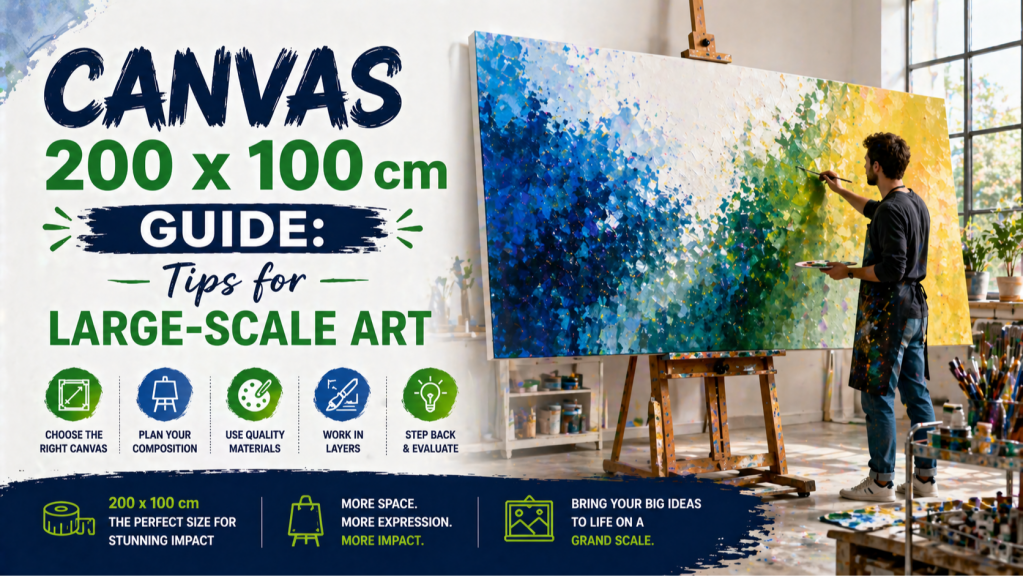
Big-format art changes how a room reads, and a canvas 200x100 cm hits a balance between cinematic scale and manageable installation. At a 2:1 aspect ratio (about 78.7 by 39.4 inches), this size suits decorators, mural artists, photographers printing wide images and gallery displays. The guide below explains when to pick a horizontal 200x100 versus a vertical 100x200 canvas, how aspect ratio shapes composition, and practical hang heights, viewing-distance rules and ordering tips so you get the scale right the first time.
Where does a large canvas 200x100 work best? Place it above a sofa, along a long hallway, behind a restaurant bench or in an office lobby where one piece should read from a distance and connect to the space. For narrow, tall areas such as stairwells, a vertical 100 x 200 canvas emphasizes movement and sightlines. Match furniture scale by aiming for the artwork to be roughly two-thirds the width of the sofa and choose orientation based on everyday sightlines and traffic flow.
Viewing distance and sightlines change how the piece reads, so plan before you order. Hang the visual centre near average eye level and allow about 1.5 to 3 metres of viewing distance for most rooms; low ceilings or tight corridors may call for shallower stretchers or smaller formats. If your source image uses a different ratio, crop carefully or add a narrow border so it reads well at 200x100. Later sections cover stretcher recommendations, hanging hardware and where to buy a canvas 200x100 in the UAE.
Quick summary
- A 200x100 canvas creates a strong panoramic presence suitable for above sofas, along hallways or in public lobbies. Use compositional lines and colour contrast so the work reads clearly from a distance. Balance the piece with surrounding furniture to avoid visual overcrowding.
- Measure the wall at multiple points and mock the 200x100 shape with paper or tape before ordering. Aim for artwork around two-thirds the width of a sofa and note switches, mouldings and doorways that might interfere. A mockup prevents returns and surprises on install day.
- Choose a horizontal 200x100 for wide panoramas and a vertical 100x200 for stairwells or narrow walls. Hang the visual centre near eye level and leave 1.5 to 3 metres for comfortable viewing. Consider how people approach and move past the piece when deciding orientation.
- Decide between pre-stretched, rolled or printed canvas based on shipping, handling and finish needs. Budget for stretcher depth, framing and hardware and confirm the finished weight before selecting fixings. Specify kiln-dried, warp-resistant stretcher bars for longevity.
- On delivery, inspect stretcher tension and corners, mark studs, use rated anchors and add crating or insurance to your total cost. Keep a 10 to 20 percent contingency for handling or customs when ordering from abroad. Follow a simple install checklist to avoid damage during hanging.
Why a 200 x 100 cm canvas makes a strong statement
Use the piece to anchor furniture groupings or create a horizontal visual flow across a wall. Above a sofa or bench, the two-thirds width rule helps the artwork feel connected to the furniture without overpowering it. For tall, narrow spaces flip to 100 x 200 to emphasize vertical rhythm and guide the eye upward.
Plan placement with viewing distance and eye level in mind before you commit to printing or stretching. The diagonal of a 200 x 100 canvas is about 88 inches, so primary viewing at 3 to 4.5 metres keeps details legible and composition balanced. For rooms with low ceilings choose lighter tones, slimmer stretcher bars, a diptych split or a vertical orientation to reduce perceived bulk.
Measure the wall and mock the piece before you order
Accurate measurement avoids returns and poor fit, so start with careful dimensions. Measure wall width and height at two or more points to catch uneven surfaces and use a stud finder or tapping method to locate supports. Hold the tape measure in place to visualise how much space the 200x100 will take before you commit.
Create a full-size template from kraft paper, cardboard or masking tape and attach it to the wall to test scale and placement. Mark the top edge, visual centre and hanger points and note clearances from furniture and moulding so you know where screws or anchors will fall. Photograph the mockup straight on and from common viewing spots to share with framers or printers when you order.
Preview the composition at full scale using a projector or phone app to check cropping and detail before printing. Confirm your image resolution meets the printer’s DPI requirements to avoid pixelation at large sizes. Measure the tops of sofas, consoles and cupboards and allow 10 to 20 centimetres of clearance above furniture to keep proportions balanced on install day.
Choose the right canvas type and materials for a large 200 x 100 canvas
How the canvas arrives affects cost, handling and when you can start working or displaying it. Main options are pre-stretched artist canvases, rolled canvas for local stretching, or printed canvases for photographic and giclée work. Each choice trades off shipping convenience, immediate readiness and the final finish you want on the wall.
- Stretched: Ready to hang and paint, stretched canvases are convenient for immediate studio work and display. They cost more to ship in large formats but arrive prepared with reinforced stretcher bars. For large pieces request high-tensile bars and reinforced corners to limit warp. (seeStretched Canvas Online UAE | Large Canvas Blank | sandhai.ae)
- Rolled: Rolled canvas is cheaper to ship and easier to store, but requires local stretching or framing before display. This option saves on freight and allows a local framer to match regional standards. Make sure the printer uses archival inks and proper priming for rolls.
- Printed: Printed canvases suit photographic reproductions and giclée prints and can arrive stretched or rolled. Choose pigment-based inks and ask about archival coatings for longevity. Confirm whether the printer will add bleed or border to preserve composition when the image is adapted to 200 x 100.
Material and priming affect how paint sits and how details read at scale. Linen provides stronger support and a finer tooth for archival work but costs more, while heavy-grade cotton is affordable and reliable when mounted on reinforced stretcher bars. Prime with two to four coats of acrylic gesso for acrylic work, sanding lightly between coats and allowing sufficient drying time in UAE humidity. For oils use an oil-primed ground and respect recommended cure times before varnishing. For an accessible primer comparison see the difference between cotton and linen canvas explained by Winsor & Newton.
For stretcher bars choose kiln-dried, knot-free wood with a depth of 35 to 45 mm for a secure gallery wrap and minimal warp. Local suppliers and framers often offer high-tensile systems and cross-bracing for large formats. Ask about reinforced corners and mounting options if the canvas will be framed or shipped frequently. For example, many UAE sellers list standard and reinforced options; see Shop For Funbo Canvases 100X100cm Online Now | sandhai.ae for a sense of available pre-stretched ranges and depths.
Expect weight, pick framing and the right hanging hardware
Large canvases add weight once stretcher depth, frame and fittings are in place, so estimate the finished weight before you drill. A simple 200 x 100 stretched canvas commonly weighs between 8 and 15 kg, while a deep float or solid timber frame can push that to 20 to 25 kg or more. Check the maker’s spec sheet and choose fixings rated at least 50 percent above your estimate to allow for dynamic loads.
Use stainless or coated hardware in humid environments to resist corrosion and reduce maintenance. For framed pieces fit D-rings paired with braided picture wire and use wall anchors or toggle bolts for drywall when a stud is not available. Select D-rings and screws rated 30 to 50 kg each and wire with a working load at least twice the canvas weight for added safety. For guidance on anchor types and load ratings, consult a trusted masonry anchor guide that covers concrete and masonry anchors.
Price, shipping and trusted places to buy a 200 x 100 cm canvas
Budgeting for a large canvas means adding shipping, crating, framing, hardware and insurance to the base price. Typical market ranges are: rolled giclée prints on canvas $30 to $120, pre-primed stretched cotton canvases $90 to $350, and premium linen or gallery-grade stretched canvases $250 to $900. Higher-grade materials and archival manufacturing push costs toward the upper bands.
You can lower costs by ordering rolled prints and having a local framer stretch the canvas, or by buying an unframed blank and fitting hardware yourself. Avoid cheap stretcher bars and poor priming if you plan to paint oils, since low-quality supports can warp and reduce longevity. Specifying kiln-dried bars and the correct depth up front costs more but saves on repairs later. For buyers across the UAE, Sandhai.ae lists warp-resistant 200x100 stretched canvases with local delivery and pay-on-delivery options, which simplifies logistics for expatriate households, restaurants and small businesses. If you prefer ready-made retailer options, consider a dedicated product listing such as Canvas Republic's 200x100cm canvas or compare pre-stretched models and local framing quotes before you commit.
Prep, prime and install: a step-by-step checklist for your 200x100 canvas
- Open the delivery carefully and photograph the packaging and canvas for records. Keep those photos for insurance or returns if damage appears.
- Press the mid-panel softly to check for even tension and tighten corner keys if provided. Note any defects and document them with photos before accepting or arranging a return.
- If using acrylics, size if required and apply two to three coats of acrylic gesso, sanding lightly between coats. Allow adequate drying time to ensure a smooth, stable ground.
- For oils use an alkyd or oil ground and allow full cure before varnishing. Do not paint oils over uncured acrylic layers to prevent adhesion issues.
- Apply a UV-protective final varnish only after paint is fully dry or cured for the medium used. Use removable varnish for oils and acrylic-safe varnishes for acrylics to allow future conservation work.
- Pre-drill stretcher bars, install D-rings at the recommended height and attach braided picture wire rated for the canvas weight. Test the assembly on a bench to ensure all fixings are secure.
- Mark wall points with a level and fit the appropriate anchors or screws, then lift with two people to hang. Confirm the artwork sits level and flush against the wall before finishing.
- Troubleshoot common issues: for minor sagging add keys or lightly mist and re-tension, for small tears patch from the back with canvas and PVA adhesive. For scuffs or dirt clean gently and retouch where needed, documenting any conservation steps.
- Schedule yearly checks to inspect tension, hardware wear and environmental exposure such as humidity and direct sun. Replace or reinforce hardware as required to protect the work.
- Compare stretched, rolled and printed 200x100 options before ordering and consider high-tensile, warp-resistant stretcher systems for large formats. Professional framing and mounting can reduce long-term maintenance and risk.
Final steps for your canvas 200x100
A well-planned large-format canvas improves a space when measurement, materials and mounting are chosen with care. Measure twice, mock up the scale on the wall and confirm image resolution, stretcher depth and hardware before you order. Once your mockup and mounting plan are set, place the order and schedule a two-person hang for a safe, clean install.
Large formats need robust packing: corner protectors, layered foam and double-wall boxes or wooden crates for long-distance transit. Crate shipping can range from $150 to $800 depending on distance and dimensional weight, while local UAE delivery is typically much lower. For packing and shipping tips see the UPS Store artwork packing and shipping guide.

Share this via
Or copy link