

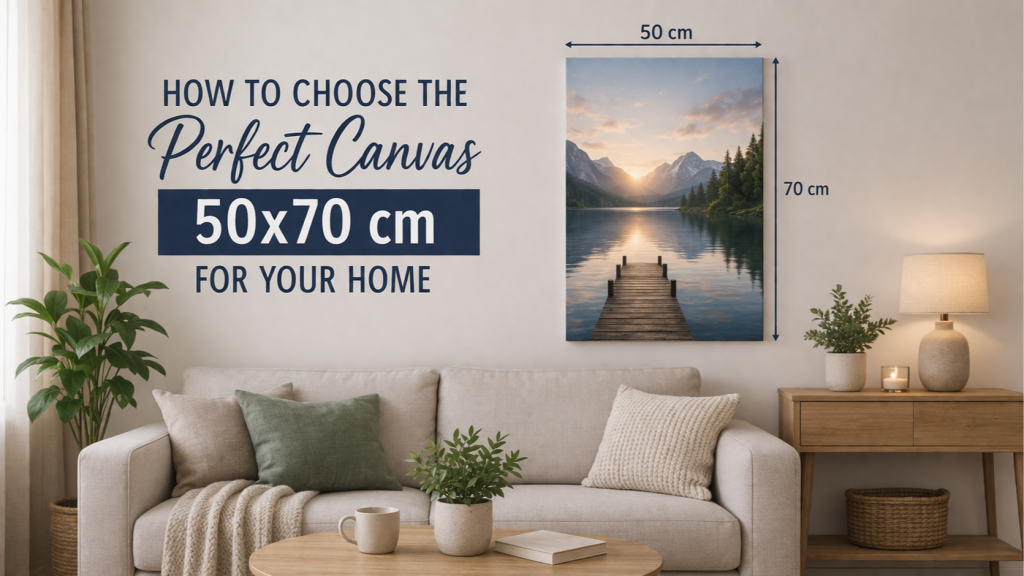
Viewing distance affects how a 50x70 canvas reads, so consider how people will move and sit in the room. At typical living-room distances, a 50x70 canvas feels intimate and shows detail, while a large open-plan area often needs a larger piece or a grouped solution to register as a focal point. For groupings, keep 5 to 10 cm between canvases, align orientation with furniture lines, and ask printers about mirrored edges for gallery wraps to preserve important image areas on the sides.
Key takeaways
Keep these quick rules in mind when shopping for a canvas 50x70 to avoid surprises with sizing and finishes. Mock up the size on your wall, hang the piece at eye level, check the material and primer, and confirm stretcher depth for the display you want. Order a sample if you have doubts, and use reliable delivery and return options when buying in the UAE.
- Create a mockup by cutting a 50x70 cm template and sticking it to the wall so you can judge scale before you buy.
- Hang the centre around 140 to 150 cm from the floor and aim for the canvas to cover 40 to 75 percent of the furniture width, increasing to 60 to 75 percent for sofas.
- Choose cotton for smoother handling and linen for texture and archival work, and favour acrylic gesso for versatility unless you need a traditional oil ground.
- Pick stretcher depth to control visual presence, allow 5 to 10 cm between grouped canvases, and request mirrored edges for gallery wraps to avoid cropping.
- Check product specs and order a sample if you're unsure.
Quick check: Will a canvas 50x70 fit your space?
For a balanced look, keep the artwork centred at eye level, roughly 140 to 150 cm from the floor to the centre, and let a single canvas span about 40 to 75 percent of the furniture's horizontal space, depending on whether you want a subtle or bold focal point. Use the mockup to compare a single canvas with pairs or triptychs, since two 50x70 pieces with a 5 cm gap create about 105 cm of visual width. That often reads as more substantial than mid-sized sofas.
Material matters: cotton vs linen and choosing by medium
Grain and tooth affect how paint behaves, so start there when choosing a support. Cotton duck runs from fine to medium tooth and hides small mistakes, while linen has a tighter, more archival weave and favours precise brushwork and great detail. As a simple rule, choose linen for oils and archival pieces and cotton for acrylics, studies, and budget projects. For a detailed comparison of weave, longevity and handling, see this linen vs cotton comparison.
Weight and GSM influence feel and the risk of sag, so check labels before checkout. Cotton canvases commonly fall in the 200 to 400 gsm range, while linen often starts around 300 gsm, and 11.5 oz converts to roughly 390 gsm as a useful benchmark. For a stretched 50x70 canvas, aim for at least 300 gsm to reduce sagging and opt for heavier weights if you want a firmer surface.
Pre-primed canvases save time and give a consistent tooth across the surface, which suits artists who want to begin painting immediately or who order gallery wraps. Many brands ship pre-primed with multiple coats of acrylic gesso and label those canvases as suitable for both oils and acrylics, though some oil painters still prefer raw linen to size and apply a traditional oil ground. Keep a short spec checklist when shopping: material, GSM or ounce weight, stretcher depth, and whether the surface is pre-primed.
Stretcher bars, depth, and gallery wrap: practical profile choices
Stretcher-bar depth changes how a piece reads across the room, so choose it with the final display in mind. Slim bars around 12 to 18 mm suit a low-profile look or a framed presentation, mid-depth bars near 38 mm add modest presence and work well with floating frames, and deep bars from about 43 to 63 mm create a gallery-style presence that often removes the need for an outer frame. For a canvas 50x70, the 38 to 63 mm range is a practical starting point, depending on whether you plan to float-frame the piece or show the sides as part of the composition. A useful guide to stretcher bars explains joint types, recommended depths, and construction tips.
Corner construction influences longevity and tension as humidity and temperature change. Butt joints are fine for short-term pieces, while keyed or routed corners with wooden wedges let you re-tension the stretcher later; higher-end canvases commonly use solid pine or poplar bars and include wedges. When you buy, check whether the canvas is back-stapled, hand-stretched and shipped with tensioning wedges so you can maintain a drum-tight surface over time.
Gallery wrap and framed edges require different preparation. A gallery wrap carries the image around the bar for a frameless look, so order prints with extra bleed or mirrored edges if you intend to wrap; if you plan to place the canvas into a conventional frame, choose a flush edge or a thinner bar and confirm how much of the image will be hidden by the frame rabbet. Those profile choices affect display options and future maintenance and will influence your priming and finishing decisions.
Priming, tooth, and finishing: how to prep for paint or print
Pick a primer that matches your medium and the canvas 50x70 format. Acrylic gesso is a fast, multipurpose option that grips both oils and acrylics, while a traditional oil ground is thicker and intended specifically for oil painting. Many manufacturers advertise "three coats," and applying two to three coats is common to build an even sealed surface, so if you work only in oils, confirm the primer is oil-compatible before purchase.
Surface tooth affects how paint layers sit, so check and adjust it before your first strokes. Lightly sand between coats with fine grit to remove loose fibres, and use sizing such as rabbit-skin or acrylic size when you need extra isolation on raw cotton or boards. Smooth, low-tooth surfaces favour glazing and fine detail, while a higher tooth holds impasto, so run through a quick checklist when the canvas arrives.
- Even primer coverage, typically two to three coats
- No loose threads or bumps after light sanding
- Stretcher tension and corner folds secure
- Primer and surface confirmed compatible with oils or acrylics
Finish choices protect the work and influence appearance, so use a retouch varnish for in-progress protection and a removable final varnish for long-term care. UV-protective varnishes are a sensible choice for originals or for a 50x70 canvas print that will see sunlight, since they reduce fading and yellowing over the years. Choose gloss for saturated colour or matte for low reflection, and allow proper drying time for oils before you varnish to keep the finish even and durable.
Framing and display: frames, float mounts, and print alternatives
Choose a frame by the mood you want to set and the display you plan. A float frame preserves visible sides and creates a narrow gap, while a classic frame surrounds the edge and looks more formal; allow 2 to 4 mm clearance for the canvas thickness so the frame does not press the surface, and leave 5 to 10 mm for seasonal movement. Shallow box frames suit contemporary work while ornate frames complement portraits and traditional interiors.
If you order a printed canvas rather than paint directly, check image resolution and file type before you upload. Aim for 150 to 300 PPI at the final print size and supply high-quality TIFF or JPEG files with embedded colour profiles, and ask vendors about archival pigment inks and heavy, primed canvas bases because those choices determine colour longevity and resistance to cracking. If you're comparing print providers, this roundup of the best canvas print services can help. For hanging hardware, pick sturdy fittings that match your wall type and the piece's weight, and use D-rings and braided wire or heavy-duty anchors for plaster or drywall installation if you cannot hit a stud.
Before you hang a larger piece, measure twice, mark the stud layout, test the weight on a single anchor, and have someone hold the frame while you level it. A small spirit level and painter's tape make marking and aligning easier and prevent extra holes. A clear mounting checklist protects both the artwork and the wall during installation.
Where to buy 50x70 canvases: brands, price ranges, and the Sandhai.ae advantage
Compare items by specification rather than price and use a short checklist to avoid surprises at delivery. Look for product pages that list material, GSM or ounce weight, stretcher depth, and corner finish, whether the canvas is pre-primed and how many coats, stretcher-bar type and whether it is hand-stretched, country of manufacture, and the return or inspection policy. Expect a wide price spread: student lines and bulk pre-packs commonly run about $2 to $15 per canvas, while professional, museum-grade stretched canvases usually sit in the $50 to $120 range, depending on linen, heavier GSM, deeper bars, and hand finishing. You can also browse ready-made 50x70 canvas options from specialist suppliers when comparing specs and prices.
Sandhai.ae offers museum-grade, pre-primed canvases with UAE-wide delivery, secure online payments, and cash-on-delivery for local convenience. Order a single sample first, check depth options if you plan a float frame, and read the return or inspection window so you can inspect tension and priming on arrival. Sandhai also lists Funbo stretched canvases in a variety of formats, including larger and smaller sizes such as 100x100 cm, compact squares like 30x30 cm, and A4-format stretched options such as 24x30 cm. Once you confirm that a canvas 50x70 fits your space, pick a material by medium and budget, then use Sandhai.ae to view specs, order a sample, and schedule delivery.
Make the canvas 50x70 fit your home
Follow a simple decision path: measure the wall, create a mockup, then choose material and profile based on how you paint and how you plan to hang the piece. Mocking up with packing paper or masking tape removes guesswork and shows scale in context, and paying attention to grain and tooth helps paint behave the way you expect. Factor in stretcher-bar depth and gallery wrap if you want finished edges or a frame-ready profile.

Comments