

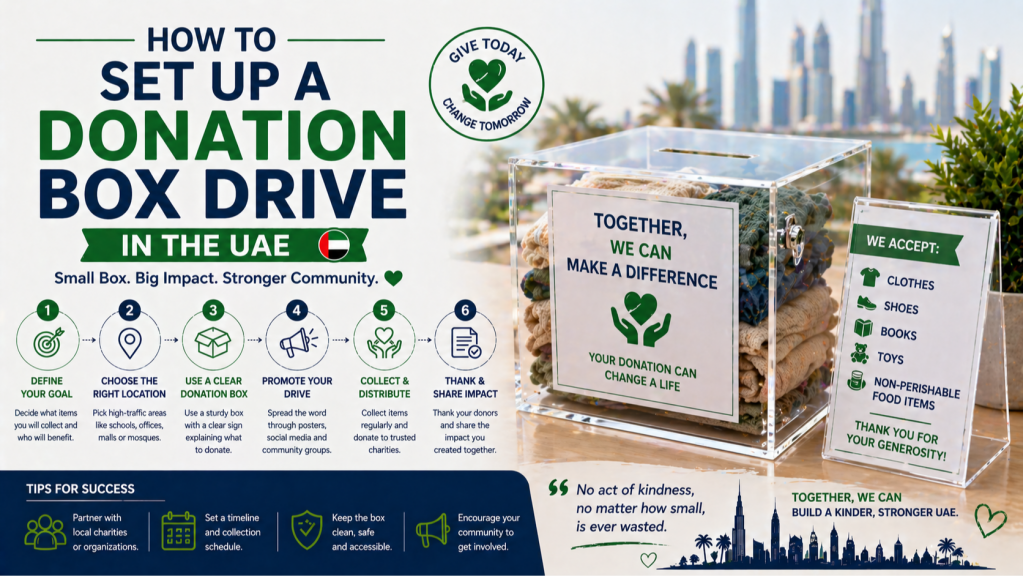
Picture the notice board in a Sharjah apartment building during Ramadan: a handwritten sign taped above a donation box near the elevator, a few grocery bags already piled beside it, and a WhatsApp message doing the rounds asking residents to contribute what they can. No committee, no charity registration, no social media campaign. Just one person who put out a box and told the group chat.
UAE expat donation drives frequently start informally. Tamil and South Indian families, Pakistani neighbors, Arab residents, and colleagues from a dozen nationalities often share a deep cultural pull toward giving during festival and religious seasons. Ramadan, Diwali, and Pongal all carry that expectation of generosity. The organizer's job isn't to create motivation; it's to give that motivation a direction.
This guide walks you through the practical side: choosing the right donation box, setting up collection points that people actually use, assembling culturally appropriate hampers, and staying within UAE guidelines. A well-placed box in the right location can generate contributions that rival far more elaborate campaigns, and getting the setup right from day one makes all the difference.
Why UAE expat communities lead donation drives
During Ramadan, charitable giving holds profound importance for Muslim residents. Zakat is a formal obligation for those who are eligible, and many residents already coordinate food donations and contributions through informal apartment-level networks, using building management offices or masjid lobbies as natural collection hubs. The infrastructure of giving is already there. It just needs a physical collection point.
For Hindu and Tamil families, Diwali and Pongal carry a strong cultural expectation of sharing abundance. Gifting and giving during these seasons is deeply embedded, not optional. In UAE high-rise buildings where dozens of nationalities share the same lift, these traditions from different communities often run side by side during the same month, creating an extended giving season that stretches across much of the year among some residential communities.
In many offices, HR or admin teams help coordinate drives, especially where staff members organise among themselves, and this is common in workplaces with large South Asian teams. Most successful drives don't start with a formal committee. They start with one motivated person, a labelled box, and a group chat message.
Choosing the right donation box for your setup
The type of collection box you choose should match your location, the expected volume, and how long it will be left unsupervised. A mismatch here is one of the most common stumbling blocks for first-time organizers, for example, using a small countertop box in a high-traffic lobby that fills within two days and then overflows. (For an in-depth buyer's checklist, see the Donation Drop Boxes: The Ultimate Buying Guide.)
Countertop and lockable donation boxes for indoor collection
For apartment lobbies, office reception desks, or masjid entrances, a lockable countertop donation box is the most practical choice. It's tamper-resistant, portable, and easy to empty on a regular schedule without disrupting foot traffic. Clear acrylic donation boxes carry a specific advantage: when residents can see items or envelopes already inside, they're more likely to add to the collection. Social proof works even in a lobby. (Consider a White Acrylic Donation Box with Lock 20 cm for small countertop needs.)
Metal lockboxes suit higher-traffic or unsupervised spots like building entrances or outdoor covered walkways. They're heavier and less portable than acrylic, but their welded seams, reinforced panels, and cam-lock lids make them significantly more resistant to tampering. For anything left unattended overnight, metal is worth the extra investment. (For a quick overview of common donation bin types and their uses, see Types of Donation Bins, Which One Fits Your Needs?)
Larger bins and clothing donation options for packaged goods
For drives collecting clothes, blankets, or bulk packaged food, a full-size clothing donation bin works well in lift lobbies or parking-level entrances. Waterproof plastic storage bins with clear signage are a practical, affordable alternative to purpose-built donation receptacles for short-term drives lasting two to four weeks. (If you need larger collection solutions, consider purpose-built options such as an Acrylic Raffle Box 40 X 40 X 40 cms.)
As a rough guide based on typical participation rates, a 60 to 80 litre bin is often enough for a two-week drive in a mid-size building, though this will vary with occupancy and how actively you promote the campaign. Larger drives may need a designated donation drop-off location near the building entrance with specified collection hours, especially if you're expecting bulk items. For outdoor spots, look for weatherproof bins with secure lids that can handle the UAE heat without warping. (For vendors who specialise in larger donation bin installations, see industry options like donation bins and housings.)
Setting up donation boxes and collection points that actually get used
The most common mistake in community donation drives is placing a collection box somewhere convenient for the organizer rather than somewhere residents actually stop. Location determines everything.
Getting approval and picking high-traffic spots
In UAE residential buildings, getting approval from building management or the owners' association is a necessary first step. Most management teams are supportive, especially for Ramadan drives. A WhatsApp message or email to the building supervisor is a good starting point, though requirements vary, for anything beyond an informal in-building goods collection. Confirm with management whether any formal documentation is needed.
It's also worth noting that Federal Decree Law No. 3 of 2021 governs all charitable fundraising in the UAE, so checking legal requirements before you launch, particularly if your drive spans common areas or involves cash, is a sensible precaution. When in doubt, partnering with a licensed charity from the outset provides the clearest protection.
The best spots are near the main elevator, at the building security desk, in the office break room near the coffee machine, or at the mosque lobby. Place the collection box where people already slow down. For office drives, coordinate with HR or admin teams early. Some UAE companies have CSR policies that support employee-led charitable campaigns and can help spread the word across departments.
Donation box signage and labels that motivate people to give
A donation box without clear signage collects nothing. Your label needs to answer three questions immediately: what you're collecting, who it benefits, and when the drive ends. Ambiguity kills participation.
Use bilingual labels at a minimum (English and Arabic). In South Indian-majority buildings, adding Tamil or Hindi is a sensible practice given the language communities present. A QR code linking to the charity partner's page or a building WhatsApp update group turns passive donors into engaged participants. In practice, residents who receive a midpoint update tend to donate more than once, and that's what turns a modest collection into a meaningful one.
Assembling hampers that reflect the culture
The difference between a generic food parcel and a culturally assembled hamper matters more than most organizers realize. For recipients, getting something familiar during a festival carries emotional weight that a generic box of tinned goods simply doesn't.
What goes into a Ramadan or Diwali hamper
A Ramadan food hamper typically includes rice, lentils, cooking oil, dates, vermicelli, canned goods, and basic spices. For South Indian families receiving these hampers, familiar staples like sambar powder, tamarind paste, and vermicelli for semiya payasam make the hamper feel genuinely useful rather than assembled from a generic checklist. Dates are essential for Ramadan; they carry both nutritional and spiritual significance during iftar.
A Diwali hamper usually includes traditional sweets, snacks, diyas or small candles, and packets of dry goods like cashews, almonds, and dried fruits. For many recipients, recognizing the festival through the hamper contents signals that the giver understood and respected their tradition. That recognition matters as much as the contents themselves.
Sourcing the right products without the hassle
This is where the right marketplace removes most of the friction. Sandhai.ae stocks festival essentials, South Indian groceries, traditional sweets, and packaged snacks, the building blocks of a well-assembled cultural hamper. Instead of driving across three stores in different parts of the city, organizers can build a single cart with vermicelli, masala packs, Diwali sweets, dates, and packaged snacks, then have everything delivered across the UAE.
For solo organizers managing an office drive while holding down a full-time job, ordering all hamper contents in bulk from one place is measurably faster, cheaper, and less stressful than sourcing products piecemeal from different shops. Assembling ten Ramadan hampers or fifteen Diwali boxes from a single order saves hours. Check each supplier's payment options, including whether cash on delivery is available, before placing your order. (If you also need lockable countertop options for your collection point, consider a White Acrylic Donation Box with Lock 35 cm.)
Running the drive from launch to handover
Setting up the collection box is the easy part. Keeping the drive running over two to four weeks without losing momentum takes a simple but consistent system.
Setting a timeline and keeping people informed
Define a start and end date before you announce anything. Drives without deadlines tend to lose momentum; many organizers find a two-to-three-week window works well for most apartment or office campaigns. Announce in building WhatsApp groups, office communication channels, and on a printed notice near the collection box itself. Send a midpoint update showing what's been collected, visible progress motivates late participants to contribute before the deadline.
Assign one or two named point-of-contact people for questions and collection updates. Drives run by informal committees with no clear owner tend to stall when no one feels personally responsible. One motivated person with a phone number on the notice is more effective than a five-person group where everyone assumes someone else is handling it.
Keeping collections secure and on schedule
Empty the donation box every two to three days to prevent overflow and keep the collection point tidy, a full or overflowing box discourages further donations. For lockable boxes, only the designated coordinator should hold the key; this keeps accountability clear. Keep a simple running log of what's been collected, including item counts, approximate weight, and hamper numbers. This makes the final handover to a charity partner straightforward and gives you something concrete to share with the community.
Take photos of filled boxes and assembled hampers to share in the building or office group. Visual proof of impact keeps engagement high through the final week and, practically speaking, sets up next year's drive.
Connecting with charity partners and staying within UAE guidelines
UAE regulations on charitable collection are specific, and understanding them upfront protects both the organizer and the community drive.
Federal Decree Law No. 3 of 2021 regulates all donations and fundraising nationwide. Unregistered public fundraising or cash collection without a permit from the Ministry of Community Development, or, in Dubai, the Islamic Affairs and Charitable Activities Department (IACAD), carries serious penalties. For informal building and office drives, goods-based collection is the lower-risk approach. Collecting food, clothing, and packaged household items within a single private residential building or company carries a different risk profile than public cash collection, but the clearest protection is always to partner with a licensed charity from the start. (For an accessible explanation of UAE charity rules and safe donation practices, see the Gulf News summary UAE charity law, donate safely.)
Several registered organizations accept community-organized goods donations in the UAE. The UAE Food Bank operates Charity Fridge initiatives in Dubai residential areas and runs food parcel distribution programs that can accommodate community collections coordinated through their network. Human Appeal UAE and the Indian Consulate's community welfare programs are worth contacting early, though availability and criteria vary by emirate, so verify directly with each organization. Some mosques and temples run their own collection networks during Ramadan and Diwali; connecting with these institutions means your collected goods reach recipients faster through established distribution channels.
Always confirm acceptance criteria before the drive starts. Some organizations accept only specific items; others prefer monetary contributions over goods, which they can deploy more efficiently. A phone call or email before launch saves significant time at the handover stage.
Start this season with one good donation box
The best donation drives in the UAE aren't complicated; they're consistent. One organized person, one well-placed donation box, and a community that already wants to give. The organizer's role is to provide direction, not motivation.
For Tamil and South Indian families, for Pakistani and Arab neighbors, for colleagues across cultures, giving during Ramadan and Diwali is second nature. That impulse is already there. A labelled box in the right spot with a clear end date is all it needs to become something real.
Start with a single collection point this season. Choose the right donation box for your building or office setup, source your hamper ingredients from one trusted place, Sandhai.ae delivers festival groceries and South Indian staples UAE-wide, and let the community do the rest. The logistics are simpler than they look. The impact tends to surprise first-time organizers.

Share this via
Or copy link