

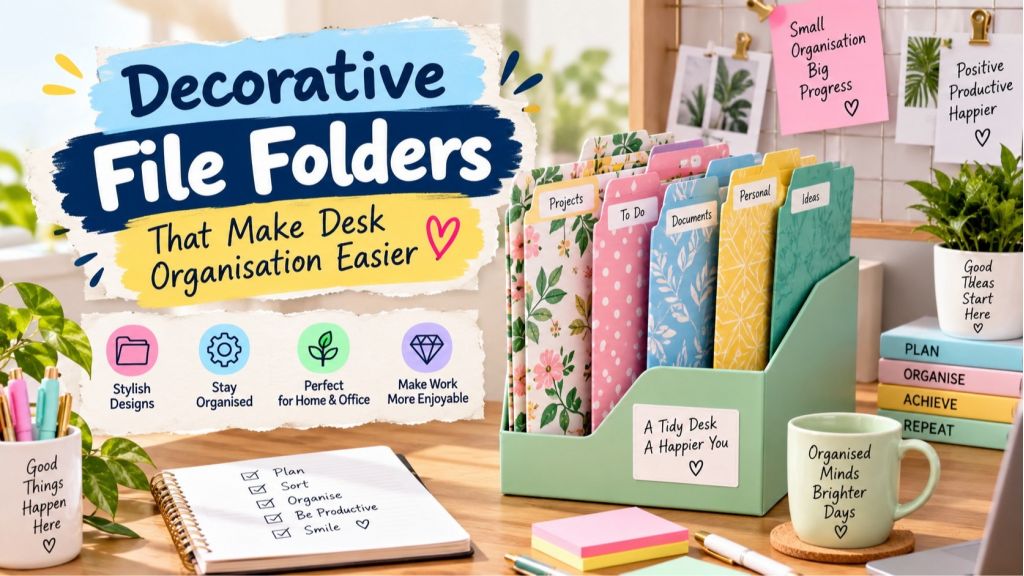
A tidy desk is not only about looking neat. It changes how quickly you find a bill, sort a school form, prepare an invoice or clear space before a video call. Decorative file folders help because they make paper organisation visible, simple and pleasant enough to maintain.
For online shoppers in the UAE, the goal is not to buy more stationery for the sake of it. The better approach is to choose folders that match your daily routine, your desk size and the kind of papers you handle most often. A good set of decorative file folders can turn scattered documents into a system you actually use.
Why decorative file folders make organisation easier
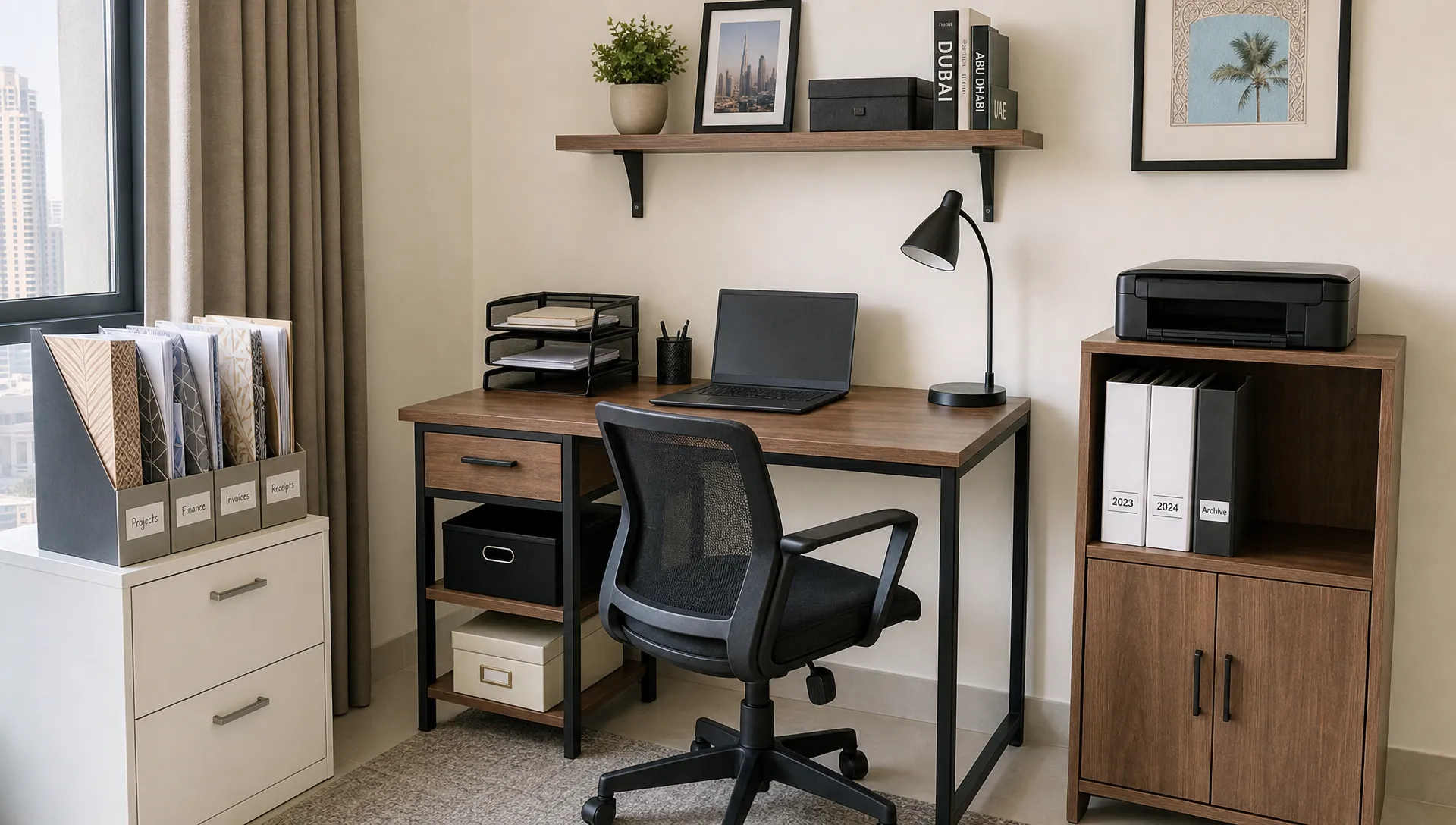
Plain folders can do the job, but decorative folders add one advantage that matters in real life: instant recognition. When your electricity bills are in a blue palm-print folder, school forms are in a yellow folder, and receipts are in a patterned folder, you do not need to open every folder to find the right paper.
There is also a focus benefit. In a 2011 paper in The Journal of Neuroscience, researchers Sabine Kastner and Daniel McMains found that visual clutter competes for attention in the brain's visual cortex. In simple terms, the more random items you leave in view, the more your attention has to filter out before you can settle into a task. You can read the paper on visual clutter and attention if you want the research background.
Decorative file folders do not magically make you productive, but they reduce the friction. They give every paper a temporary home, make categories easier to spot and help your desk look intentional instead of chaotic.
What makes a file folder genuinely useful?
A folder can be beautiful and still be annoying if it bends too easily, does not fit A4 sheets or cannot handle regular use. Before buying, focus on the practical details first, then choose the design.
| Feature | Why it matters | Best choice for most UAE desks |
|---|---|---|
| Size | Most office, school and household documents are A4 | A4 folders or expanding folders that fit A4 sheets |
| Material | Weak paper folders tear quickly with daily handling | Thick card, coated paper or flexible plastic |
| Tabs | Tabs make categories faster to scan | Top tabs or side tabs with writable labels |
| Closure | Loose papers can fall out during commuting | Elastic, button or flap closure for portable use |
| Finish | A finish affects durability and appearance | Matte for a soft look, coated for easier wiping |
If your desk is also due for an upgrade, pair your folders with a stable work surface. A wooden office desk gives files, laptops and stationery a more defined place, which makes any organisation system easier to maintain.
Choose decorative file folders by how you work
The best decorative file folders are the ones that fit your paper habits. A student, a home manager and a small business owner usually need different folder formats.
For daily paperwork
If you regularly handle delivery notes, invoices, school circulars, medical papers or bank letters, choose slim decorative folders in different colours. Keep them light and easy to grab. This is ideal for papers you check often but do not need to archive permanently.
A simple category set works well:
- Bills and payments
- School and family documents
- Work papers
- Receipts and warranties
- Urgent action items
Five folders are enough for most home desks. More than that can create a new kind of clutter, especially if the categories are too narrow.
For students and stationery lovers
Students need folders that survive bags, shared desks and frequent handling. Decorative plastic folders, subject folders and expanding folders are practical because they protect worksheets and notes while adding personality.
Choose a separate design for each subject or project. A visual difference makes it easier to avoid mixing maths worksheets with language notes or exam papers with rough sheets. If the student also carries pens, erasers and markers, a compact organiser like The Scruffles Pencil Case can keep small items from being dropped into the same folder as papers.
For small business owners
If you run orders, quotations or admin tasks from home, use a system that separates active papers from reference papers. Decorative folders can look friendly and modern, but the categories should remain professional.
A small business desk may need folders for supplier invoices, customer orders, delivery documents, banking papers and government paperwork. Keep the most active folders on the desk and store completed records elsewhere. That way your desk remains a decision area, not a paper warehouse.
Build a simple folder system in 15 minutes
The easiest system is not the most detailed one. It is the one you can reset quickly at the end of the day.
Start by removing every loose paper from your desk and sorting it into three piles: act now, keep for reference and discard. Do not create folder labels until you see what papers you actually have. Many people buy folders first, then invent categories that do not match their real routine.
Once the piles are ready, label folders in action-based language. Instead of vague labels like "miscellaneous” or "important”, use labels such as "pay this week”, "school forms”, "tax and banking” or "warranty receipts”. Action labels make decisions easier when new papers arrive.
A practical weekly flow looks like this:
| Folder label | What goes inside | When to review |
|---|---|---|
| To action | Forms, bills or papers needing a decision | Daily or every other day |
| Waiting | Receipts, claims or documents awaiting confirmation | Twice a week |
| To file | Papers that are finished but must be kept | Weekly |
| Reference | Documents you may need again soon | Monthly |
Place the "to action” folder closest to your dominant hand. Put the less urgent folders slightly farther away. Small physical placement choices help your desk guide your behaviour without extra effort.
Match folder designs to your desk style
Decorative file folders are part stationery and part décor. The design you choose should support the mood of your workspace rather than fight it.
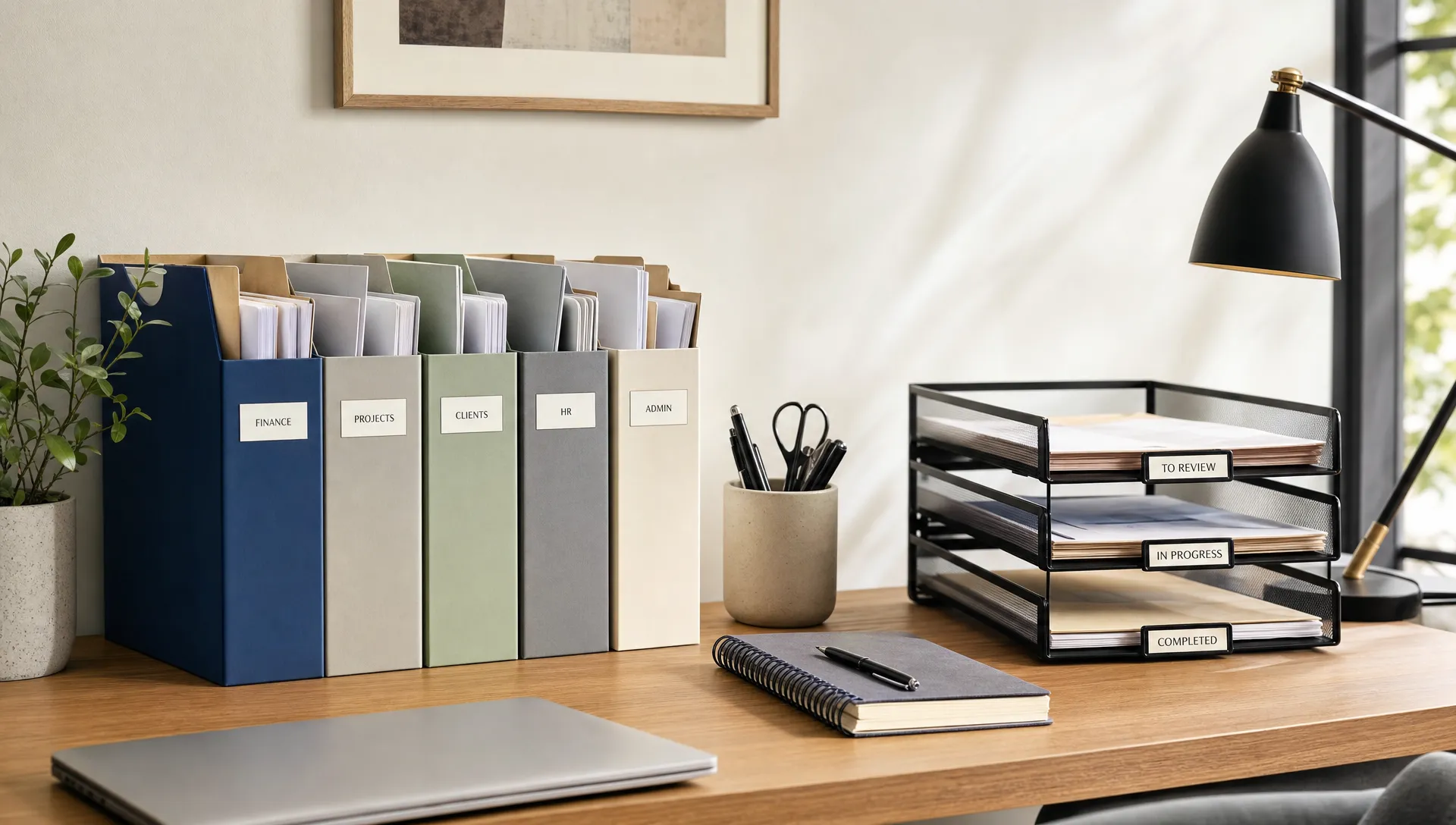
For a calm home office, go with soft neutrals, muted greens, beige patterns or minimal line art. These designs blend well with wood furniture, white walls and natural textures. For a creative desk, try bold florals, geometric prints, colour blocking or metallic accents. These can make admin tasks feel less dull without overwhelming the space.
If you share a desk with family members, colour coding is often better than name labels. One colour per person keeps papers separate without making the desk look like a notice board. For a child’s study corner, choose bright themes that feel fun, but keep the folder labels clear so the system remains easy to follow.
The best desk setups use contrast carefully. If your desk already has colourful accessories, choose simple folders. If your desk is plain, folders can bring in the personality.
Where to keep decorative file folders on your desk
Folders only work if they are easy to reach. If they are hidden in a cupboard, loose papers will usually return to the desktop.
Use a vertical holder for active folders. Vertical storage takes less surface space and lets you see tabs at a glance. If you handle printed catalogues, forms or A4 documents for customers, an A4 brochure holder stand can also help keep frequently used paperwork upright and visible.
For completed files, move them away from the main work zone. A drawer, cabinet or shelf is better for archived documents. If you want furniture that hides files while keeping them accessible, a wooden chest of drawers can help separate stationery, cables and older paperwork from the papers you need today.
Think of your desk in three zones:
- Immediate zone for the folder you use every day
- Reach zone for weekly folders, notebooks and writing tools
- Storage zone for archived papers and backup supplies
When each zone has a purpose, your folders stop drifting across the surface.
Buying tips for decorative file folders online
When shopping online, photos can make a folder look sturdier than it is. Read the product details carefully and check the dimensions, material and closure style before adding to cart.
For UAE shoppers, A4 compatibility is usually a must. Many household and office papers, including school notices, invoices and printed forms, use A4 sizing. If you often carry papers between home, office, school or business locations, look for stronger closures and water-resistant materials.
Also consider how many folders you truly need. A set of 5 to 8 folders is practical for a home desk, while a small business may need 10 or more. Buying too many designs at once can make the system confusing, especially if several patterns look similar.
Good folder shopping questions include:
- Will this fit A4 papers without bending the edges?
- Can I label it clearly?
- Does it stand upright in a holder?
- Is it strong enough for daily handling?
- Does the design match my desk or study area?
You can browse home, stationery and office essentials through Sandhai.ae when you are building a more organised workspace in the UAE.
Common mistakes that make folder systems fail
The biggest mistake is treating folders as storage for everything. Decorative file folders are best for active or semi-active papers. Old documents, manuals and long-term records need deeper storage, not a folder sitting permanently on your desk.
Another common mistake is over-labelling. If you create separate folders for every tiny category, filing takes too long. A folder system should reduce decisions, not add them. Keep categories broad enough that new papers have an obvious place.
People also forget to schedule a reset. Even the best folders will overflow if you never empty them. Choose one day each week to move completed papers into storage, shred what you no longer need and bring the "to action” folder back to a manageable size.
Finally, avoid mixing stationery with documents. Pens, sticky notes and clips often end up inside folders, where they bend papers and create bulk. Use a pencil case or desk organiser for small supplies, then let folders do one job well.
A quick desk organisation checklist
Use this checklist before you buy or rearrange anything:
- Choose A4 folders for everyday UAE paperwork
- Pick 4 to 6 main categories to start
- Use different colours or patterns for fast recognition
- Keep only active folders on the desktop
- Store archived papers in drawers or cabinets
- Review folders weekly so they do not become hidden piles
A simple system that you repeat is better than a perfect system you abandon after two days.
Frequently Asked Questions
Are decorative file folders practical for office use? Yes. Decorative file folders can be practical when they are sturdy, correctly sized and easy to label. Choose professional patterns or solid colours if they will be visible in a shared office or client-facing space.
How many decorative file folders do I need for a home desk? Most home desks work well with 5 to 8 folders. Start with broad categories such as bills, school papers, receipts, medical documents and urgent tasks. Add more only when a category becomes too full.
Should I choose paper or plastic file folders? Paper folders look stylish and are good for light use, while plastic folders handle daily movement, school bags and commuting better. If you carry documents outside the home, plastic or coated folders are usually safer.
How do I stop folders from becoming messy? Review them once a week. Remove papers that are completed, discard what you no longer need and move important long-term documents into a drawer or cabinet. A folder should be a temporary sorting tool, not permanent storage for everything.
Can decorative file folders help small business organisation? They can. Use separate folders for active orders, invoices, supplier documents and banking papers. For older records, transfer documents to labelled archive storage so your desk stays clear for current work.
Make your desk easier to manage
Decorative file folders are a small purchase, but they can make a noticeable difference to how your desk feels and functions. Choose designs you enjoy, keep the categories simple and pair your folders with sensible desk storage.
When your papers, pens and daily tools each have a place, desk organisation becomes less of a chore and more of a habit you can maintain.

Comments