

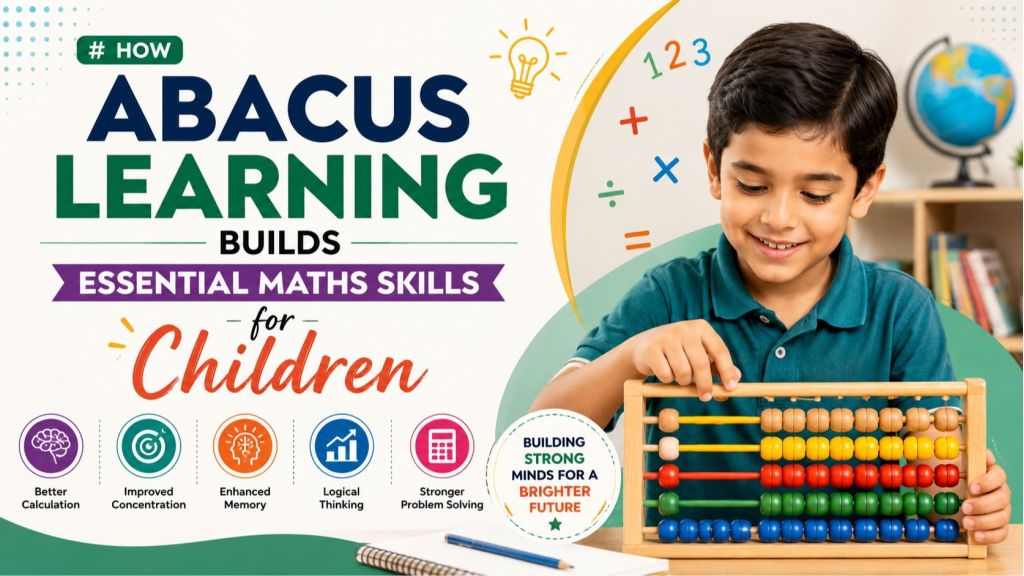
Many children learn to say numbers before they fully understand what numbers mean. They may recite "one to ten” confidently, then struggle when asked to show seven objects, compare 14 and 41, or explain why 9 plus 6 becomes 15. Abacus learning helps close that gap because it turns maths into something children can see, touch and move.
For parents shopping for educational toys in the UAE, an abacus is also refreshingly simple. It does not need a screen, subscription or battery. With a few minutes of guided practice, it can support counting, place value, addition, subtraction, mental maths and confidence.
The key is not just buying an abacus. It is knowing how to use it in a way that matches your child’s age and current maths level.
 Why abacus learning works for young minds
Children build mathematical understanding in stages. At first, they need concrete objects: beads, blocks, counters, fingers or household items. Over time, they connect those objects to drawings, then finally to written symbols such as 8, 23 or 145.
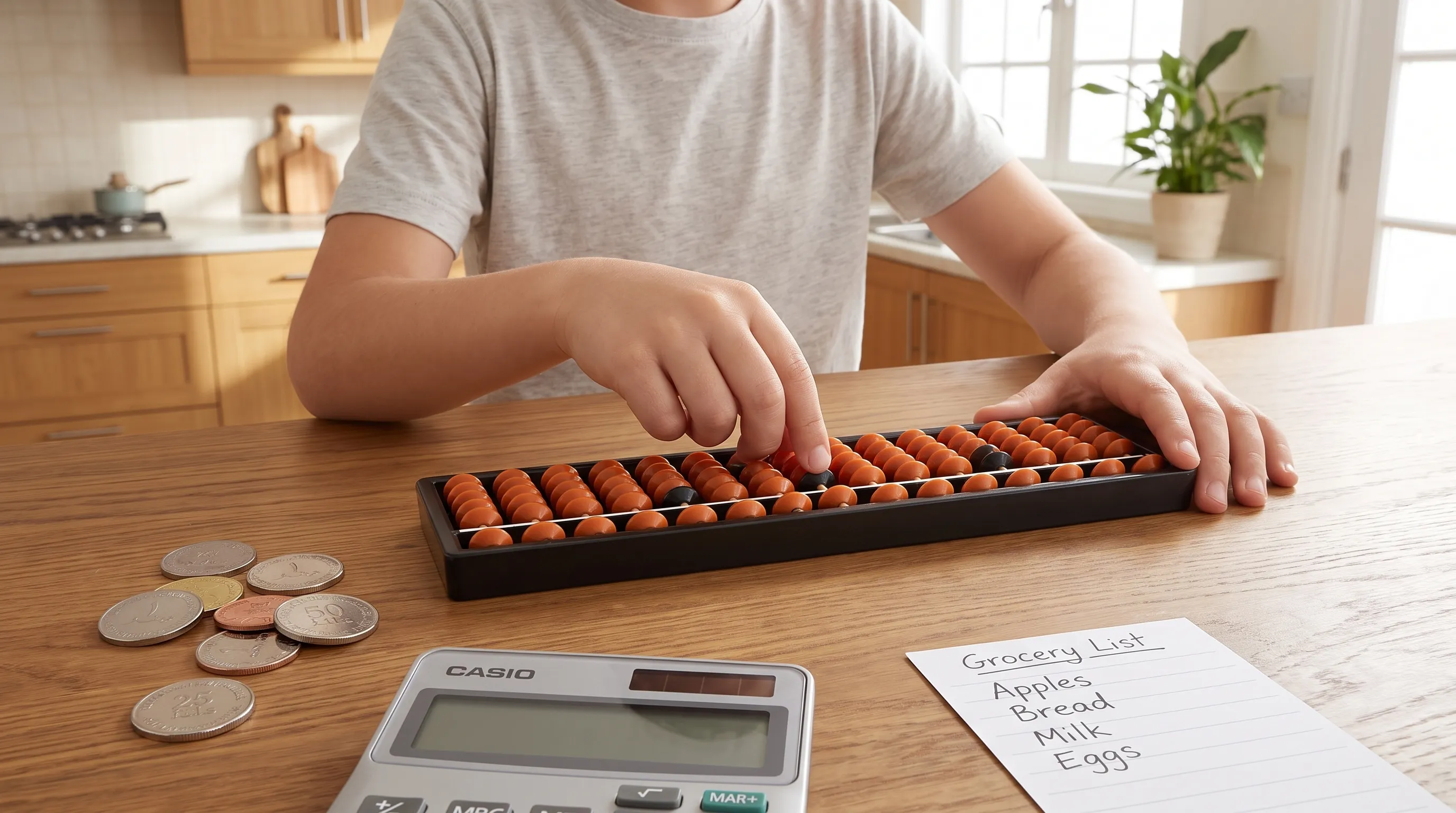
An abacus fits naturally into this learning path. Each bead represents a quantity. Each rod or column can represent a different place value. When a child slides three beads and then two more, they do not just hear that 3 plus 2 equals 5. They physically create the result.
The NAEYC and NCTM joint position statement on early childhood mathematics recommends rich, meaningful maths experiences that help children connect ideas through materials, language and problem solving. The abacus supports that approach because it makes numbers less abstract.
The National Academies report, Mathematics Learning in Early Childhood, also highlights the importance of early experiences with number, operations and spatial thinking. A good abacus routine can bring these foundations into daily home learning without making maths feel like a test.
Essential maths skills children build with an abacus
Abacus learning is often associated with speed calculation, but for younger learners its biggest value is deeper understanding. The beads help children slow down, notice patterns and explain what they are doing.
Counting and one-to-one correspondence
One-to-one correspondence means understanding that each object counted gets one number word. This sounds basic, but it is a major early maths milestone.
When a child moves one bead while saying "one”, another bead while saying "two” and continues carefully, they learn that counting is not just chanting. Each number is tied to a specific quantity. This helps prevent common mistakes such as skipping objects, counting the same object twice or saying numbers faster than they move items.
A mini abacus can be useful for short counting games at home, in a study corner or even during travel. The goal is not speed at this stage. It is careful movement and accurate matching between words and quantities.
Number recognition and quantity sense
A child may recognize the written number 6 without understanding how much six really is. With an abacus, children can build six, break it into 3 and 3, then change it into 5 and 1.
This develops number sense: the ability to understand size, order, comparison and relationships between numbers. A child who can see that 8 is close to 10 and that 4 plus 4 also makes 8 is building the mental flexibility needed for later arithmetic.
Pairing abacus practice with other hands-on toys can strengthen this skill. For example, a Shape Matching Board supports matching, sorting and visual recognition, which are useful early thinking skills before formal maths becomes more symbolic.
Place value understanding
Place value is where many children begin to struggle. The difference between 14 and 41 is not just the order of digits. It is the value of each digit based on its position.
A traditional abacus makes this visible. One column can stand for ones, another for tens, another for hundreds. Children can build 23 as two tens and three ones, then compare it with 32 as three tens and two ones. This is far clearer than asking them to memorize rules from a worksheet.
For parents who want a larger counting range, the Brown 17 Digits Abacus For Kids can be a relevant option to explore because its 17-digit format gives children more room to practise place value patterns as they progress.
Addition and subtraction with regrouping
Many children can solve 4 plus 3 by counting all the beads one by one. The next step is learning strategies: counting on, making ten and regrouping.
For example, if a child solves 8 plus 5, an abacus helps them see why moving 2 beads to complete 10 leaves 3 more, making 13. This turns "carry the 1” from a mysterious instruction into a visual action.
Subtraction becomes easier too. For 12 minus 5, children can see that removing 2 reaches 10, then removing 3 more reaches 7. This kind of visual breakdown builds confidence because the child understands the process, not just the answer.
| Maths skill | Abacus activity | What the child learns |
|---|---|---|
| Counting | Move one bead for each number word | Numbers match real quantities |
| Number bonds | Build 10 using different bead groups | Whole numbers can be split and recombined |
| Place value | Use separate rods for ones, tens and hundreds | A digit’s position changes its value |
| Addition | Slide beads together and group into tens | Addition combines quantities efficiently |
| Subtraction | Remove beads in steps | Subtraction can be broken into simpler moves |
| Mental maths | Visualize bead movement without touching | Calculation can happen through internal images |
Pattern recognition and logical thinking
Maths is full of patterns. Counting by twos, recognizing pairs that make ten, spotting repeated groups and comparing shapes all depend on pattern awareness.
Abacus practice naturally introduces patterns because children see repeated rows, bead groupings and rhythmic movement. You can ask questions like "What changes when we add one more?” or "How many beads are missing to make ten?” These small prompts help children think logically instead of guessing.
Building toys can support the same kind of reasoning in a different way. Rainbow Wooden Building Blocks encourage children to compare size, arrange shapes and test balance, which all connect to spatial thinking and problem solving.
How to start abacus practice at home
The best abacus routine is short, consistent and calm. A five-minute session done regularly is usually better than a long session that leaves the child tired or frustrated.
Start with free exploration. Let your child move the beads, notice the colours, count rows and describe what they see. Once the abacus feels familiar, introduce simple tasks such as "show me four”, "make seven” or "move two more beads”.
After that, move into small challenges:
- Ask your child to build numbers from 1 to 10, then from 10 to 20.
- Practise number bonds, such as 5 plus 5, 6 plus 4 and 7 plus 3.
- Use everyday examples, such as counting snacks, pencils, toy cars or fruits.
- Say the maths sentence aloud after moving the beads, such as "6 plus 2 equals 8”.
- Let your child explain the answer in their own words.
Do not rush into speed drills. Fast calculation is useful later, but early abacus learning should focus on accuracy, understanding and confidence.
Choosing the right abacus for your child
There are different types of abacus models, and the best choice depends on your child’s age, hand control and learning goal.
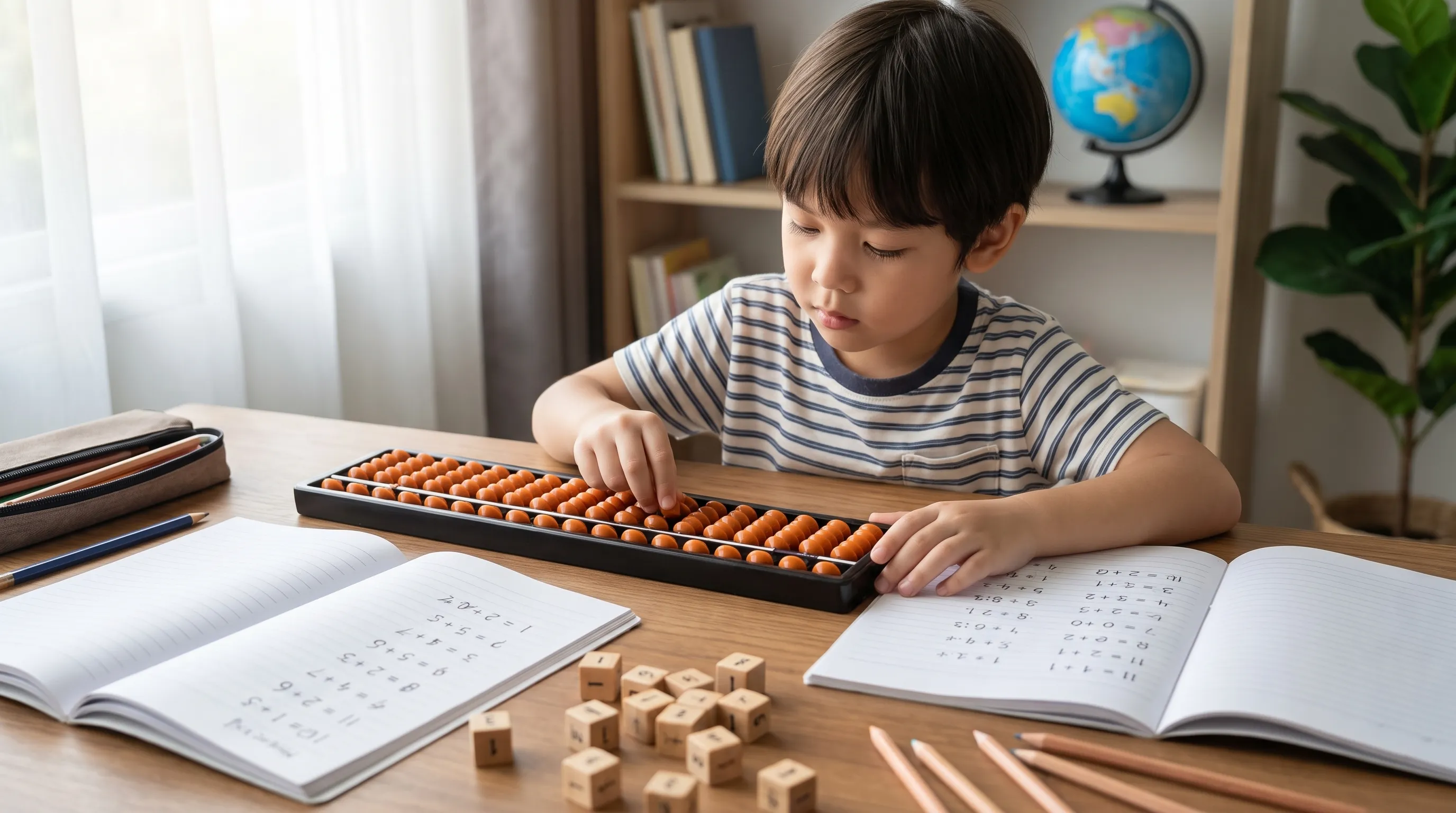
A plastic abacus is often a practical choice for younger children because many models are light and easy to handle. A mini abacus works well for quick practice, travel or children who are just starting to explore counting. A student abacus is better when your child is ready for more structured school-style maths practice. A traditional abacus, especially one with clear rods or columns, can be helpful for place value and multi-digit calculations.
For children who respond well to colour and visual grouping, the Multicolor 13-Digit Abacus for Kids is worth considering as a home learning tool. The multicolour design can help keep practice visually engaging, especially when parents are introducing number patterns.
If you prefer a tactile wooden option, the 15-Rod Wooden Abacus for Kids may suit families looking for a classic learning resource that supports repeated counting and arithmetic practice.
The right abacus is one your child will actually use. Comfort matters more than complexity. Beads should move smoothly, the layout should be clear and the size should match your child’s hands and study space.
Making abacus learning part of everyday life
Abacus learning works best when it connects to real situations. Children remember maths better when it feels useful rather than separate from daily life.
At breakfast, ask your child to show how many idlis, dates or apple slices are on the plate. During homework time, use the abacus to check addition answers before writing them down. While preparing a school bag, count pencils, notebooks or crayons. These ordinary moments make numbers feel familiar.
You can also combine maths with language. Ask your child to say the number, build it on the abacus, then write it. This connects spoken numbers, physical quantities and written symbols. If your child is also building early literacy skills, alphabet puzzles such as the ABC Puzzle in uppercase) can create a balanced learning shelf with both number and letter activities.
Parents should also celebrate strategies, not only correct answers. If your child says, "I made ten first, then added three”, that explanation is a sign of real understanding. Praise the thinking process so your child learns that maths is about reasoning, not just being fast.
Common mistakes to avoid
Abacus learning is simple, but a few habits can reduce its value.
Avoid turning every session into a test. If the child feels watched or judged, they may focus on avoiding mistakes instead of exploring ideas. Keep the tone playful, especially for younger learners.
Do not move too quickly from physical beads to mental maths. Some children need many weeks or months of concrete practice before they can visualize bead movement in their head. That is normal.
Also avoid using the abacus only for answers. Ask your child how they got the answer. The explanation is often more important than the final number because it shows whether the child understands the method.
Finally, keep practice age-appropriate. A preschooler may only need counting and number matching. A primary school child may be ready for place value, regrouping and early multiplication. The same abacus can support both levels when the activity is adjusted.
When can children start using an abacus?
Many children can begin simple abacus play around preschool age if they are ready to count objects and follow short instructions. Formal arithmetic practice usually works better once a child can recognize numbers, count in order and sit for a few focused minutes.
For younger children, start with counting, colours and simple quantities. For school-age children, connect the abacus directly to what they are learning in class. This keeps the tool relevant and prevents confusion between home practice and school methods.
Frequently Asked Questions
Is abacus learning good for all children? Abacus learning can help many children because it makes numbers visible and hands-on. Some children take to it quickly, while others need slower, playful practice. It should support school learning, not create pressure.
What is the difference between a mini abacus and a student abacus? A mini abacus is usually chosen for portability and short counting activities. A student abacus is generally used for more structured arithmetic practice, such as addition, subtraction and place value work.
Can an abacus improve mental maths? It can support mental maths when children first practise with real beads, then gradually learn to picture bead movements in their mind. The strongest results usually come from consistent practice and clear guidance.
Should I choose a plastic abacus or a wooden abacus? A plastic abacus may suit younger children who need a light, simple tool. A wooden abacus may appeal to families who prefer a more traditional abacus feel. Choose based on your child’s comfort, age and learning stage.
How often should my child practise with an abacus? Short sessions of five to ten minutes, several times a week, are a good starting point. Stop before your child becomes tired so the activity stays positive.
Build maths confidence with the right learning tools
An abacus helps children understand numbers by turning abstract ideas into movement, pattern and touch. With steady practice, it can support counting, place value, arithmetic, focus and confidence.
If you are building a home learning corner, explore age-appropriate abacus options and educational toys through Sandhai. A simple tool, used regularly and patiently, can make maths feel less intimidating and much more meaningful for children.

Comments