

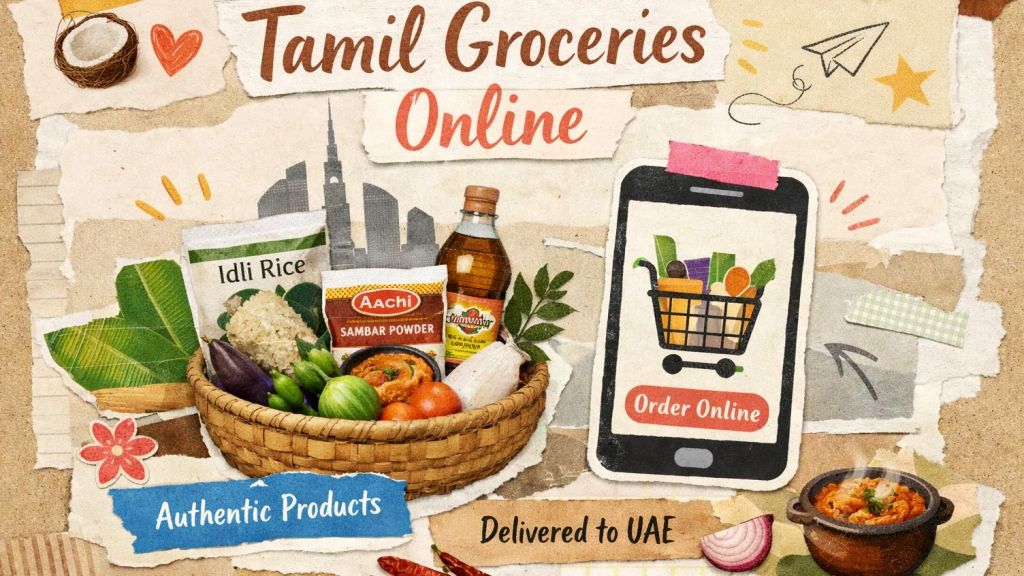
Picture this: a Tamil family in Dubai orders rice for Pongal online. The listing says "South Indian boiled rice," the packaging looks fine, and the price seems reasonable. Then it arrives, the grain is wrong, the texture is wrong, and the Pongal tastes nothing like home. This is not a rare experience. If you want to buy authentic Tamil groceries online in UAE, you need to know exactly what to look for before placing an order, because vague product descriptions and generic substitutes are far more common than most shoppers expect. A growing number of Tamil families across the UAE have learned this the hard way and now shop with considerably more precision as a result.
The hard part is not finding Tamil food online. The hard part is finding the real thing: proper Ponni rice, stone-ground idly podi, Chettinad snacks made with coconut oil. Generic platforms carry Indian groceries in bulk but rarely make the regional distinctions that Tamil cooking depends on. Knowing what to look for, which brands to trust, and which platforms actually curate for Tamil households makes the difference between a grocery order that works and one that wastes your money.
This guide covers all of it, from the staples worth sourcing correctly to the label checks that confirm product origin and the platform signals that separate genuine curation from catalogue padding.
Why the "authentic" label online is often misleading
How generic substitutes get listed as Tamil products
Most large e-commerce platforms and general Indian grocery stores in the UAE stock products labelled "South Indian spice blend" or "Indian boiled rice" without specifying region, producer, or sourcing. The issue is not necessarily deliberate misrepresentation. These platforms serve a broad Indian audience across multiple states and cuisines, so they use wide descriptors that appeal to as many buyers as possible. In some cases, a generic boiled rice gets labelled as Ponni rice. A mass-produced chilli powder gets sold as "South Indian masala." The label is technically adjacent to Tamil cooking, but the product is not.
Tamil expats who grew up cooking with specific ingredients recognise the difference the moment they open the packet. For shoppers newer to sourcing food online, the gap only becomes obvious when the dish does not turn out right.
What Tamil cooking actually requires
Tamil cuisine is regional and ingredient-specific in ways that matter at the product level. A proper Chettinad curry calls for specific stone-ground masalas. Kozhukattai needs the right rice flour consistency. A rasam that tastes like home requires ingredients sourced from producers who understand what a rasam is supposed to do. A substitute grain or a generic spice blend might look identical on a product page but cook and taste completely different.
Getting the wrong product does not just affect the dish. It costs money, wastes time, and erodes confidence in online grocery shopping altogether. The solution is not to avoid shopping online, it is to know exactly what you are looking for before the order is placed. That clarity starts with the staples themselves.
The Tamil pantry staples that generic brands cannot replicate
Heritage rice varieties worth sourcing correctly
Three rice varieties are consistently popular among Tamil families in the UAE: Ponni Boiled Rice, Mappillai Samba, and Black Kavuni Rice. Each serves a different purpose in Tamil cooking, and each has characteristics that no generic substitution can replicate. Ponni Boiled Rice is the everyday cooking staple, medium grain, moderate starch, reliable for rice, rasam, and sambar combinations. Royal Chef's Thanjavur Ponni Boiled Rice (5kg, AED 36) is a benchmark product in this category, sourced from the Cauvery delta region where the grain is grown.
Mappillai Samba is a traditional red rice with a nutty, earthy flavour and a chewy texture. It needs soaking for 8 to 12 hours before cooking and uses a higher water ratio than white rice, a generic boiled rice behaves nothing like it. Flavory Mappillai Samba Rice (AED 22) is the right product for this. Black Kavuni Rice, used in festive sweets and desserts, has a deep colour and distinct flavour that disappears entirely if you substitute a standard black rice. Flavory Black Kavuni Rice (AED 28) is sourced with that specificity in mind. You can browse these heritage varieties in Sandhai's Agaram collection which highlights region-specific grains and traditional rice types.
Podis, masalas, and snacks no substitution can replace
Stone-ground podis have a texture and flavour profile that mass-produced alternatives simply do not match. Flavory Idly Podi uses traditional stone-grinding, which preserves the coarse texture that gives idly podi its characteristic bite. The difference between this and a factory-ground version is immediately obvious. For masalas, Aachi and Veera are two widely stocked Tamil Nadu-based producers available in the UAE. Aachi Chilly Powder and Veera Briyani Masala are manufactured to regional formulations, not pan-Indian approximations.
Snacks are where authentic sourcing becomes especially visible. Flavory Chettinad Thenkuzhal Murukku is made with rice flour, urad dal, and coconut oil using traditional production methods. Annapoorna Coconut Milk Murukku follows the same logic. These are not the same as generic murukku made with refined oil and gram flour. Flavory Tapioca Chips and the brand's Ginger Candy (Inji Mittai) round out a range that reflects how Tamil snack culture actually works. Millets like Barnyard Millet (Kuthirai Vaali, AED 11) have also grown in popularity among UAE Tamil families seeking healthier staple options without sacrificing cultural familiarity; you can find millet and related items in Sandhai's farm-organic range.
How to buy authentic Tamil groceries online in UAE: what to check first
Label checks that confirm product origin
Three checks apply to every Tamil grocery product you consider ordering online. First, the country of origin must be printed on the primary packaging. A sticker added by a UAE distributor does not count as origin verification. Second, look for an ESMA registration number on the label. All legally imported food products in the UAE carry an ESMA/FOOD/ code, which confirms the product has been registered through the correct import channels. For a practical overview on importing packaged food into the UAE and the documentation involved, see this guide on how to import packaged food into the UAE.
Third, the expiry date must be printed directly on the packaging, not applied on a separate sticker. A sticker-only date is a signal the product may have been repackaged rather than properly imported, which is a concern flagged by UAE food import requirements. These are not optional checks. Products that fail them have either bypassed proper import channels or are generic goods repositioned for a specific market. You can also consult Dubai Municipality's food product registration guidance to understand local compliance expectations: Dubai Municipality food product registration.
Tamil grocery delivery in UAE: platform signals that build or break trust
Beyond the product label, the platform itself tells you a great deal. A genuine Tamil grocery platform names specific origins: Thanjavur Ponni, Chettinad Murukku, Mappillai Samba. These are not marketing terms, they are supply chain details that only appear when the platform has actual traceability in its sourcing. Platforms that use terms like "South Asian spice blend" or "Indian rice" without additional specifics are optimised for volume, not authenticity.
Check whether product listings name the brand and manufacturer. Check whether those manufacturers are based in Tamil Nadu. Check whether the platform distinguishes between South Indian regional cuisines or groups everything under a single "Indian food" umbrella. These signals separate curated Tamil grocery platforms from general Indian grocery stores that happen to carry a few relevant products. Certification and proper documentation are part of that trust equation, learn why certification in the UAE matters for imported food brands entering the market.
Tamil brands you can trust when ordering online in the UAE
The brand names to look for on product pages
Five brands appear consistently across authentic Tamil grocery sourcing in the UAE: Flavory, Aachi, Veera, Royal Chef, and Annapoorna. Flavory specialises in heritage grain varieties and regional snacks, with products sourced from Tamil Nadu producers who maintain traditional methods. Aachi is known for masalas and spice blends manufactured under FSSAI-certified production standards. Veera focuses on biryani and curry masalas formulated specifically for Tamil cooking, not generic South Asian blends.
Royal Chef handles large-format rice staples, with Thanjavur Ponni Boiled Rice as its most recognisable product in the UAE market. Annapoorna produces traditional savouries including Coconut Milk Murukku. All five are manufactured in Tamil Nadu. When you see these names on a product listing alongside a named UAE importer, you have a strong signal of legitimate Tamil sourcing, though it is still worth checking individual listings for ESMA registration and origin labels to confirm compliance.
What to do when a brand name is unfamiliar
If a product lists a brand you do not recognise, search the brand name alongside "Tamil Nadu" before purchasing. If results confirm manufacture in Tamil Nadu and the product page lists a UAE importer, that is a reasonable signal of compliance. If the product page gives no manufacturer details and no origin information beyond "India," treat it as a generic product until proven otherwise.
Buying from platforms that only stock verified, named Tamil brands removes most of this guesswork. You should not have to research every product individually. The platform's curation should have already done that work. For context on where Tamil-focused curation sits within the wider UAE grocery market, see a roundup of the best Indian supermarkets in the UAE which highlights how specialised stores differ from large marketplaces.
How Sandhai.ae approaches Tamil grocery sourcing in the UAE
Why curation matters more than catalogue size
Large general marketplaces optimise for variety across all Indian sub-cuisines, thousands of listings spread across Punjabi, Gujarati, Maharashtrian, and South Indian categories, with Tamil products scattered throughout. Finding the right product requires significant effort, and there is no guarantee the item listed is genuinely sourced from Tamil Nadu. Sandhai.ae was built specifically for the Tamil and South Indian community in the UAE, which means its grocery catalogue reflects a depth of focus that general platforms cannot match.
Sandhai.ae focuses on Tamil brands and lists named Tamil-origin products throughout its grocery section, shoppers are not sorting through 200 "Indian spice" listings. The platform curates for Tamil-specific sourcing, so what you see on the site is what you actually need. That focus is the core value proposition, and it is why Tamil families across Dubai, Sharjah, and Abu Dhabi return to it for regular grocery orders. Learn more about Sandhai.ae and its Tamil-focused catalogue at Sandhai.ae.
Delivery, payment, and the details that matter
Product authenticity matters, but so does reliable delivery. Sandhai.ae covers Dubai, Sharjah, and Abu Dhabi, with 24/7 delivery in Dubai through its partner logistics network. For Tamil expats who need groceries before a festival or want to cook a specific dish on a specific day, that delivery reliability is not a nice-to-have, it is the difference between the dish happening or not. The platform holds a 4.9 out of 5 customer rating from verified reviews, with delivery scoring at the same level.
The cash on delivery option adds another layer of accessibility, particularly for families who prefer not to enter payment details online or who are still setting up their banking in the UAE. Combine that with a catalogue built around Tamil pantry staples, and the shopping experience is straightforward from start to finish.
Shop smart and eat well
That Pongal rice story from the opening is more common than it should be, and entirely preventable. Once you know the specific varieties, podi brands, and snack producers that define Tamil cooking, you have a clear filter for evaluating any product page. Once you know the label checks that confirm legal import compliance, you can verify what you are buying before it arrives. And once you know which platforms curate for Tamil households rather than the broadest possible Indian audience, you stop wasting time searching through irrelevant listings.
When you buy authentic Tamil groceries online in UAE, these checks are what separate a confident order from a disappointing one. Sandhai.ae has already done much of that sourcing work, the Tamil brands are verified, the staples are region-specific, delivery is reliable, and payment is flexible. The next time you need Ponni rice for a weekday meal, Mappillai Samba for a traditional preparation, or Black Kavuni for a festive dessert, the sourcing has already been done. You just need to place the order.

Comments