

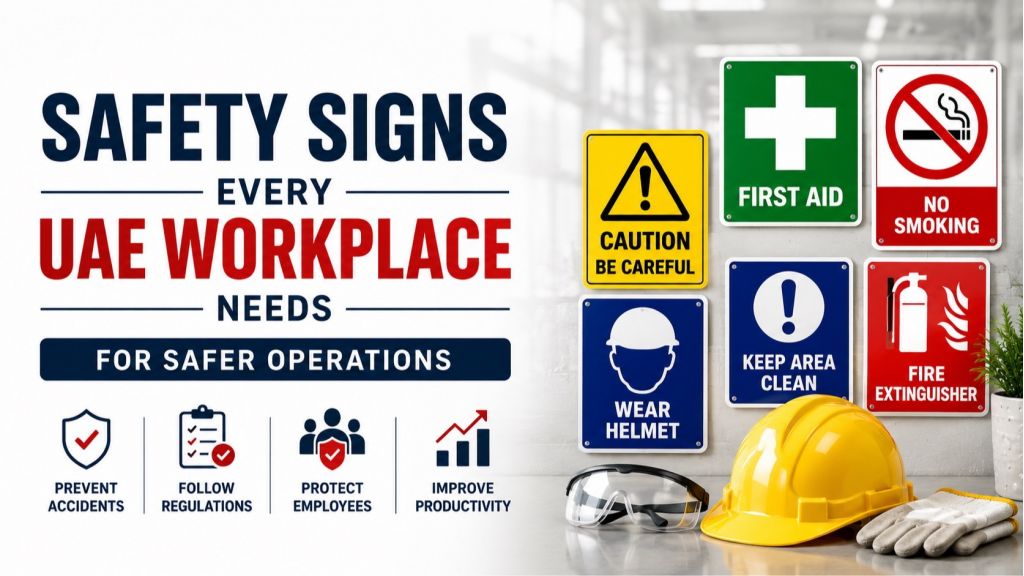
In a busy Dubai workplace, safety often depends on whether a person sees the right warning at the right moment. A driver entering a warehouse yard, a visitor walking into a reception area, a technician opening an electrical room, or a contractor stepping onto a fit-out site should not have to guess what is safe.
That is where well-planned safety signs make a practical difference. They guide behaviour, reduce confusion, support training, and help teams respond faster during emergencies. For UAE businesses, especially in high-traffic areas such as Dubai Investment Park, Al Quoz, Jebel Ali, Deira, Business Bay, and industrial zones across Sharjah and Abu Dhabi, clear signage is a basic part of safer daily operations.
This guide explains the safety signs every UAE workplace should review, how to place them, and what to consider when buying signs online for construction sites, warehouses, laboratories, offices, and retail spaces.
 Why safety signs matter in UAE workplaces
Safety signs are not a replacement for training, supervision, or proper risk controls. They are a visible layer of protection that supports all three. In workplaces with multilingual teams, rotating contractors, delivery drivers, and visitors, signs help communicate essential instructions quickly.
UAE employers are expected to provide safe working conditions and protect workers from occupational hazards. The UAE Ministry of Human Resources and Emiratisation provides labour law resources that businesses can refer to alongside requirements from Dubai Municipality, Dubai Civil Defence, free zone authorities, and sector-specific regulators. For regulated sites, always confirm signage requirements with your safety officer, consultant, or relevant authority.
From an operational point of view, signage also reduces downtime. A clear emergency contact board can save minutes during an incident. A PPE reminder at a work zone entrance can prevent workers from entering without helmets, gloves, or eye protection. A no smoking sign in a flammable storage area helps reinforce a rule that cannot rely on verbal reminders alone.
What makes a safety sign effective in Dubai?
A sign is only useful if people notice it, understand it, and trust it. The right safety signs board should be easy to read from the normal viewing distance, placed before the hazard, and kept clean and unobstructed.
For Dubai and wider UAE workplaces, the best approach is to combine universally understood symbols with clear wording. Internationally recognised symbols, such as those aligned with ISO 7010 safety sign principles, can help workers from different language backgrounds recognise hazards and instructions. Arabic and English are commonly used for formal communication, while some workplaces add supplementary languages such as Hindi, Urdu, Malayalam, or Tamil where it helps the workforce understand instructions better.
Material also matters. Indoor offices may need different sign solutions from dusty warehouses, temporary construction zones, or areas exposed to sunlight. A4 UV printed PVC foam board signs, rigid boards, laminated notices, and tabletop displays all have their place depending on durability needs, mounting location, and how often the message changes.
| Sign category | Main purpose | Common UAE workplace locations | Examples |
|---|---|---|---|
| Prohibition signs | Stop unsafe actions | Entrances, fuel areas, stores, pantries, site offices | No smoking, no entry, no mobile phones |
| Mandatory signs | Tell people what they must do | Construction zones, workshops, warehouses, labs | Wear helmet, wear gloves, use eye protection |
| Warning signs | Alert people to hazards | Electrical rooms, forklift routes, chemical stores | High voltage, wet floor, forklift traffic |
| Emergency signs | Guide response during incidents | Reception, corridors, assembly points, warehouses | Emergency numbers, first aid, exits |
| Fire safety signs | Identify fire equipment and routes | Staircases, corridors, kitchens, industrial areas | Fire extinguisher, fire hose reel, fire exit |
| Security signs | Inform and deter | Building entrances, loading bays, retail stores | CCTV in operation, restricted access |
The essential safety signs workplace checklist for Dubai operations
A practical safety signs workplace plan should be based on real risks, not just a generic pack of stickers. Walk through your workplace from the perspective of a new employee, a delivery driver, a visitor, and an emergency responder. Ask what each person needs to know before entering a risky area.
1. Construction and fit-out sites
Construction and fit-out activity is common across Dubai, from villa renovations to commercial towers, retail units, warehouses, and office refurbishments. On active projects, a safety signs construction checklist should be part of mobilisation, not a last-minute purchase before inspection.
The safety signs for construction site access should be visible before workers and visitors enter the work area. At a minimum, review signs for PPE, restricted access, falling objects, open excavations, electrical hazards, lifting operations, scaffolding, fire points, first aid, and emergency contact information.
When buying signs, group your safety signs ppe requirements by task. A general PPE board at the entrance may state helmet, safety shoes, and high-visibility vest, while specific work areas may require eye protection, hearing protection, respiratory protection, or gloves. This avoids confusion when different teams are working on electrical, cutting, painting, welding, or demolition tasks.
Smoking restrictions are especially important around flammable materials, temporary stores, and enclosed work areas. For site offices, pantry areas, and controlled indoor zones, the No Smoking Sign | A4 UV Printed on 3mm PVC Foam Board is a relevant option to reinforce a clear prohibition.
Assign someone to inspect safety signs on site at the start of each shift, especially after deliveries, cleaning, sand, wind, or layout changes. If safety signs on site are faded, blocked by stored materials, or no longer match the hazard, replace or relocate them immediately.
2. Warehouses, logistics, and loading bays
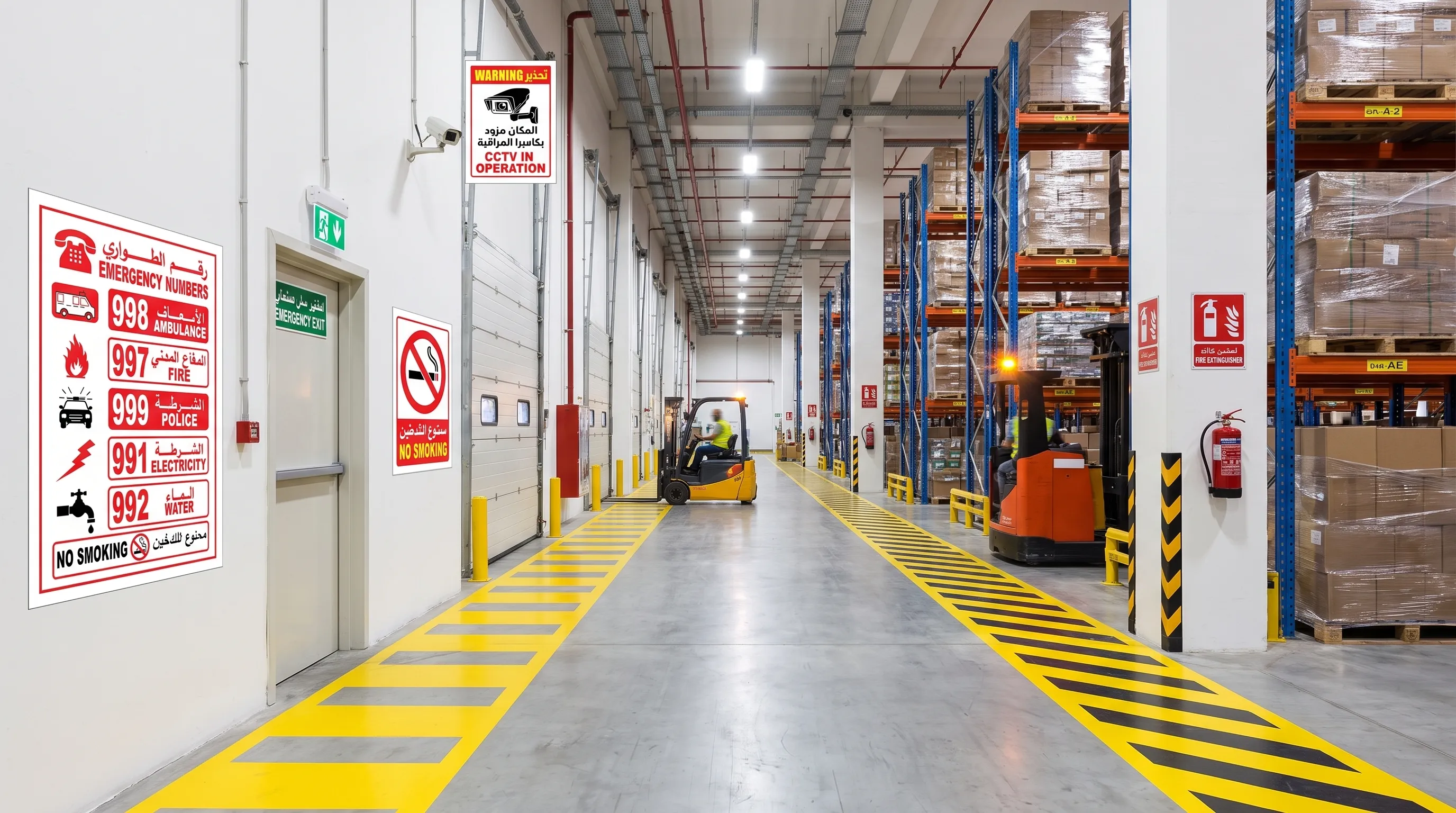
Safety signs for warehouse environments need to speak to both people and movement. Forklifts, pallet trucks, loading docks, racking systems, delivery vehicles, and pedestrians often share the same space. In Dubai logistics hubs and storage facilities, signage should guide traffic flow and protect workers who may be focused on picking, packing, or loading.
Use floor-level markings where appropriate, but do not rely on floor markings alone. Wall-mounted and eye-level signs are important for forklift routes, pedestrian crossings, speed limits, loading dock edges, emergency exits, fire extinguishers, spill kits, and restricted stock areas.
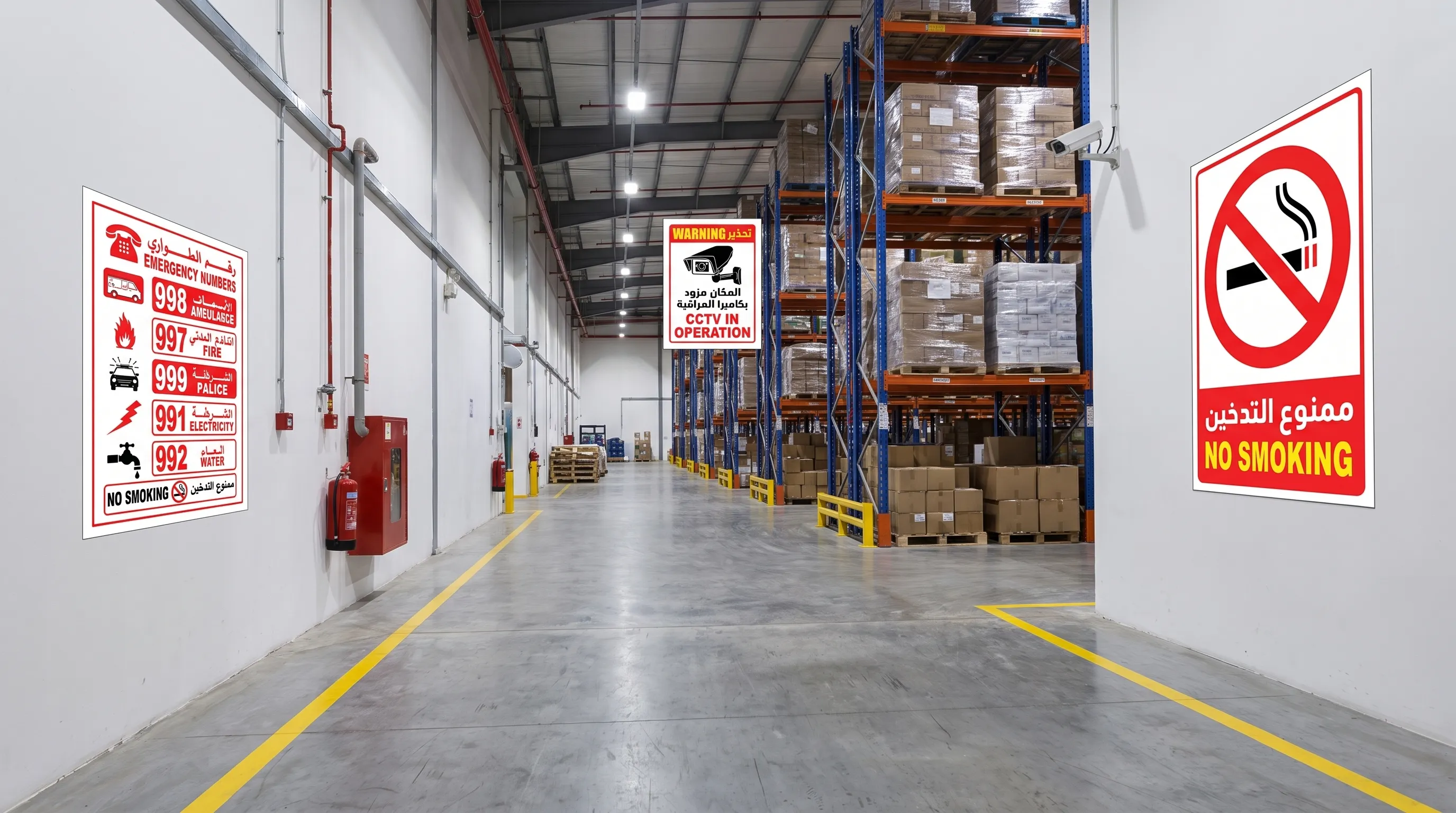
Warehouses should also display emergency information in locations where supervisors, drivers, and visitors can see it quickly. A sign such as the Emergency Numbers Sign | A4 Size UV Printed on 3mm PVC Foam Board can support faster action by keeping key contact information visible in reception areas, dispatch offices, site cabins, and warehouse control points.
3. Laboratories, clinics, and maintenance rooms
Safety signs in the laboratory should be specific because lab hazards are often invisible. Chemical exposure, biological materials, sharp objects, hot surfaces, compressed gases, and electrical equipment all require clear warnings and mandatory instructions.
For school labs, clinics, testing rooms, quality control labs, and industrial maintenance areas, review signs for eye protection, gloves, lab coats, handwashing, chemical storage, no food or drink, emergency shower, eyewash station, sharps disposal, and spill response. If chemicals are stored, signs should align with your safety data sheets and internal procedures.
Do not place lab safety signs only at the main entrance. Put instructions at the point of use, near equipment, storage cabinets, sinks, waste bins, and emergency response stations. A visitor entering a lab should understand the basic rules before touching anything.
4. Offices, retail spaces, and customer-facing areas
Office and retail workplaces may feel lower risk than construction or warehouses, but signage still matters. In Dubai offices, shops, salons, showrooms, restaurants, and shared commercial buildings, employees and customers need clear guidance for exits, restricted areas, first aid, electrical rooms, wet floors, cleaning in progress, and smoking rules.
Security signage is also common in customer-facing spaces. If your premises use surveillance, a visible CCTV notice helps inform visitors and staff. The CCTV in Operation Sign Board | A4 UV Printed on 3mm PVC Foam Sheet is a practical sign type for entrances, reception areas, corridors, stock rooms, and loading zones where CCTV notification is appropriate.
For temporary messages such as visitor instructions, event notices, maintenance alerts, or reception desk reminders, a clear acrylic sign holder can help keep printed notices upright and visible without permanently fixing them to a wall.
How to choose safety signs before buying online
Online shopping makes it easy to order workplace signs, but it is worth checking a few practical details before adding items to your cart. A sign that looks correct online may not work well if the size, location, material, or message is wrong for the site.
Use this quick buying checklist:
- Match each sign to a real hazard, instruction, or emergency need identified in your workplace risk assessment.
- Choose wording that is short, direct, and easy to understand for workers, visitors, and contractors.
- Use recognised symbols and consistent colours so people can interpret signs quickly.
- Select a size that can be read from the approach distance, not only when standing directly in front of it.
- Choose a material suitable for the location, including indoor, sheltered, dusty, temporary, or high-traffic areas.
- Plan installation height and placement before purchase so signs are not hidden by doors, shelves, vehicles, or equipment.
- Review signs after layout changes, new machinery, fit-out work, inspections, or incident reports.
For larger workplaces, create a simple sign register. List every sign, its location, purpose, installation date, and inspection status. This helps facilities teams replace damaged signs and avoid having outdated instructions around the building.
Placement mistakes that reduce safety
Even good signs fail when they are placed badly. A fire exit sign hidden behind stock, a PPE board after the hazard, or a no smoking sign inside the prohibited area rather than before it can reduce the sign’s value.
Avoid placing signs too high, too low, behind glass reflections, beside too many unrelated posters, or in areas with poor lighting. In warehouses, make sure signs are visible from forklift routes and pedestrian walkways. In construction areas, reposition signs as the site layout changes. In laboratories, place hazard warnings at the equipment or storage point, not only at the door.
Also avoid sign clutter. Too many messages in one place can make people ignore all of them. If one board has twenty instructions, workers may miss the one that matters most. Group messages logically, use clear headings, and keep high-risk warnings prominent.
Frequently Asked Questions
What safety signs does every UAE workplace need? Most workplaces should review emergency contact signs, fire exit signs, first aid signs, no smoking signs, restricted access signs, PPE signs, warning signs for specific hazards, and CCTV notices where surveillance is used. The exact list depends on your workplace risk assessment and local authority requirements.
Are Arabic and English required on safety signs in Dubai? Many UAE workplaces use Arabic and English for clarity and consistency. Depending on your workforce, supplementary languages may also help, but they should not replace recognised symbols or any language requirements set by the relevant authority, free zone, landlord, or project consultant.
Where should PPE signs be placed? PPE signs should be placed before the work area where protection is required, such as site entrances, workshop doors, welding zones, chemical handling areas, loading bays, and maintenance rooms. Place additional signs at task-specific areas if different PPE is required.
How often should workplace safety signs be checked? High-risk locations should be checked frequently, sometimes daily on construction sites or busy warehouses. Offices and retail spaces can usually be reviewed during routine facilities inspections, but signs should always be checked after layout changes, incidents, renovations, or authority feedback.
Can one safety sign board cover an entire workplace? A main safety board is useful at entrances, but it cannot replace point-of-hazard signage. Workers should see instructions where they need them, such as near electrical panels, machinery, chemicals, emergency equipment, loading docks, and restricted areas.
Make safety signage part of everyday operations
The safest workplaces do not treat signs as decoration. They use them as part of a wider system that includes training, supervision, housekeeping, emergency planning, and regular inspections.
If you are reviewing workplace essentials for a Dubai office, warehouse, shop, lab, or construction support area, you can browse practical signage and business supplies through Sandhai.ae. Start with the hazards your team faces every day, choose clear signs that match those risks, and keep them visible, clean, and up to date.

Comments