

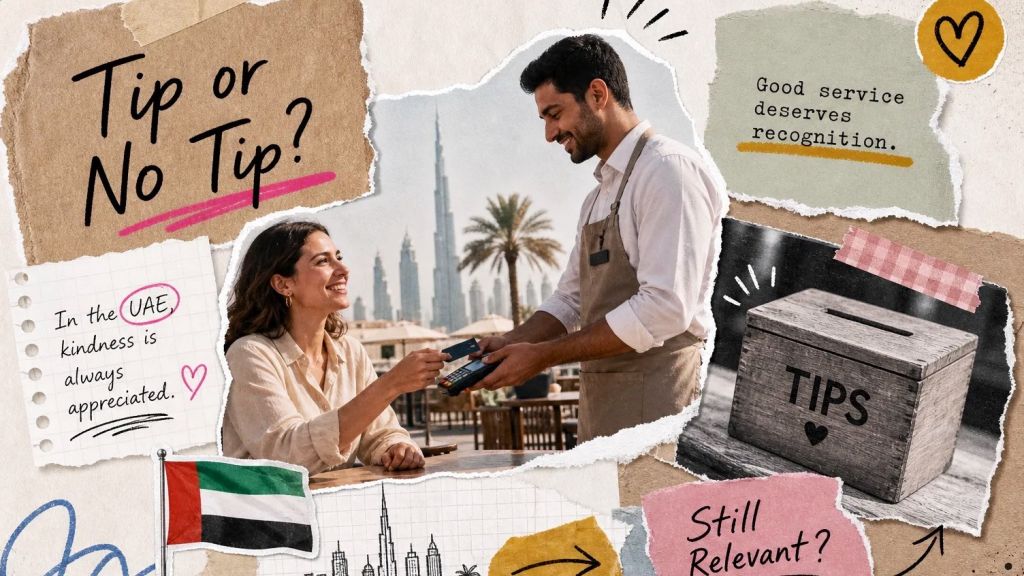
Picture this: you've just picked up your flat white from a specialty café in JLT, the barista handed it over with a smile, and now you're standing at the counter facing a small acrylic tips box with a cheerful label on it. You pause. You're not sure whether tipping is expected, how much is appropriate, or whether anyone actually uses that jar. So you pick up your coffee and walk out.
That moment of hesitation tells you something useful. Tipping in the UAE is real, widely practiced, and genuinely important to service workers, but the culture around it is uneven, and many businesses still haven't figured out how to make it easy for customers. For café and salon owners especially, that gap can affect staff income significantly. This article covers how tipping actually works across different UAE service settings, whether a physical tips box is still worth having, and how to choose, set up, and message one effectively.
How tipping actually works in the UAE
The UAE has no legal requirement to tip. There are no federal regulations mandating gratuity, and staff understand tips as a bonus rather than a guaranteed part of their income. That said, tipping is customary across most hospitality and service sectors, and in many settings it's quietly expected. The baseline most customers follow is 10 to 15 percent for good service, with up to 20 percent for something exceptional.
One piece of information worth knowing before you ever touch a tips box: a service charge printed on a restaurant bill does not go to your server. In the UAE, service charges are typically retained by the business. This means a separate tip still matters for the person who actually served you, regardless of what the bill already includes.
Restaurant and café etiquette
Full-service restaurants follow a fairly standard model: leave 10 to 15 percent in cash or ask for it to be added at the card terminal. In hotel restaurants, tipping is especially customary, given that hospitality staff in the UAE commonly rely on gratuity to supplement their base wages. Casual cafés operate differently. Counter service doesn't carry the same expectation, which is exactly why a well-placed tip jar fits naturally in that setting.
Salons, spas, and personal services
Tipping in UAE salons and spas is common but informal. Ten percent is generally considered the customary baseline, with 15 to 20 percent appropriate for more complex treatments or exceptional care. Most salons don't maintain a formal tips box at the reception desk; staff typically receive cash tips directly or through digital tools like EasyTip on card terminals. That said, a small, visible tip jar near the register can remove the awkwardness of customers not knowing where to leave a tip, particularly in walk-in settings where the interaction is brief.
Delivery drivers and online orders
Food delivery tipping has grown more structured. Apps like Talabat and Deliveroo UAE include an in-app tip option, and riders receive 100 percent of what's added through the platform. Cash tips are still appreciated and reach drivers instantly. Standard practice in the UAE is AED 5 to 10 for most orders, with higher amounts for large orders or deliveries made during summer heat or late-night hours.
Is the tips box still a fixture in UAE venues?
The short answer is yes, but selectively. Tip jars and tips boxes are common in certain settings and nearly absent in others. Understanding the difference helps business owners make a smarter call rather than defaulting to what they've seen elsewhere.
Where you'll spot a tips box in the UAE
The highest-fit environments for a physical tip jar are specialty coffee shops, juice bars, casual bakeries, barber shops, nail salons, and street-side food counters. In these spaces, a small acrylic or wooden tips box at the counter is normal and expected. Customers are standing, the interaction is brief, and cash changes hands regularly. A visible jar makes the tipping option obvious without requiring any awkward conversation.
Where the tip box has mostly disappeared
Higher-end restaurants and hotel venues have largely moved to integrated billing or table-side card terminals with a built-in tip prompt. In these settings, a counter tip jar looks out of place and is rarely used. QR-code-based tipping is also expanding rapidly in tech-forward venues across Dubai and Abu Dhabi, where a QR sticker on the receipt or table handles the entire transaction digitally.
Digital vs. physical tip collection
Both approaches have real advantages. QR-code tipping works well for cashless customers, generates a digital record for transparent staff payouts, and requires no physical maintenance. Physical tips boxes are better suited for cash-heavy environments, quick-service settings, and venues where customers may not want to open an app mid-transaction. Some UAE venues run both in parallel: a small locked tips box at the counter alongside a QR sticker near the payment station. That combination covers every customer type.
Choosing the right tips box for your venue
The right tips box comes down to material, security level, and aesthetics. Getting all three right matters more than most business owners anticipate, because a poorly chosen jar either collects nothing or becomes a theft target.
Acrylic tip boxes: the UAE café standard
Acrylic tip jars are the most popular choice in UAE cafés and juice bars. They're lightweight, visually clean, and let customers see tips accumulating inside, which creates social proof that others are tipping. Acrylic transmits up to 92 percent of light, giving it near-glass clarity at a fraction of the cost. One real downside in the UAE climate: prolonged direct sunlight can cause the material to soften, warp, or become brittle over time. Keep acrylic boxes away from windows and outdoor counters exposed to intense heat, and choose UV-coated versions if the placement can't avoid sun exposure. For more on outdoor use and durability, see this analysis of acrylic heat resistance for outdoor applications.
Wood and metal options for a different look
Torched wood tip boxes suit artisan coffee shops and boutique salons aiming for a warmer, more artisanal feel. Metal locking tip boxes with steel construction are harder to grab and run with, making them the better call for high-footfall counters where the register area isn't always attended. On Amazon.ae, steel locking options typically run AED 90 to 130, while standard acrylic jars start around AED 55 to 75, though prices shift with exchange rates, so it's worth checking current listings before ordering. The locking steel versions include combination cable locks that tether the box to a counter surface, keeping it in place during busy service.
When a locked tip box is worth the investment
If your counter is ever unattended, even briefly, a locked tip collection box with key access and a cable tether is the smarter choice. It stops both opportunistic theft and casual pilfering. For lower-risk settings like appointment-based salons where staff are always present, a simple acrylic jar with a slot lid is sufficient. The security upgrade is about environment, not paranoia.
Tips box placement and messaging that genuinely move the needle
A tips box sitting in the wrong location, or carrying a bland "TIPS" label, collects significantly less than one positioned deliberately with a smart message. Behavioral studies on tipping consistently show that placement and wording significantly affect tip rates, often more than the quality of service itself.
Where to position a tip jar for maximum visibility
Place the box at eye level near the point of payment. Customers make tipping decisions in the moment they complete their transaction; if the jar is behind the register or tucked off to one side, that moment passes. For outdoor or casual setups, positioning the jar roughly 18 inches off the ground is a practical standard for visibility and wind resistance. The goal is for the jar to be the last thing a customer sees before they step away from the counter.
Messages and labels that prompt action
Generic "TIPS" labels underperform. The tip jar messages that actually work fall into three categories: humor-based ("Money is the root of all evil. Cleanse yourself here."), gratitude-forward ("Thanks in advance"), and goal-framing ("College fund" or "Help keep the espresso flowing"). Avoid any phrasing that reads as a direct demand. The tone should feel light and inviting, not transactional, and it should be consistent with your brand's personality.
The two-jar voting tactic
One of the most effective techniques for increasing total tips is the two-jar system. Set up two clear jars labeled with opposing choices: "Karak vs. filter coffee," "Cat people vs. dog people," or any pairing that fits your customer base. Customers drop their tip into whichever jar reflects their vote. This adds an interactive element, sparks brief conversation at the counter, and tends to boost total tips compared to a single-jar setup. It works because the decision shifts from "should I tip" to "which side am I on."
Where to source a tips box in the UAE
Whether you need a basic acrylic tip jar for a pop-up stall or a heavy-duty locking metal box for a high-traffic café, options exist across different price points and delivery timelines.
Online options and price expectations
Amazon.ae carries a solid range: acrylic tip jars typically start around AED 55 to 75, while steel locking versions run AED 90 to 130. International platforms like Displays2Go and specialty guides such as the complete guide to acrylic donation boxes cater primarily to the US market but do ship internationally, though delivery timelines and import costs add up. For UAE-based buyers who need faster delivery and don't want to wait on international shipping, locally focused online marketplaces are a more practical first stop.
Finding acrylic and display boxes through UAE platforms
For businesses looking for acrylic tips boxes, donation boxes, or suggestion boxes for office or retail use, Sandhai.ae stocks a range of acrylic display and storage products suited for small business setups. The platform focuses on practical, affordable products for UAE-based buyers with fast local delivery across Dubai, Sharjah, and Abu Dhabi, making it a more convenient starting point than waiting on international stock. Examples include the Transparent Acrylic Tips Box with Lock (20 cm), the Black Acrylic Tips Box with Lock (20 cm), and the larger Acrylic Donation Box with Lock (50 cm).
The DIY option for tight budgets
If budget is the real constraint, a repurposed coffee tin covered in kraft paper with a coin-slot cut in the lid works well for short-term or event use. Add a printed vinyl label with a custom message, seed the jar with a few notes to signal legitimacy, and the setup is ready in under 30 minutes for less than AED 20. It won't last forever, but for a pop-up event or a temporary setup while you wait for stock, it does the job.
The takeaway for UAE business owners
Tipping culture in the UAE is real, nuanced, and continuing to evolve. It's neither mandatory nor irrelevant, and for businesses operating in casual food service, salons, or any counter-based setting, a well-placed tips box remains one of the simplest and most cost-effective tools available. The material, lock type, placement, and message all shape how much it actually collects. For local context and practical guidance on tipping norms, see this guide on how much to tip service providers in the UAE and this overview of tipping customs in the Middle East.
Start with the right container for your environment, position it where payment happens, and give it a label that fits your brand's tone. Whether you pick up a sleek acrylic tips box from a UAE platform like Sandhai.ae or put together a quick DIY version for your next market stall, the mechanics are simple. Make it visible, make it easy, and make the message feel human. Then move the box if the first placement isn't working, because sometimes the only variable separating an empty jar from a full one is six inches to the left.

Comments