

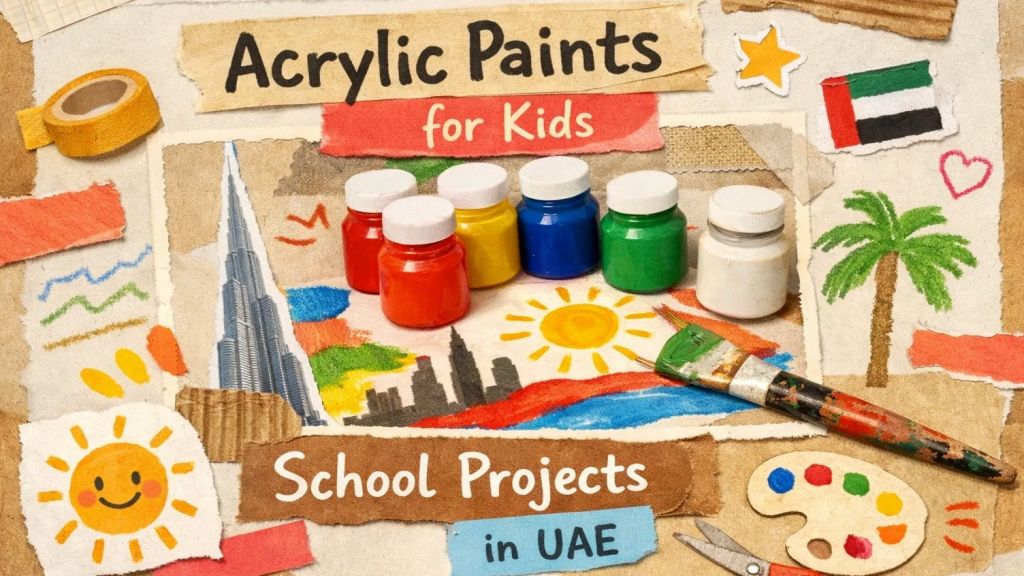
It's 9 pm on a Sunday. Your child's school project is due tomorrow morning, and the only paints in the house are a cracked set of poster colours from last term, with half the caps fused shut and the yellow turned a suspicious shade of brown. Sound familiar? Acrylic paints are the answer most UAE parents eventually land on, and for good reason: they dry fast, stick to nearly any surface a school project might require, and come in sets that children can actually use without constant adult intervention.
The problem isn't the product. It's the choice overload. Search for acrylic paint sets online and you'll find everything from professional artist tubes at eye-watering prices to unlabelled craft packs with vague safety information. If you're buying for a Grade 3 poster project, that range is genuinely confusing. If you're buying for a senior art student with specific assignment requirements, it's a different kind of confusing. This guide cuts through both scenarios and tells you exactly what to look for, which sets are worth buying, and how to store them so they last through the school year. And if you'd rather sort your child's paints, brushes, notebooks, and school bag in one place, platforms like Sandhai.ae let you do exactly that.
Why acrylic paints are the go-to choice for school projects
They dry fast and work on nearly every surface
School project deadlines are rarely forgiving, and fast-drying acrylics solve a very real logistical problem. A painted cardboard model left to dry overnight is generally ready to assemble by morning; a watercolour wash on the same surface is more likely to buckle the board and bleed through the layers. Acrylic paint bonds well to paper, cardboard, canvas board, wood, and fabric, which covers the full range of surfaces UAE school children typically work with. That versatility alone makes them a more practical choice than poster paint: many basic poster paints can crack on textured surfaces and struggle with layering, which limits what children can do with them on more ambitious projects.
Richer colour with less effort than poster paint
Student-grade acrylics generally deliver more vibrant, opaque coverage than standard poster paints, though results do vary by brand and pigment formulation. In practice, children spend less time going back over thin patches and more time finishing their work. Fluid acrylics are also worth considering for younger children: the thinner consistency flows more easily off the brush, requires less pressure to apply, and tends to deliver solid colour on the first pass, making them easier for small hands to manage. For a concise explanation of different acrylic consistencies, see this guide to the four acrylic consistencies.
Easy cleanup before the paint dries
Acrylic paints are water-based, which means brushes, palettes, and the inevitable smear across a school uniform all clean up with water as long as you catch them before the paint dries. Once dried, acrylic paint is water-resistant and significantly harder to remove, so speed matters. Keeping a small bowl of water nearby during painting sessions makes cleanup straightforward for children working independently.
The non-toxic question: what labels to look for
ASTM D-4236, EN71, and the AP Non-Toxic seal explained
Three certifications appear most often on acrylic paint packaging sold in the UAE, and each one tells you something slightly different. The AP Non-Toxic seal from ACMI (Art and Creative Materials Institute) is a widely recognised indicator that a product is safe for children's use and free from harmful chemicals. ASTM D-4236 is a US standard confirming the product has been evaluated for chronic hazards and properly labelled. EN71, particularly EN71-3, is the European safety standard covering chemical limits including heavy metals; you'll often see the CE mark alongside it on products sold through UAE retail channels. When buying acrylic paints for children, look for at least one of these seals on the packaging before purchasing.
Why professional-grade paints aren't always right for kids
Artist-grade acrylics and heavy body acrylic paint can contain cadmium, cobalt, or manganese-based pigments. These deliver exceptional colour quality for professional painters, but they're not formulated for unsupervised use by young children. Student acrylics and kids' craft-grade sets replace these pigments with safer synthetic alternatives that still produce strong, usable colour without the toxicity risk. For school projects, the reduction in colour intensity is barely noticeable.
What "non-toxic" doesn't cover
Non-toxic certification means the paint won't cause chronic harm under normal use conditions. It does not mean stain-proof or edible. Even certified safe paints should be used with basic supervision, especially for primary-age children. A cheap plastic smock and a silicone palette mat make cleanup significantly easier and protect clothing from the permanent staining that dried acrylics can cause.
Top beginner-friendly acrylic paints for school kids
Budget picks that still deliver good colour
Mont Marte's student acrylic sets are a reliable starting point, available in the UAE through specialist art retailers. The 48-colour 36ml collection offers a wide range for the price, and the mid-body consistency suits most paper and cardboard work. For younger children specifically, look for sets that include a good titanium white and black alongside the primaries; these two colours do a lot of work when mixing.
Daler-Rowney System 3 is a trusted student-grade acrylic paint brand known for consistent coverage and a solid colour selection without the cost of professional lines. Availability in the UAE can vary, so it's worth checking with local retailers before committing. Both Mont Marte and Daler-Rowney carry enough pigment load to produce vibrant results on school projects while staying within a parent-friendly budget.
Mid-range sets worth the upgrade for older students
Arteza's student acrylic sets are a step up in consistency and colour reliability, making them a practical choice for secondary school students who are mixing colours more deliberately or working on larger canvas board pieces. Liquitex Basics sits in a category of its own: it's technically a student-grade line but bridges toward semi-professional quality in a way that most other budget sets don't. The pigment load is noticeably better, colour mixing is more predictable, and the sets come in useful sizes, from 22ml tubes with 24-colour selections. If you want more detail on the difference between heavy-body and soft-body acrylic paint, that resource helps explain which consistency fits which project. For a student who takes art seriously or has assignments that require genuine colour accuracy, the Liquitex Basics range is worth the modest price difference.
What a practical starter set should include
A school-ready set of acrylic paints needs a warm and cool version of each primary colour:
- Warm red and cool red
- Warm blue and cool blue
- Warm yellow and cool yellow
- Titanium white and black
Pre-mixed greens and earth browns save younger children considerable time and frustration. Sets of 12 to 24 colours cover the vast majority of school project requirements comfortably. Anything beyond 24 colours is a bonus for hobbyists, not a necessity for school work.
Matching the paint to your child's project type
Primary school crafts: think fluid and forgiving
For younger children working on poster projects, papier-mâché, or dioramas, soft-body or fluid student acrylics are the right choice. The thinner consistency requires less brush pressure, which suits smaller hands and reduces fatigue during longer painting sessions. Fast-drying acrylic paints are a practical advantage here because layering for primary school projects typically happens quickly, and children don't always have the patience to wait between coats. Many student-grade acrylics dry rapidly for thin layers, though actual drying times vary depending on paint formulation, layer thickness, and UAE climate conditions.
Secondary school art assignments: when consistency and opacity matter
Older students doing canvas work, 3D model painting, or mixed-media assignments need a mid-body student acrylic with a stronger pigment load. The visual difference between a thin student paint and a properly pigmented mid-body formulation becomes obvious at this stage, especially for dark backgrounds or saturated colour fields. Check the assignment brief before buying because some secondary art teachers specify a particular brand or grade. At this level, acrylic painting mediums also become relevant: a matte medium or gloss finish varnish applied over completed work protects the surface and gives the finished piece a professional appearance that teachers notice.
Acrylic paints: storage tips for UAE climate
Heat and humidity are the real enemies
The UAE's summer temperatures and the constant shift between outdoor heat and heavily air-conditioned interiors create a challenging storage environment for acrylic paint. Manufacturers recommend storing acrylics between 15, 24°C; temperatures above this cause tubes to dry out, and the emulsion in the paint can separate after repeated exposure to temperature swings. Direct sunlight degrades the binder over time, even in sealed tubes. Store paints in a cool indoor drawer away from windows, not in a school bag left in a car or near a sunny classroom window. If you're worried about shelf-life, read more about whether acrylic paint expires.
Practical habits that extend paint life
Replace tube caps tightly immediately after use. Store tubes in a cool, dry location and try to keep them in an airtight container or zip-lock bag, particularly in humid months. If a cap seal looks damaged, a small piece of plastic wrap pressed over the opening before capping creates a temporary airtight barrier until you can transfer the paint to a properly sealed container. When a tube has hardened beyond the nozzle, or the paint inside is rubbery and won't blend smoothly, replace it rather than struggling through a project with compromised materials.
Buying smart: bundle art supplies with your child's school essentials
Why separate shopping trips are an unnecessary headache
The typical UAE school supply run often involves multiple stops: one for bags, notebooks, and stationery, and another for art supplies from a specialist store that may or may not have what you need in stock. Art supply stores across Dubai and Sharjah carry good ranges, but they're rarely convenient alongside the rest of the back-to-school shopping, especially during August when supply lists arrive late and queues are long.
One cart, everything covered
Sandhai.ae is already a go-to for UAE families stocking up on school essentials like notebooks, backpacks, trolley bags, and lunch bags. The same cart that handles your child's stationery can include acrylic paints, brushes, and palettes, for example, you can add a product like Funbo Acrylic essentials 100ml (19 Pink) or the Funbo Acrylic painting for kids 100ml (82 Brown) alongside your other supplies, with cash-on-delivery available and UAE-wide delivery covering Dubai, Sharjah, and Abu Dhabi. During the back-to-school rush, when managing multiple supply lists across multiple children is genuinely stressful, consolidating into a single order saves time and avoids the frustration of realising you've forgotten the paints after the bags and books are already sorted. It's a practical solution that fits how UAE families actually shop.
Making the right choice doesn't require art school knowledge
For most school-going children, what matters is straightforward: a certified safe formula, decent colour vibrancy, and a consistency that's easy to apply and clean up. Start with a 12- to 24-colour student set from a trusted acrylic paint brand, check the packaging for the AP Non-Toxic or EN71 label, and store it in a cool, dry drawer away from direct sunlight.
For primary school children, prioritise fluid or soft-body acrylic paints with easier-to-clean formulations (check the packaging for washable claims). For secondary students, move toward mid-body student acrylics with a more reliable pigment load, and consider a basic gloss or matte medium for finishing work. The brand matters less than the certification and the grade; a properly labelled student set from Mont Marte or Liquitex Basics will serve the vast majority of school projects well.
The easiest part of the whole process is where to buy. Head to Sandhai.ae, add your acrylic paints alongside the school bag and notebooks, and check out in one go, with delivery straight to your door.

Comments