

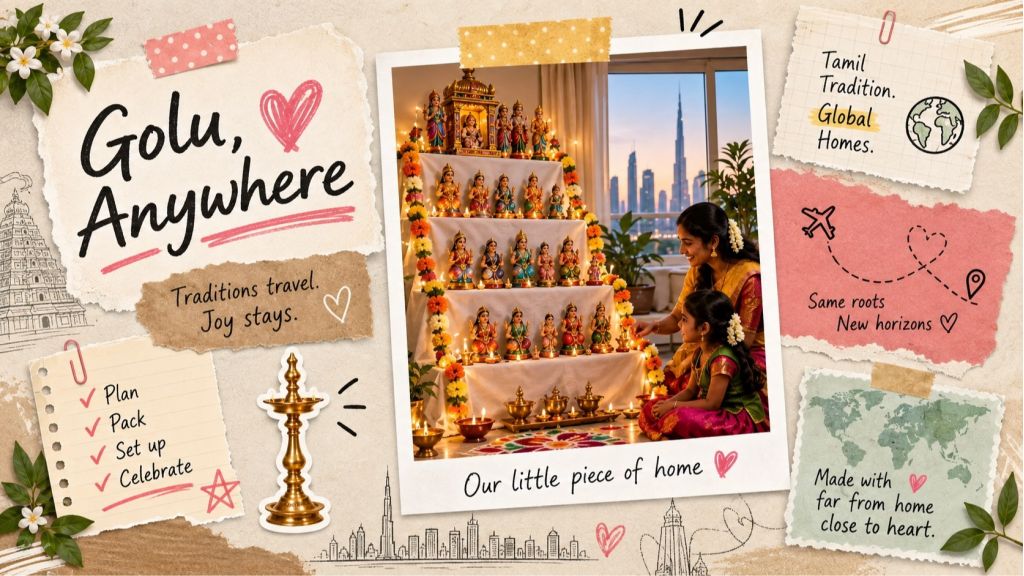
Every September or October, somewhere in a UAE apartment, a Tamil family pushes the living room furniture aside and stands in the corner trying to remember: was it seven steps or nine that Paati used to set up back in Chennai? The golu stand, the tiered display at the heart of Navratri, determines everything about how the celebration takes shape, from how many dolls fit to whether the whole thing looks dignified or just cluttered. Get the foundation right, and the nine days that follow feel genuinely festive. Get it wrong, and you spend the festival week anxious about structural stability.
Many families once had to drag a kolu padi home on the flight from Chennai or trust a relative to ship one with prayers that customs wouldn't damage it. That situation has changed considerably for Tamil expats across Dubai, Sharjah, and Abu Dhabi. Platforms like Sandhai.ae now carry golu stands and full Navratri essentials with UAE-wide delivery, which means the planning conversation has shifted from "how do we even get a stand here" to "which one do we actually need." This guide answers that question, covering tier counts, doll placement, materials, sizing, and sourcing, so you can order with confidence and focus on the celebration itself.
How many tiers your golu stand actually needs
The cultural rule is straightforward: golu steps must always be in odd numbers. The accepted configurations are 3, 5, 7, and 9 steps, with 9 being the most auspicious for households with the space to accommodate it. The odd count carries symbolic weight in Hindu tradition, representing completeness and spiritual wholeness. Deviating from this is something many observant Tamil families prefer to avoid.
For expat families setting up their first display abroad, a 5-step golu stand is the most practical starting point. It balances cultural correctness with a realistic apartment footprint, holds a respectable doll collection, and leaves room to grow as your bommai koluvu collection expands year by year. A 3-step stand works well for a compact studio where floor space is genuinely limited. A 7-step or 9-step golu display stand makes sense if you have a large open-plan area or a dedicated room where Navratri guests will gather for prayers.
One thing many families underestimate the first time: the display takes up noticeably more room once the dolls, accessories, and fabric covering are in place than the bare stand dimensions suggest. A stand that measures three feet wide on paper can feel considerably larger once dressed and lit. When in doubt, choose the smaller configuration and upgrade next season rather than buying something too large for the space you actually have.
Doll arrangement from base to apex: the traditional order
Tamil tradition maps doll placement onto a hierarchy of living beings, moving from the simplest forms of life at the bottom to the divine at the top. The lowest tiers hold plants, insects, and crawling creatures. The middle tiers hold birds, animals, and then human figures. The upper tiers hold saints, sages, mythological figures like Dashavataram sets, and the large deity figures your family has collected over years. The very top step holds the presiding goddess, often the Ashtalakshmi grouping or a Kalasam, as is common in many Tamil households.
In practical terms, the bottom one or two tiers are for your largest and heaviest figures. These form the visual foundation of the display and sit on the widest, most stable shelves. How large is "large" depends on your specific stand's shelf depth, a plate depth of around nine inches or more handles small to medium figures comfortably, while deeper shelves give you flexibility for the bigger base pieces. The middle tiers are where most families place their thematic village scenes, miniature market displays, or seasonal narrative groupings. These shelves are where the storytelling happens, and many families update this section slightly each year as new pieces join the collection.
The top tier calls for small, finely detailed deity figurines that suit a narrower shelf. This height naturally draws the eye upward toward the point of reverence, and it should feel clean and deliberate, visitors offering prayers look here first, and a crowded top step undermines the effect the entire display is building toward.
Materials compared: wood, metal, MDF, and plastic
Wood
Wooden golu stands have the strongest visual presence and the most authentically traditional look. A solid wood kolu padi holds heavier dolls comfortably and lasts for decades when maintained well. For families committed to a long-term Navratri tradition in their home and with adequate storage space, wood is the premium choice. The trade-offs are weight, cost, and the difficulty of moving and storing a solid wood structure in a smaller apartment.
Metal (foldable)
Foldable metal stands are often the most practical choice for UAE apartment living, given their durability and space-saving design. Powder-coated steel and iron stands disassemble quickly, some models are designed for full assembly in under three minutes from four parts. A 7-step foldable metal stand typically collapses to a carton of roughly 70 x 66 x 15 cm, which slides under a bed or into a cupboard without drama. The powder coating provides a festive finish while resisting rust, which matters in the UAE's humid coastal climate. These stands are built for repeated yearly use, and their load capacity handles a substantial doll collection without concern.
MDF and plastic
MDF offers a smooth, paint-friendly surface at a lower cost than solid wood, and it produces a polished appearance for smaller displays. Plastic stands are the lightest option and work well for a compact 3-step or 5-step foldable golu steps setup where the doll collection is not especially heavy. Both materials function well as starter options for a family's first year abroad. Many families find they move to a metal or wooden stand once they've settled on the tier count and dimensions that work for their space, an anecdotally common pattern in the expat Tamil community.
Sizing your golu stand before you order
Measure the floor area and ceiling height of the corner you plan to use before placing any order. A 5-step foldable stand in display position typically measures around 113 cm high, 131 cm long, and 91 cm wide. A 7-step stand expands that to roughly 165 cm high, 183 cm long, and 91 cm wide. These are open-display dimensions. Factor in the full footprint when the stand is set up and covered in fabric, not just the bare frame measurements.
Shelf depth is the specification that determines whether your dolls fit safely. A stand with around 23 cm (approximately 9 inches) of shelf depth handles small to medium dolls comfortably. A stand with 25 to 30 cm of depth gives flexibility for the larger base figures you want to place on the lower tiers. When ordering online, always check the stated shelf depth or plate gap in the product listing. This single measurement saves you from discovering on setup day that your Marapachi bommai overhangs the edge.
For metal foldable stands, a 5-step model folds to approximately 114 x 29 x 152 cm in storage position, while a 7-step folds to approximately 114 x 29 x 215 cm. These numbers give you a realistic picture of the closet or storage space you need to account for after Navratri ends.
Where to source a golu stand outside India
Generic marketplaces occasionally carry listings for Navratri doll stands, but availability is inconsistent and the products are not always verified for sizing and tier proportions that match traditional kolu padi formats. A stand that looks functional in a product photo may arrive with shelf depths that don't suit the doll collection you have, or with a structure that simply doesn't reflect the traditional format. This matters more than it sounds when you are recreating a display that needs to feel right, not just look assembled.
Etsy-based handmade options are available for US and Canada shoppers, with smaller detachable models starting around CA$180 and larger wooden builds scaling up considerably. Specialist Indian retail platforms carry a wider selection, with 5-step stands ranging from roughly $90 to $500 depending on material and build quality, and wooden premium models starting above $400. For international orders involving customs, plan for a lead time of three to six weeks; domestic orders from UAE-based sellers typically need only one to two weeks, though ordering early is always advisable heading into peak Navratri season.
Sandhai.ae carries golu stands alongside a full range of Navratri festival essentials, with UAE-wide delivery. The platform's 7-step golu stand listing holds a 4.9 seller rating. Beyond the stand itself, Sandhai stocks decorative accessories, puja supplies, and traditional festival items that round out the full display without requiring separate orders from multiple sources, a straightforward option for expat families who want a single, reliable sourcing point for Navratri.
Setup tips that make the display look polished
Cover the steps completely with fabric before placing a single doll. Traditionally, a white cotton cloth, often a veshti or dhoti, is draped from the top step to the bottom to create a clean, temple-like surface. Some families use silk in gold or deep green for a richer look, depending on what is available locally. Pull the fabric taut and pin or tuck it securely at the back so it does not shift when dolls are placed. Getting this step right first avoids significant rearranging later when the display is half assembled.
Small LED strips or fairy lights along the step edges can make a noticeable difference in how the display reads during evening prayer visits, which is when most guests arrive. A vilakku or small oil lamp placed at the base of the stand adds a traditional element without requiring much additional floor space. For families working in a compact apartment, positioning the golu stand against a single plain, light-colored wall is a practical styling choice, the wall becomes a natural backdrop, and the display reads as intentional rather than improvised.
Plan your setup to align with Mahalaya Amavasya, which is the traditional day for assembling the steps. Arrange the dolls on Pratipada or during your family's preferred muhurtham the following day. With the stand already assembled and covered, the doll arrangement becomes the creative and meaningful part of the process rather than a rushed final step.
Start planning now, not the week before
Setting up a proper golu display outside India is genuinely manageable when you approach it in the right order: settle on your tier count, choose a material that suits your apartment and storage situation, and verify shelf depth and open dimensions before placing an order. The logistics, handled early, free you to focus on the tradition itself.
For Tamil families across the UAE, Sandhai.ae is a practical first stop for golu stands, puja supplies, and the decorative accessories that round out a full display. Check the stand listings and place your order while September stock holds. The effort of recreating this tradition abroad is exactly what keeps it alive for the generation growing up watching you set it up.

Comments