


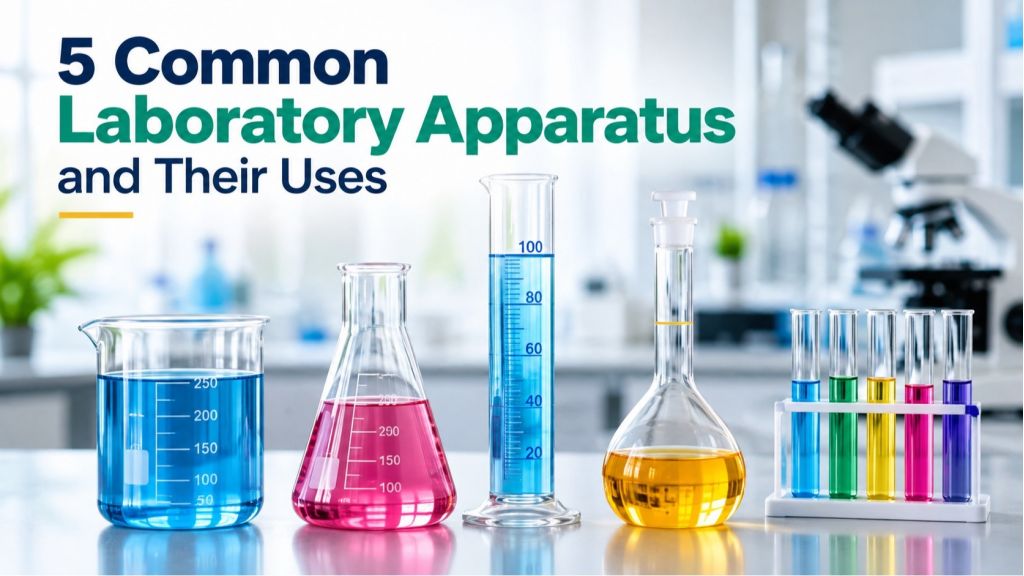
Laboratories rely on a range of essential tools and equipment for conducting experiments, testing samples, measuring liquids, and handling different materials safely. From beakers and test tubes to measuring cylinders and conical flasks, each piece of laboratory apparatus has a specific purpose.
In this guide, we explore five commonly used laboratory apparatus and explain their main uses and applications. Whether you are a student, teacher, researcher, or simply learning about laboratory equipment, this guide will help you understand the purpose of these essential tools.
You can also explore our collection of laboratory apparatus at Sandhai for laboratory and educational requirements.
1. Beakers
Beakers are among the most commonly used pieces of laboratory equipment. They are generally used for holding, mixing, stirring, and heating liquids during experiments and other laboratory activities.
Most beakers have a wide cylindrical body, a flat bottom, and a small pouring lip. Graduated markings on the side provide an approximate indication of the volume of liquid inside. However, these markings are generally intended for approximate measurements rather than highly precise volume measurement.
Beakers are available in a wide range of capacities, making them suitable for different laboratory applications. Common sizes include 100ml, 250ml, 500ml and 1000ml, while larger capacities are also available.
When selecting a beaker, consider the required capacity, material, and intended application. Explore our range of laboratory beakers in different sizes and capacities, suitable for mixing, stirring, holding, and heating liquids in educational and laboratory applications. Browse our collection to find the right beaker for your requirements.

2. Conical Flasks
The Erlenmeyer flask, commonly known as a conical flask, is another important piece of laboratory glassware. It has a distinctive conical body with a wide base and a narrow neck.
This design makes the flask useful for mixing and swirling liquids while helping to reduce the risk of spills. The narrow opening also makes it convenient for certain laboratory procedures where controlled handling of liquids is required.
Conical flasks can also be held using appropriate laboratory clamps and may be used in applications involving heating or mechanical shaking, depending on the flask material and laboratory procedure.
Because of their practical shape, conical flasks are commonly used in chemistry, biology, educational laboratories, and other scientific applications.
Shop conical flasks for laboratory and educational applications, ideal for mixing, swirling, holding, and preparing liquids during experiments. Explore our collection to find a conical flask suitable for your laboratory or educational requirements.
3. Measuring Cylinders
A measuring cylinder, also called a graduated cylinder, is designed to measure the volume of liquids more accurately than the graduations on a typical beaker.
The cylinder has graduated markings along its body that allow the user to determine the approximate volume of liquid. For a more accurate reading, the cylinder should be placed on a level surface and the liquid should be read at eye level.
When reading certain liquids, you may notice a curved liquid surface known as the meniscus. The appropriate point of the meniscus should be aligned with the graduation marking when taking a measurement.
Measuring cylinders are commonly used in educational laboratories, chemistry experiments, testing environments, and other applications where measuring liquid volumes is required.
Explore measuring cylinders at Sandhai to find laboratory equipment for educational and scientific requirements.
4. Volumetric Flasks
Volumetric flasks are laboratory glassware designed for preparing and measuring a specific volume of liquid. They typically have a rounded body, a long narrow neck, and a marked line indicating a particular volume.
To use a volumetric flask correctly, liquid is added until the appropriate level reaches the calibration mark. When working with liquids, temperature can affect volume, so laboratory procedures should take temperature and measurement conditions into consideration.
The narrow neck and clearly defined calibration mark make volumetric flasks particularly useful when a specific liquid volume is required for laboratory preparation.
Volumetric flasks are commonly used in chemistry, educational laboratories, and scientific applications involving the preparation of solutions.
Browse volumetric flasks for laboratory applications designed to prepare and measure specific liquid volumes with greater precision. Explore our collection to find volumetric flasks suitable for chemistry experiments, educational laboratories, and scientific applications.
5. Test Tubes
Test tubes are simple but essential laboratory tools used for holding, mixing, and observing small quantities of substances. They typically consist of a narrow glass or plastic tube with one open end and a closed bottom.
Because of their compact size, test tubes are especially useful when you need to handle or compare several small samples during an experiment. They are commonly found in chemistry, biology, educational, and laboratory environments.
Test tubes can also be used with suitable racks and holders to keep multiple samples organized. Depending on the material and laboratory procedure, some test tubes may be suitable for heating.
Shop test tubes and laboratory accessories for handling, storing, mixing, and observing small samples in educational and laboratory settings. Explore our collection to find suitable test tubes and essential laboratory accessories for your requirements.
Important: Never heat a sealed or capped test tube. Always follow appropriate laboratory safety procedures when handling or heating test tubes.
Common Laboratory Apparatus at a Glance
| Laboratory Apparatus | Common Purpose |
|---|---|
| Beaker | Holding, mixing, stirring and heating liquids |
| Conical Flask | Mixing and swirling liquids |
| Measuring Cylinder | Measuring liquid volume |
| Volumetric Flask | Preparing and measuring a specific volume |
| Test Tube | Holding and testing small samples |
How to Choose Laboratory Apparatus
Choosing the appropriate laboratory apparatus depends on the type of experiment, required capacity, level of measurement accuracy, material, and intended application.
For example, beakers are useful for general-purpose liquid handling, while measuring cylinders are more appropriate when a measured liquid volume is required. Conical flasks are useful for mixing and swirling, while volumetric flasks are designed for preparing specific volumes.
For educational laboratories, schools, colleges, and other scientific environments, it is also important to consider the appropriate size and material for the intended use.
Explore Laboratory Apparatus at Sandhai
Whether you are looking for laboratory glassware for a school, college, educational project, or laboratory, having the right equipment makes experiments and testing easier to organize.
Explore laboratory apparatus at Sandhai and discover laboratory equipment including beakers, measuring cylinders, test tubes, flasks, and other laboratory supplies.
For more laboratory glassware and scientific equipment, explore the relevant Sandhai categories and products to find equipment suited to your requirements.

Comments