

Gorilla construction adhesive can be useful when a repair needs more contact area, better resistance to movement or a bond between different materials. But a strong adhesive cannot compensate for loose plaster, contaminated surfaces or an unsupported load. The result depends on choosing the right formula, preparing both surfaces and leaving the joint undisturbed while it cures.
For UAE shoppers, outdoor heat and dusty surfaces add another consideration. This guide explains where construction adhesive makes sense, how to use it for demanding non-structural repairs and when another repair method is more appropriate.
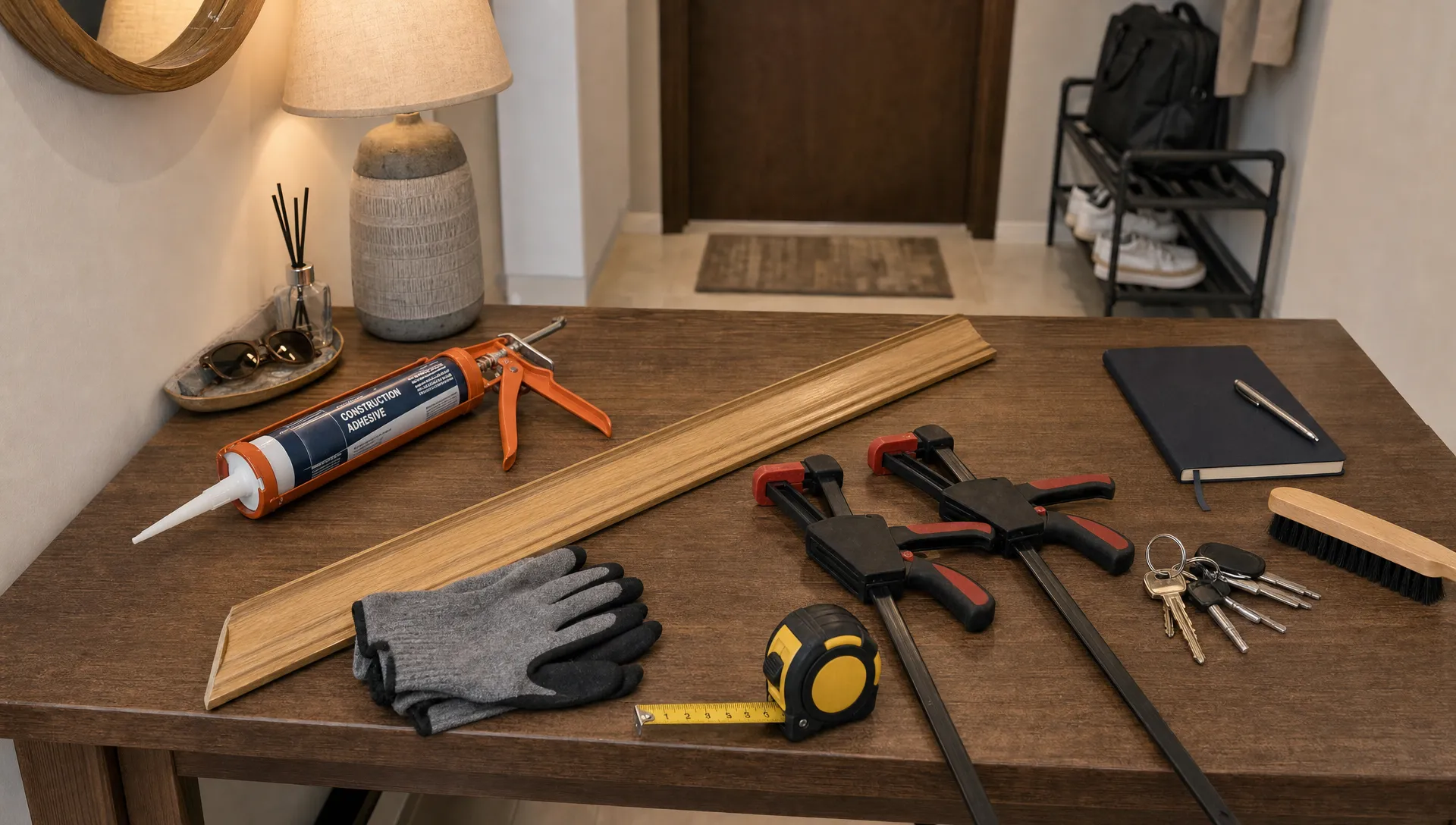 What makes a repair demanding?
A repair becomes challenging when the joint faces more than a simple pull. A projecting trim piece creates leverage, repeated movement can peel a bond from its edge and temperature changes can make the joined materials expand at different rates.
The underlying surface matters just as much. An adhesive might attach firmly to paint while the paint itself separates from the wall. Similarly, bonding to crumbling concrete only creates a connection to material that is already failing.
The entire repair is only as dependable as its weakest layer. Before choosing an adhesive, inspect the substrate, the shape of the joint and the forces it will face. Wider contact between sound surfaces is generally more favourable than a narrow edge carrying a projecting load.
Where Gorilla construction adhesive can help
Construction adhesives are intended for building materials and installation tasks, although approved materials vary by formula. They can be useful for securing suitable trim, bonding decorative components or reattaching non-structural pieces where the surfaces provide adequate contact.
Gap-filling capability can help with small surface irregularities when the product label permits it. That does not mean adhesive can rebuild a missing corner, stabilise damaged masonry or fill an unrestricted void.
| Repair situation | Why construction adhesive may help | What to check first |
|---|---|---|
| Loose decorative trim | Provides a bond across the back of the piece | Sound substrate, compatible materials and temporary support |
| Non-structural wood attached to masonry | Can join dissimilar materials with an approved formula | Dust removal, surface condition and permitted application conditions |
| Decorative panel coming away from a wall | Allows bonding over a broader contact area | Panel weight, wall coating and fixing requirements |
| Minor unevenness between mating surfaces | A suitable gap-filling formula can accommodate limited irregularities | Maximum permitted gap and sufficient contact area |
| Exterior decorative repair | An exterior-rated formula may suit weather exposure | Temperature limits, drainage and water-exposure restrictions |
For a demanding repair, Gorilla construction adhesive should be assessed as part of the complete joint rather than treated as a universal replacement for screws or brackets. A broad bond on compatible, stable materials is a different proposition from a tiny contact point supporting a heavy object.
Do not rely on adhesive alone for handrails, structural connections, safety barriers or heavy overhead items. Those applications need appropriate mechanical fixings and, where necessary, professional assessment.
Check the exact formula before buying
The Gorilla brand sells different adhesive products. A construction adhesive, an expanding polyurethane glue and a two-part epoxy should not be treated as interchangeable, even if the packaging uses similar strength claims.
Start with the exact product name and its technical instructions. Confirm that both materials are supported, whether the application is indoors or outdoors and whether the expected moisture exposure is permitted. Also check the application temperature, working time, support requirements and full cure time.
The manufacturer’s Gorilla Heavy Duty Construction Adhesive page provides product-specific instructions and restrictions. Use the information for the exact cartridge you have, since claims for another formula may not apply.
Plastic deserves particular attention. Polyethylene and polypropylene are difficult bonding surfaces and are excluded by some construction adhesive formulas. Identifying the plastic is more useful than assuming that every rigid plastic behaves alike.
When buying Gorilla construction adhesive online, match the listing to the product label before deciding whether it suits your repair. Do not infer compatibility from the brand name alone.
Prepare the joint before applying adhesive
Remove weak material and contamination
Take off loose paint, flaking plaster and remnants of failed adhesive that would prevent contact with a sound surface. Remove dust thoroughly rather than brushing it into nearby corners. Oil, grease and cleaning-product residue can also interfere with bonding.
Follow the manufacturer’s cleaning recommendations for each material. A solvent that cleans metal may damage plastic or a decorative finish, so test any cleaner on an inconspicuous area and let it evaporate as instructed.
Surface moisture requirements vary by adhesive chemistry. Do not automatically wet the joint because instructions for a different Gorilla glue recommend it. Construction adhesive instructions must be followed independently.
Dry-fit the parts and plan the support
Place the pieces together without adhesive first. Check alignment, contact area and whether the part springs away when you release it. A warped panel or tightly stressed joint may need a different fixing approach rather than more adhesive.
Plan how you will hold the repair before opening the cartridge. Depending on the job, suitable support might include clamps, props or specified mechanical fixings. Protect finished surfaces from clamp marks and avoid clamping so aggressively that the parts distort.
Applying Gorilla construction adhesive to an unplanned joint can leave you trying to arrange supports while its working time is running out. A dry fit lets you solve those problems without risking the bond.
Apply the specified bead pattern
Use the bead size and application pattern on the product label. More adhesive is not automatically better: excessive material can squeeze out, make alignment harder and leave a thicker joint than intended.
Bring the surfaces together within the stated working time and press them into the required position. Avoid repeatedly separating and rejoining them unless the instructions explicitly permit that method.
Clean excess adhesive using the manufacturer’s recommended method before it hardens. Do not assume a cured bead will peel away harmlessly from paint, polished stone or a decorative coating.
Initial grab is not full cure
A part that stays in position has not necessarily reached its usable strength. Initial grab helps with positioning, while curing develops the bond over time. Moving or loading the joint too early can weaken a repair that otherwise appeared successful.
For its Heavy Duty Construction Adhesive, Gorilla lists a 24-hour cure time. Follow the instructions on your exact product and any qualifications relating to application conditions, materials or adhesive quantity. Do not transfer that timing to every Gorilla formula.
Keep the repair supported for the specified period and protect it from disturbance. For example, a bonded decorative strip should not be tugged to test its strength shortly after application. A test pull can damage a developing bond rather than provide useful reassurance.
If the application involves a heavy component, temporary support is not a substitute for the permanent fixings required by its installation instructions.
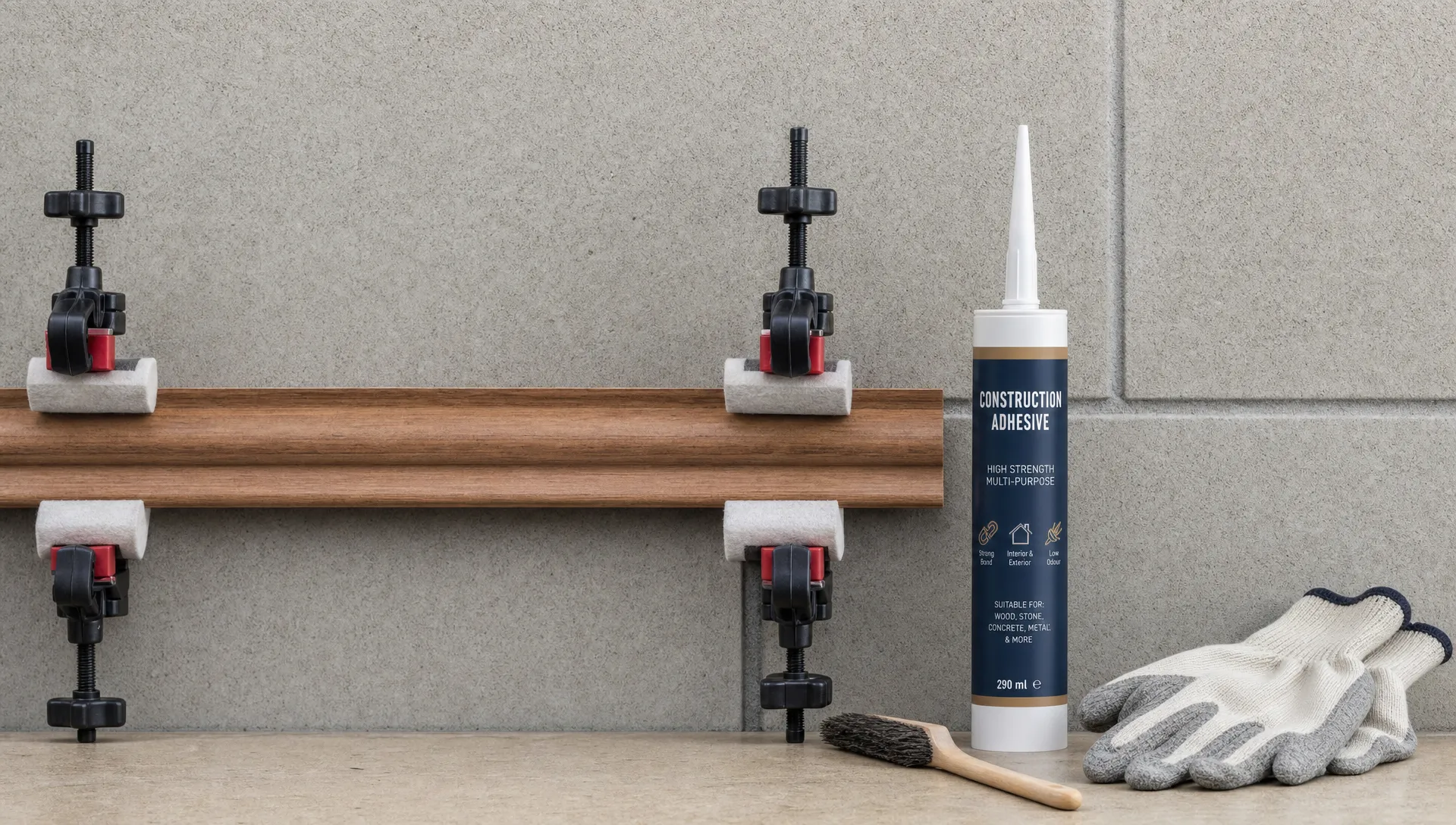
Allow for UAE heat, dust and outdoor exposure
A shaded room and a sun-exposed balcony present different application conditions. Metal, stone and concrete can become hotter than the surrounding air, so a comfortable air temperature does not prove that the bonding surface is within the product’s permitted range.
For exterior work, check the temperature of the actual surface and choose a suitable application period. Clean shortly before bonding, since airborne dust can settle back onto a prepared joint. Store cartridges according to the label rather than leaving them in a parked car or direct sunlight.
Outdoor use also requires a distinction between weather exposure and continuous water contact. An exterior-rated or waterproof adhesive is not automatically suitable for submerged joints, repairing leaks or replacing a waterproofing system.
Gorilla construction adhesive can only be evaluated for an outdoor repair against the exact formula’s stated limits. For tiled wet areas, failed grout or a damaged waterproof membrane, identify the underlying problem instead of covering it with an adhesive bead.
When a different repair product makes more sense
Small, close-fitting breaks
A construction adhesive bead can be awkward for a tiny component with almost no gap. A precision adhesive such as Fevicol Superglue 3g may be a more relevant product to investigate for a small repair, provided its label supports the materials and service conditions.
The choice should follow the joint’s requirements. A fast-setting adhesive does not necessarily tolerate movement, fill a gap or support a substantial load.
Flexible footwear and fabric
Shoes bend repeatedly and face a different set of demands from fixed building trim. For sole or heel repairs, compare a dedicated footwear product such as Italo Shoe-Fix 17ml, checking its instructions for the shoe materials involved.
Textile work also calls for a different approach. A product such as Fevicryl Fabric Glue 80ml is more relevant to investigate for fabric applications than assuming Gorilla construction adhesive will suit a flexible seam. Check washing instructions, fabric compatibility and any effect on appearance before committing to the repair.
Temporary patches rather than bonded joints
For temporary bundling or a non-structural patch, Polar Bear Blue Duct Tape serves a different purpose from a cured adhesive joint. Tape can be useful in the appropriate situation, but it does not make a broken load-bearing component safe.
If you need an invisible permanent repair, a flexible joint or a load-rated connection, choose the method for that requirement rather than simply selecting the strongest-sounding product.
Frequently asked questions
How long should I leave a construction adhesive repair before using it? Follow the full cure time and support instructions for the exact product. Gorilla’s Heavy Duty Construction Adhesive lists a 24-hour cure, but other formulas may differ. Initial hold is not permission to load the repair.
Can Gorilla construction adhesive replace screws? It may be suitable for some non-structural applications when the product and component instructions allow it. Do not use it as an assumed replacement for mechanical fixings in structural, safety-critical or heavy overhead applications.
Will it bond every type of plastic? No. Compatibility depends on the formula and the plastic. Polyethylene and polypropylene are excluded by some products, so check the label and identify the material before application.
Can I paint over the finished joint? Only if the exact adhesive is described as paintable. Follow its curing and coating instructions, and test compatibility where appearance matters. Painting does not compensate for an unsuitable or incompletely cured bond.
Choose the repair method before shopping
Start with the materials, joint movement and expected load, then compare the product instructions. You can browse Sandhai’s online marketplace for repair products and check individual listings for pack details and availability. For Gorilla products, confirm the exact formula and its suitability before purchasing, especially when the repair faces heat, moisture or repeated stress.

Comments