


A canvas collage lasts longer when its materials work together, not simply when each packet says "artist quality”. The support needs to carry the layers without sagging, the adhesive must suit both surfaces and the colours need reasonable resistance to fading. A protective coating cannot compensate for weak paper or poorly bonded edges.
For shoppers choosing supplies online, the most useful details are often missing from the product photograph. Look beyond size and colour to check construction, composition and compatibility before you buy.
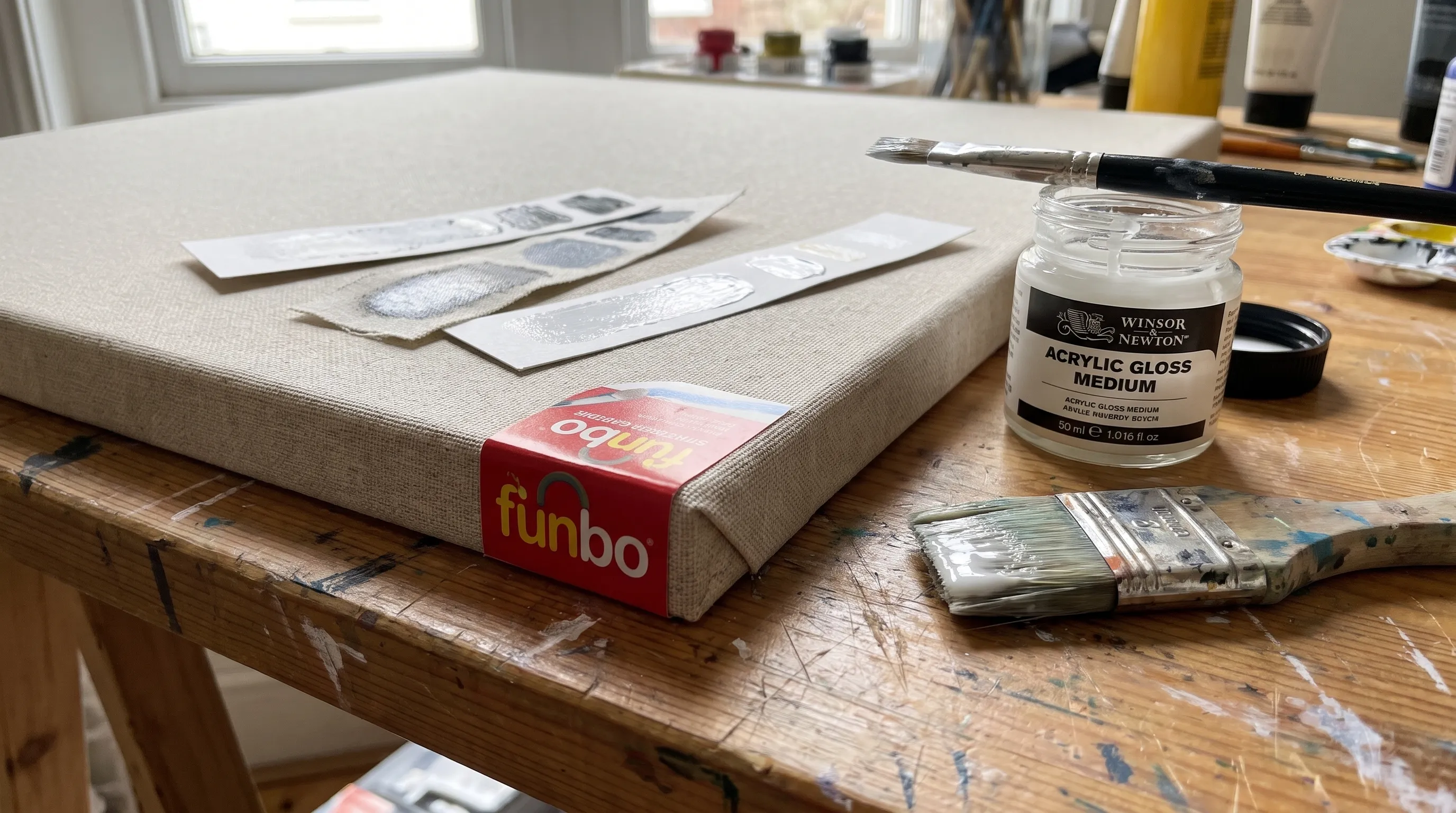 Compare materials by how they can fail
Start with the finished artwork: will it contain thin paper, photographs, fabric or raised objects? Each creates different demands on the support and adhesive.
| Material | What to look for | What can go wrong |
|---|---|---|
| Stretched canvas | Even tension, straight stretcher bars and suitable bracing for the size | Sagging or movement beneath heavy layers |
| Paper | Acid-free and lignin-free composition where available | Yellowing, brittleness or distortion |
| Printed images | Documented print durability and compatibility with wet media | Fading, bleeding or surface damage |
| Adhesive | Stated suitability for the materials being joined | Lifting edges, staining or a weak bond |
| Paint and finishes | Lightfastness information and application guidance | Colour change, cloudiness or tackiness |
Treat "archival” as a claim to investigate, not a lifetime guarantee. A product’s technical information, intended uses and limitations tell you more than a broad marketing label. Even good materials can fail when combined incorrectly or displayed in unsuitable conditions.
Choose a support that suits your canvas collage
Stretched canvas works well for lightweight paper and fabric compositions. Its flexibility becomes a disadvantage when you add substantial objects or build thick, uneven layers. For those projects, consider a suitably prepared rigid art panel instead.
When comparing stretched supports, check whether the listing identifies the fabric, priming, stretcher construction and depth. Larger formats also deserve closer attention to bracing. A heavier cloth does not automatically mean stronger stretcher bars or better preparation.
The Funbo Stretched 3D Canvas 380 gms, 100 × 120 cm is a large-format option to assess when planning a substantial wall piece. Its listed dimensions and weight description are useful starting points, but confirm the priming and support construction rather than assuming them from the name.
For a square composition, the Custom Canvas Extra Large Canvas Plain 150 × 150 cm offers a different layout scale. At that size, plan the distribution of layers before buying and check access through doorways, handling space and wall-hanging requirements.
Neither size alone establishes suitability for heavy embellishments. If an attached object pulls the fabric out of plane, changing the support is usually a better solution than adding more glue.
Select paper, photographs and fabric for stability
For a canvas collage containing paper, choose acid-free and lignin-free sheets where possible. These terms describe different properties: paper can be acid-free when manufactured yet still contain lignin that contributes to deterioration over time. Cotton rag papers are another option, although their texture and thickness still need testing.
Newspaper, receipts and inexpensive decorative papers may change colour or become brittle. You can use them deliberately, but accept that their appearance may evolve. For meaningful documents, work with a reproduction and store the original separately.
Photographs require similar care. Print longevity depends on the ink, paper and display conditions, not simply whether a printer uses pigment or dye. Ask for permanence information about the complete printing system. Test a duplicate before applying any water-based medium because some prints bleed or suffer surface damage.
With fabric, check for loose fibres, coatings and dye transfer. Where the textile permits washing, prewash it and let it dry completely before cutting. Test coloured fabric against a damp white cloth to check for transfer.
The Library of Congress guidance on caring for paper also reinforces the importance of suitable handling, storage and light exposure. Material choice and everyday care belong together.
Match the adhesive to both surfaces
The best adhesive for a canvas collage depends on what you are bonding, how porous it is and whether the finished support will flex. "Clear-drying” alone says little about long-term performance.
Artist acrylic gel medium is a useful candidate for many paper-to-canvas combinations. Different consistencies suit different tasks: a fluid medium can spread beneath thin paper, while a thicker gel can help with more textured lightweight materials. Follow the manufacturer’s stated uses rather than treating every gel as interchangeable.
An artist-grade PVA adhesive may suit some porous paper applications, provided its specifications support the intended use. General household glue, glue sticks and hot glue should not be assumed suitable for permanent artwork simply because the initial bond feels secure.
Non-porous objects need separate assessment. Metal, glass and some plastics may require a different adhesive or mechanical attachment. Heavy objects also need a support capable of carrying their load.
A continuous, compatible bond matters more than a thick application. Spread adhesive evenly and pay attention to corners without flooding delicate paper. Excess moisture can cause distortion, while thick adhesive trapped beneath non-absorbent layers can take longer to dry.
Check both drying and curing instructions. A surface that feels dry may not yet be ready for another coating, packing or hanging.
Choose colour by lightfastness, not just shade
Colour can be the least durable part of a canvas collage, even when every layer remains firmly attached. Lightfastness describes resistance to colour change under light exposure. It is different from water resistance or how quickly a paint dries.
Look for pigment identification and a published lightfastness rating when available. Ratings can differ between colours within the same paint range, so assess the shades you actually intend to use.
For a neutral background, Funbo Acrylic Paint 100ml in Gray is a colour option to consider. Its water-based formulation does not, by itself, establish a permanence rating; check the label or ask for technical information if longevity is a priority.
The same approach applies to brighter accents such as Funbo Acrylic Paint 200ml in Pink. Choose the colour for the composition, then verify the performance details separately.
Also test how each colour looks beneath a transparent medium. Gloss can deepen the appearance of dark areas, while matte products may soften contrast or alter the appearance of textured surfaces.
Test the complete layer sequence before buying in quantity
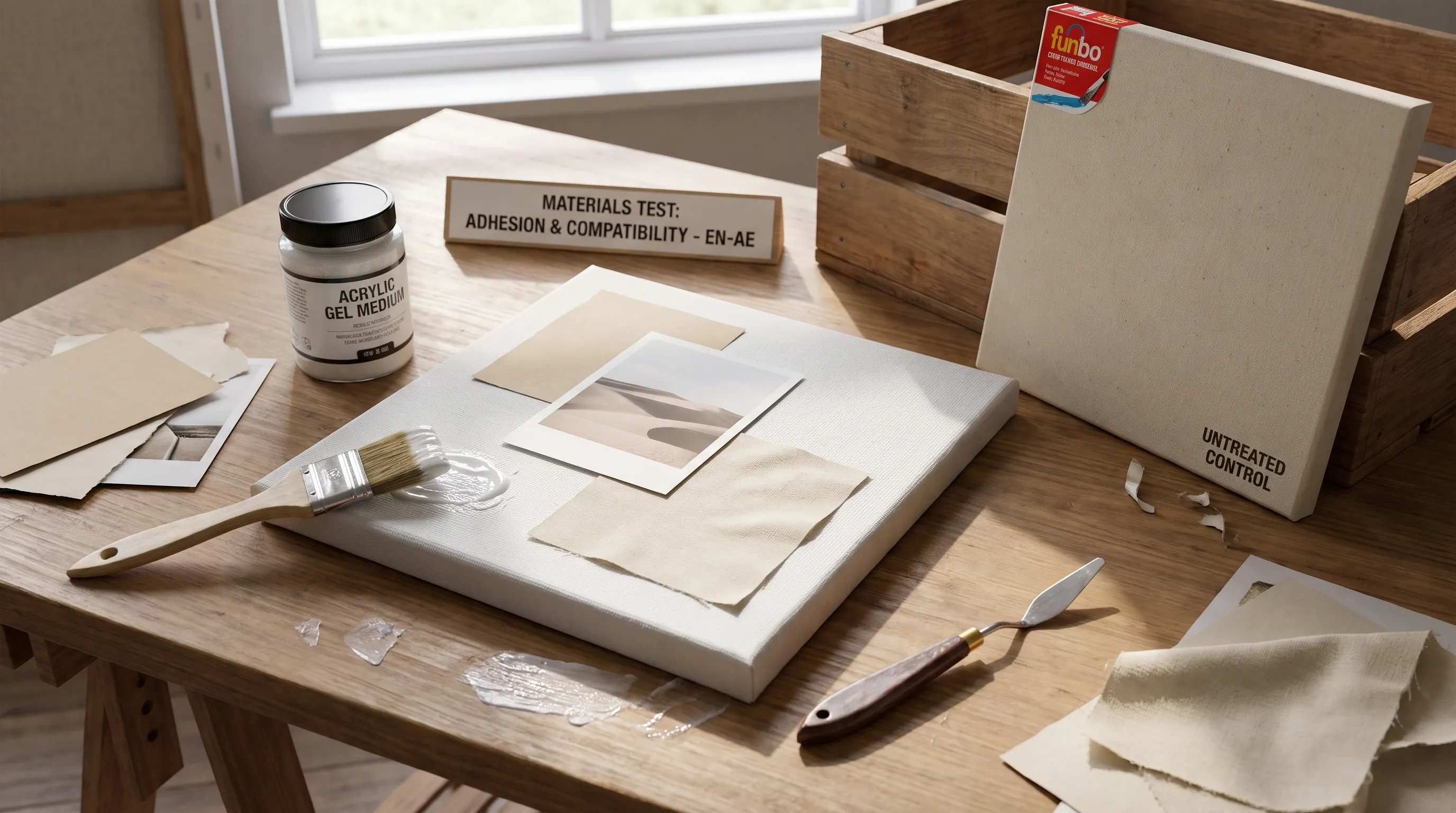
A small trial is more useful than testing each material separately. Your canvas collage needs to work as a layered system: primer, paint, adhesive, paper and any final coating can affect one another.
A Maxi Canvas in the 20 × 30 cm size provides a smaller format for a materials study. For the closest comparison, use the same surface preparation as the final support. If the test canvas has a different fabric or primer, it cannot verify every aspect of the larger work.
- Reproduce the background: Apply the intended paint or preparation and allow the drying time specified by its manufacturer.
- Attach representative samples: Include your thinnest paper, darkest print, a fabric piece and any textured material you plan to use.
- Use the intended adhesive: Apply it at the same thickness and with the same tools planned for the artwork.
- Inspect after drying: Check for colour transfer, bubbles, curled edges, staining and remaining tackiness.
- Test the proposed finish: Coat only part of the sample so you can compare colour, sheen and surface texture with an untreated area.
Keep notes on the products and sequence. This test can reveal immediate incompatibilities, but it is not an accelerated ageing test or proof that materials will remain unchanged for decades.
Protect the surface without creating new problems
A final coating is optional, not an automatic requirement. Mixed surfaces can respond very differently to the same product, particularly when photographs, absorbent paper and raised textures share one support.
An isolation coat and a varnish perform different roles. In some acrylic painting systems, an isolation layer separates the paint from a subsequently applied removable varnish. That approach cannot be assumed safe for every paper or photographic element. Use a coating system only where the manufacturer supports the materials involved.
Acrylic medium used as a topcoat is not automatically equivalent to a removable varnish. Likewise, UV-protective claims do not make sensitive colours fade-proof. Direct sunlight remains a poor display choice.
If the surface contains fragile or water-sensitive elements, glazing may be a better option than a liquid coating. A suitable frame with spacers can keep glazing away from raised details and reduce direct handling and dust deposition. Fragile or valuable originals deserve advice from a qualified conservator.
For a canvas collage with uncertain surface compatibility, leaving the work uncoated and protecting it through framing can be safer than applying an irreversible finish that changes the materials.
Plan for display conditions in UAE homes
Indoor placement matters even when an artwork is made from carefully selected supplies. In UAE homes, avoid direct sun through windows, hot enclosed balconies and positions close to cooking steam or bathroom moisture. Do not leave finished work in a parked car during transport or errands.
Air conditioning helps manage indoor conditions, but placing art directly beneath a cold-air outlet can create local fluctuations. Choose a location away from direct airflow and use a simple hygrometer if you need to understand humidity changes in the room.
Hang larger pieces with hardware appropriate to their weight and the wall construction. When moving them, support the frame rather than pressing against the fabric or gripping raised collage elements.
Dust stable surfaces gently with a soft brush only where nothing loose can catch. Avoid household cleaning sprays, wet cloths and solvents. If an edge lifts, investigate the cause instead of covering it with tape.
For a canvas collage intended to last, stable display conditions and careful handling are part of the material plan, not an afterthought.
Frequently asked questions
Is stretched canvas better than a wood panel? Neither is universally better. Stretched canvas suits lightweight layers, while a properly prepared rigid panel is generally more appropriate for substantial objects or thick constructions. The panel itself also needs suitable preparation and support.
Can I use ordinary magazine pages? Yes, particularly if their imagery is central to the design. Their paper and printing may have uncertain long-term stability, however. Test for bleeding and bonding, avoid strong light and use reproductions when preserving the source material matters.
What is the best glue for canvas collage? There is no single best glue for every combination. Artist acrylic gel medium is a useful starting point for many paper-based projects, but photographs, fabric and non-porous objects need compatibility checks. Follow the adhesive manufacturer’s guidance and test the full layer sequence.
Will varnish stop fading or make the artwork waterproof? No coating should be treated as complete protection against fading or water damage. Performance depends on the finish and underlying materials. Keep the artwork away from direct sunlight, splashes and persistently damp conditions, whether it is coated or not.
Buy materials around the project’s needs
Before placing your Sandhai order, settle the support size, approximate layer weight and materials you want to combine. Check the listings for missing specifications and ask questions about priming, adhesive compatibility or lightfastness where needed.
Prioritise a sound support, stable papers and a compatible adhesive before spending on decorative finishes. A small test piece can expose a mismatch before you commit your photographs, time and full-size canvas.

Comments