


Choosing a Golu stand in wood starts with the space you have, the dolls you want to display and how you will store the stand after Navarathri. A beautiful finish matters, but it cannot compensate for shallow shelves, weak supports or a structure that blocks your living room.
For UAE homes, a practical choice balances festival presentation with everyday realities: apartment layouts, visiting guests, children and limited storage. This guide explains what to measure, which construction details to check and how to compare online listings without assuming that every stepped stand is wooden.
Measure your display area before choosing a stand
Start with the stand’s assembled footprint, not just its advertised width. A stepped display needs floor depth as well as height, and the area in front must remain accessible for arranging dolls and welcoming visitors.
Measure the available width, depth and height at your intended location. Then check whether curtains, doors, nearby furniture or electrical sockets will interfere with the display. Use masking tape on the floor to mark the proposed footprint so you can see how much walking space remains.
Shelf depth deserves its own check. Measure the bases of your largest dolls, including any decorative platforms they sit on. A doll should fit fully on the shelf without its base projecting beyond the edge. Allow additional room if you plan to add flowers or other decorations behind it.
Ask for assembled dimensions and usable shelf dimensions if the listing does not provide both. Overall depth alone does not tell you how much usable space each step offers.
The right golu stand in wood should accommodate your collection while leaving comfortable access around the display, rather than simply filling the largest available wall.
Choose the number of steps around your collection
Golu displays commonly use odd numbers of steps, with arrangements shaped by family tradition and available space. Follow your household’s practice rather than buying a larger stand solely because it appears more impressive.
Before ordering, group your dolls into the rows you intend to create. Keep tall pieces, wide scenes and smaller figurines separate during this planning stage. This makes it easier to judge whether you need more steps or simply wider shelves.
Sandhai’s Golu Stand-5 steps is a relevant listing to review when comparing five-step arrangements. Its name establishes the step count, but you should confirm the material, dimensions, assembly requirements and load guidance before deciding whether it meets your wooden-stand preference.
If your collection needs additional rows, compare the Navarathri Golu Stand - 9 Steps against your measured space. More steps can mean a taller or deeper structure, depending on the design, so step count alone is not a reliable size guide.
Also consider reach: you should be able to place and remove dolls safely without leaning across fragile pieces or climbing on furniture.
What to check when choosing a golu stand in wood
Identify the shelf material and the frame material
"Wooden” can describe several different constructions. A stand might use solid timber throughout, plywood shelves on a timber frame or wood-based panels supported by metal. Ask what each major component is made from, rather than accepting a general material description.
| Material | What to inspect | What to confirm with the seller |
|---|---|---|
| Solid wood | Cracks, warped boards, rough edges and joint quality | Timber type, finish and care instructions |
| Plywood | Supported shelf edges, exposed layers and edge sealing | Panel thickness, grade and load guidance |
| MDF or particleboard | Swelling, chipped edges and fixing points | Moisture precautions and assembly instructions |
| Wood-and-metal construction | Shelf attachment and frame connections | Which parts are wood and which are metal |
Material alone does not establish quality. A well-supported plywood shelf may suit your needs better than a thin solid-wood board with a long unsupported span. Likewise, a polished surface tells you little about the strength of the joints underneath.
When evaluating a golu stand in wood, prioritise clear material information, suitable support and a finish you can maintain over vague descriptions such as "premium quality”.
Inspect supports, joints and shelf stability
Look closely at product photographs showing the sides, underside and rear of the stand. These views can reveal how the shelves are supported and whether the structure includes braces or other stabilising components.
Check that shelves sit securely on their supports and that the assembled frame does not rack, meaning shift sideways out of shape. Ask whether bolts or screws need periodic checking and whether assembly requires tools that are not supplied.
Heavy clay dolls make load information especially important. Request the permitted load per shelf and any guidance on distributing weight. Do not invent a safe weight limit from photographs, shelf thickness or the material name.
If the seller cannot provide load guidance, do not assume the stand will support your heaviest collection. Once assembled, check it on a level floor before adding dolls and stop if you notice movement, loose connections or visible shelf sagging.
A dependable golu stand in wood needs secure connections and adequate shelf support, not just an attractive front-facing photograph. Where wall restraint is recommended by the manufacturer, follow those instructions and use fixings appropriate to your wall.
Compare wooden and metal options honestly
Wood is worth considering when you want its appearance, a particular finish or a construction that suits your existing décor. It is not automatically the lightest, strongest or easiest option to store. Those qualities depend on the individual design.
For a material comparison, Sandhai’s Navarathiri Metal Golu Stand 120cm - 7 Steps is explicitly a metal option, not a wooden stand. Check what the listed 120 cm measurement refers to, along with the complete dimensions and shelf specifications.
If you intend to cover the entire structure, the visible difference between wood and metal may matter less than stability, shelf depth and ease of assembly. Conversely, an exposed display makes the finish and edge detailing more prominent.
Compare both options using the same questions. Neither material should be assumed to offer greater load capacity, easier dismantling or better durability without supporting product information.
Plan covers and decorations before ordering
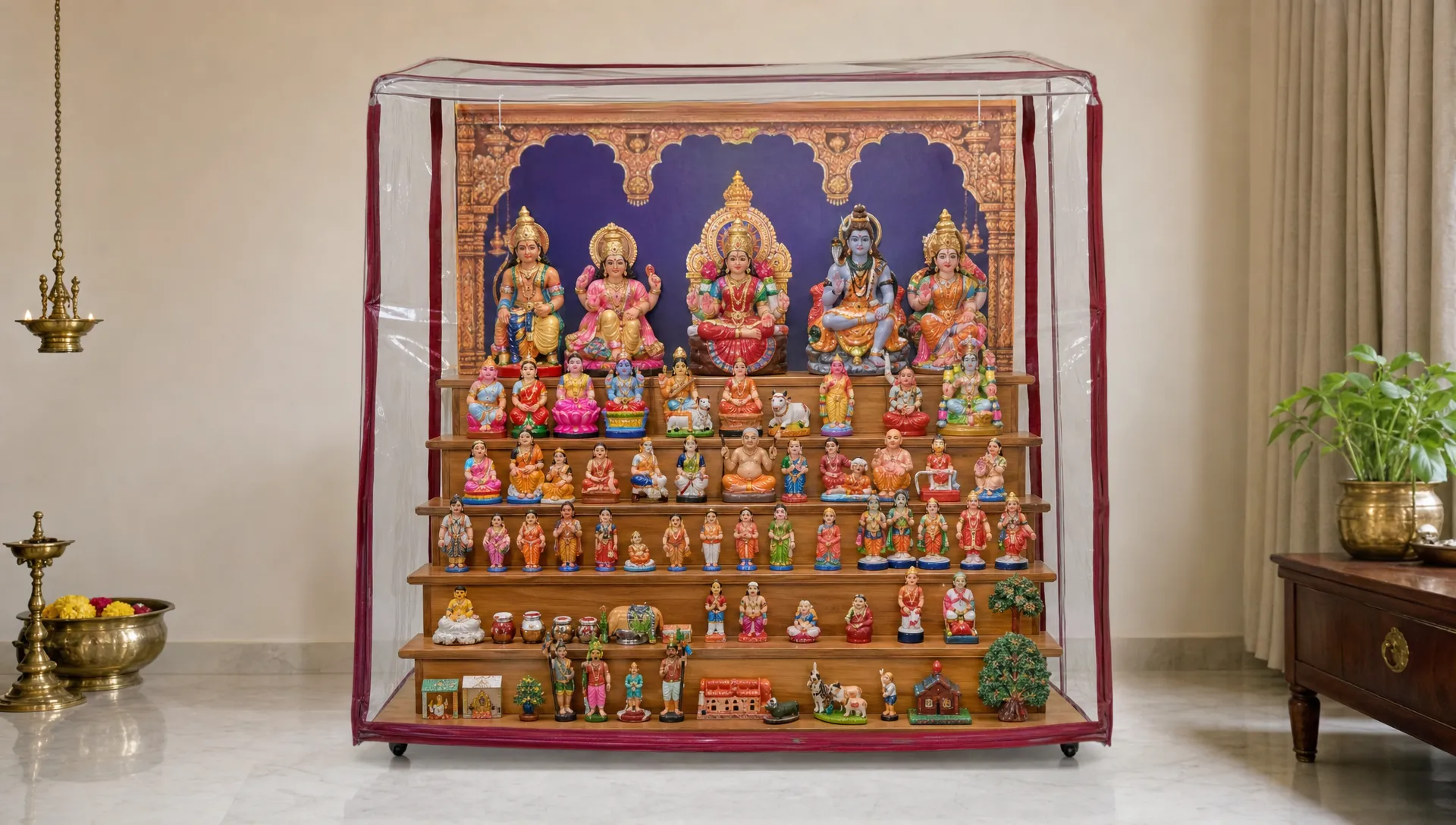
A cover can create a consistent background for your dolls, but it must fit the stand’s actual geometry. Two seven-step stands can have different widths, shelf depths and rises between steps.
If you are considering Sandhai’s 7 Steps Golu Stand Cover, check its dimensions against your chosen stand rather than treating the shared step count as proof of compatibility. Avoid fabric hanging into walkways or folds that create an uneven surface beneath doll bases.
A backdrop also needs its own mounting plan. The Golu backdrop decoration can be considered as part of your arrangement, but confirm its size and how you will support it. Do not assume the stand can carry a backdrop unless its design allows this.
Keep lamps, candles and other heat sources away from wood, fabric and decorations. Battery-operated LED lighting avoids an open flame, but cables, battery compartments and accessories should still remain clear of walking routes and accessible to adults.
Check how the stand will be stored after Navarathri
Storage is part of the buying decision, especially if your festival display stays up for only a short period each year. Ask whether the stand is fixed, folding or designed to dismantle, and request its packed dimensions where relevant.
A dismantled stand still needs space for its longest shelf and largest frame section. Measure your storage cupboard or spare-room area before ordering. Also check whether one adult can reasonably handle the components or whether assembly and moving require assistance.
Keep wooden parts in a dry indoor location, away from leaks and persistent humidity. Follow the seller’s cleaning instructions and avoid packing components while damp. Protect finished surfaces from rubbing against hardware or other boards during storage.
For a reusable golu stand in wood, labelled components and a small container for bolts can simplify next year’s setup. Photograph the assembled joints before dismantling and keep the instructions with the parts. Recheck connections and shelf condition when you bring it out again, rather than assuming last year’s assembly remains sound.
Use a short checklist before placing your order
Online photographs help you assess appearance, but the purchase decision should rest on specifications and clear answers. Save the relevant product details so you can compare options consistently.
Before checkout, confirm these essentials:
- Fit and capacity: Assembled dimensions, usable shelf depth, step count and load guidance match your space and doll collection.
- Construction and handling: Shelf and frame materials, assembly method, required tools and packed dimensions are clear.
- Order conditions: Current availability, delivery arrangements for your UAE address, return terms and the process for reporting missing or damaged parts are understood.
If a critical detail is absent, ask the seller before paying. This is particularly worthwhile when your display includes heavy dolls, your room has tight dimensions or you need the stand delivered ahead of a planned gathering.
The best golu stand in wood for your home is the one that meets these practical requirements. A lower price or a larger step count offers little value if the stand cannot safely accommodate your dolls or be stored between festivals.
Frequently asked questions
Is solid wood always better than plywood for a Golu stand? No. Construction quality, shelf support, panel thickness and verified load guidance matter alongside material. Compare the complete structure rather than choosing by the material label alone.
How many steps should I choose? Follow your family’s tradition, then check how your collection fits into the planned rows. Five, seven and nine steps are common choices, but dimensions and shelf depth matter as much as the number of tiers.
How do I know whether an online listing is really wooden? Ask the seller to identify the shelf and frame materials separately. For a golu stand in wood, confirm whether it uses solid timber, plywood, another wood-based panel or a mixed-material construction.
Will any seven-step cover fit a seven-step stand? Not necessarily. Compare the cover’s width and stepped profile with the stand’s measurements. Step count alone does not guarantee a suitable fit.
Choose your stand with the measurements in hand
Before selecting a stand on Sandhai, note your available floor space, largest doll base and storage dimensions. Use those measurements to compare the linked listings, then confirm any missing material or load details with the seller. That preparation helps you choose a display you can assemble confidently, decorate neatly and reuse for future festivals.

Comments