

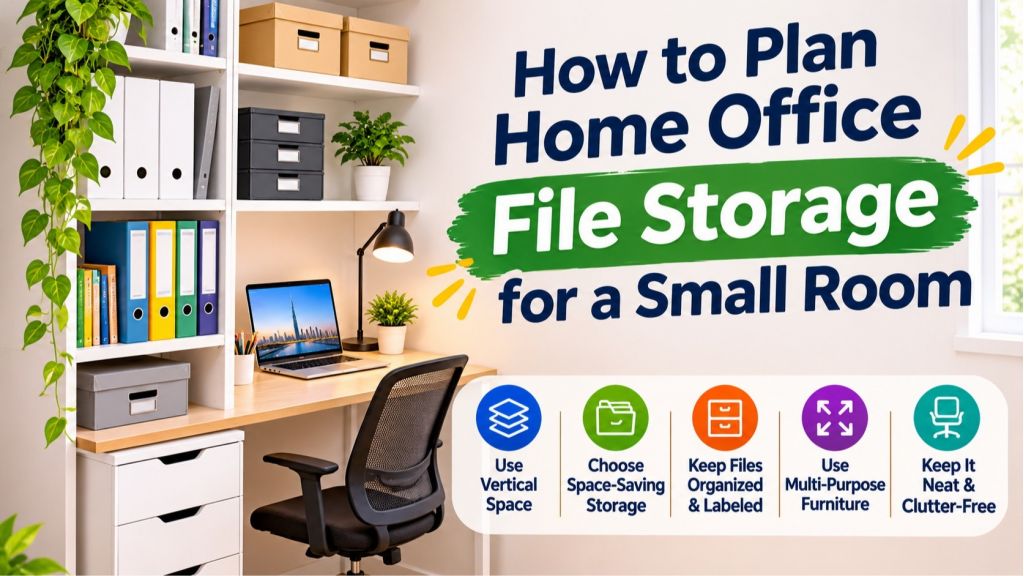
Good home office file storage starts with measuring your paperwork, not choosing a cabinet. In a small room, a unit can fit against the wall yet still block your chair, clash with a cupboard door or leave too little space to open its drawers.
The most useful setup keeps frequently used documents within reach, protects sensitive records and moves occasional paperwork away from the desk. Use the steps below to work out how much storage you need, which format suits your room and what to check before ordering in the UAE.
 Start with a paper audit
Gather the paperwork currently spread across drawers, bags and shelves. Separate documents you use regularly from records you rarely consult, then remove duplicates and material you no longer need.
Keep originals where required, particularly for legal, identity or contractual purposes. Scanning can reduce everyday paper handling, but a digital copy is not automatically an acceptable replacement for an original. Retention requirements also vary by document type and, for business records, the rules that apply to your work.
Group what remains into three practical categories: active work, reference documents and archives. This prevents valuable desk-side space from filling up with papers you might only need once a year.
Calculate capacity from the files you actually own
Stand your filled folders upright and measure their combined width without squeezing them together. Measure bulky binders and document boxes separately because they may need shelves rather than filing drawers.
Allow some empty capacity for new paperwork. For example, 40 cm of existing folders needs approximately 54 cm of usable filing space if you want about 25% of that space to remain free. Measure usable internal space, not the cabinet’s external width.
Planning home office file storage around this measured volume helps you avoid both an oversized cabinet and a smaller unit that becomes crowded immediately.
Measure the room with doors and drawers open
Record the available width, depth and height, including skirting boards, sockets, curtains and projecting window ledges. Check whether the unit would obstruct a door, wardrobe or existing cupboard.
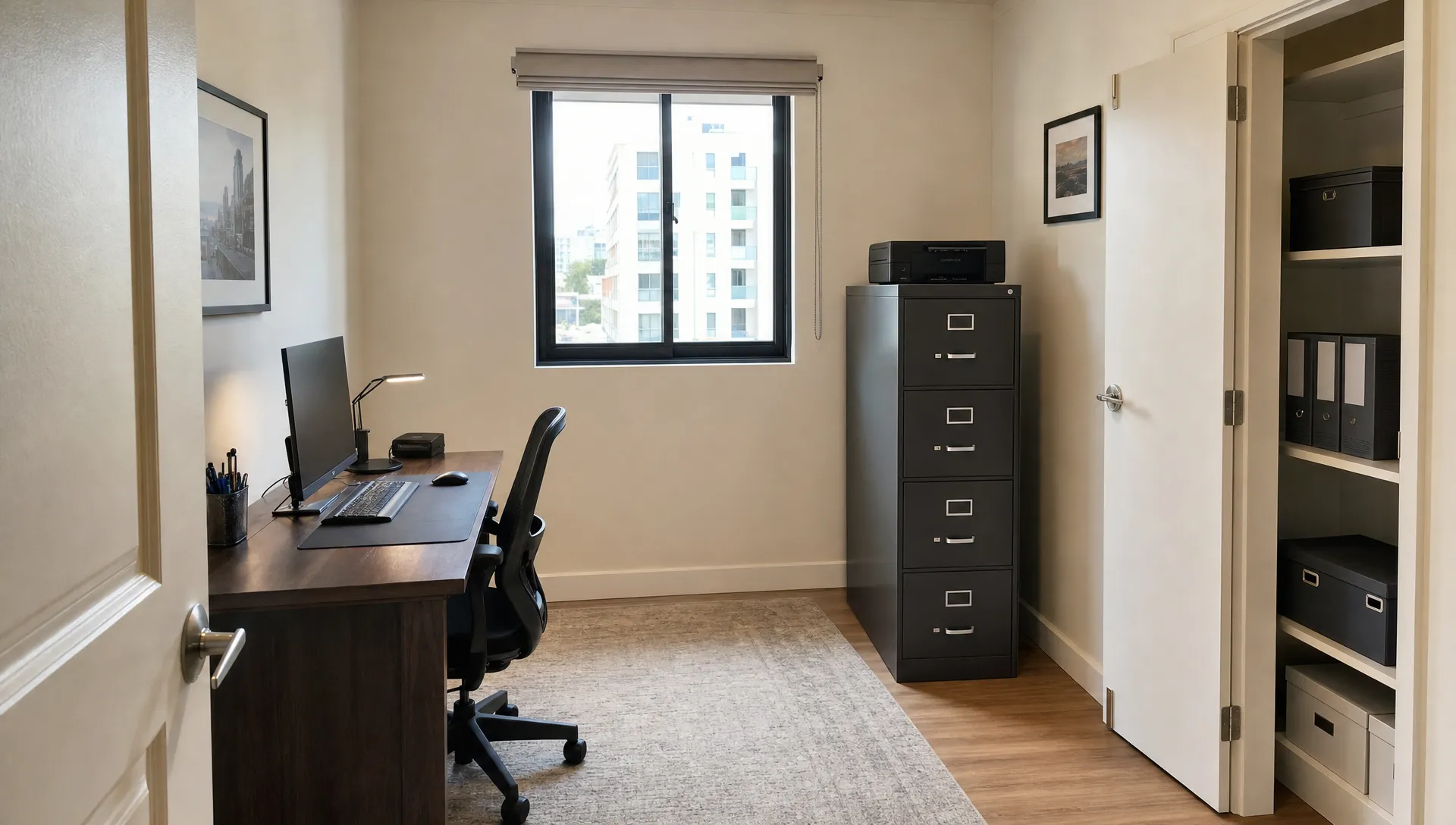
Next, measure the space needed to use it. A cabinet that is 45 cm deep with a drawer projecting another 35 cm occupies 80 cm from its back to the open drawer’s edge, before allowing room for the person using it. These are illustrative measurements, so check the actual product specifications.
If you are comparing a wooden office desk, assess its usable underside clearance alongside any proposed storage. Desktop width alone does not reveal whether legs, rails or built-in drawers will obstruct a pedestal.
In a shared reading room, include the occupied space around furniture such as a wooden easy chair, not just its footprint when empty. Files should remain accessible without making the room’s other functions awkward.
Before buying home office file storage, mark its outline on the floor with removable tape and simulate opening the drawers and moving your desk chair. This simple test often reveals problems that a room measurement misses.
Check paper sizes and folder compatibility
An "A4 cabinet” does not necessarily accommodate every folder containing A4 paper. Suspension folders, plastic wallets and lever-arch files extend beyond the sheets inside them.
| Format | Sheet dimensions | What to check before buying |
|---|---|---|
| A4 | 210 × 297 mm | Clearance for the folder or binder, not just the paper |
| US Letter | Approximately 216 × 279 mm | Whether the filing rails support the intended folder size |
| US Legal | Approximately 216 × 356 mm | Sufficient drawer depth and compatible suspension rails |
| Foolscap or F4-labelled products | Dimensions vary by format and supplier | The stated dimensions of both the paper and its folder |
For suspension files, confirm the supported folder format and rail arrangement. Some drawers have adjustable rails, while others support only a particular size or orientation. Do not assume adjustability from the product photograph.
For upright binders, check clear shelf height, usable depth and shelf load limits. An adjustable shelf is useful only if the available positions provide enough space for your tallest binder.
The safest way to choose home office file storage is to measure one filled example of every folder type you plan to keep. Include protruding tabs, handles and the space needed to lift the file out comfortably.
Choose home office file storage to suit the layout
Different storage formats solve different space problems. A narrow cabinet may preserve wall width, while a wider unit can make better use of an otherwise awkward space below a window.
| Storage type | Useful when | Main limitation to check |
|---|---|---|
| Vertical filing cabinet | Wall width is limited and you need dedicated filing drawers | Drawer extension and stability |
| Lateral filing cabinet | You have a wider wall and want files arranged across the unit | Overall width and clear access in front |
| Mobile pedestal | Documents need to stay beside or beneath the desk | Knee space, castor height and movement |
| Shelving with labelled boxes | Most documents are archives or binders | Shelf loading and protection from dust |
| Closed sideboard | The office shares space with a living or guest room | Internal dimensions and lack of dedicated filing rails |
A sideboard is worth considering when you want documents out of sight in a multipurpose room. However, treat it as general furniture unless its specifications explicitly confirm filing compatibility. Measure the shelves and use suitable folders or boxes rather than assuming it will accept suspension files.
Choose home office file storage according to how you retrieve documents, not simply how many drawers it has. Daily paperwork benefits from easy access; archive boxes can usually sit farther from the desk.
Compare materials for your indoor conditions
Material affects weight, maintenance and appearance, but it does not replace a well-built structure. Check joints, drawer operation, shelf supports and the quality of the finish as well as the material name.
Steel cabinets can offer durable, relatively slim construction. Their finish still matters: damaged coatings and persistent moisture can allow corrosion. Inspect corners, drawer edges and any signs of damage when the unit arrives.
Solid wood and wood-based furniture may blend more naturally into a bedroom or living area. Solid wood can move with changes in humidity, while MDF and particleboard are particularly vulnerable to water entering exposed edges or damaged surfaces.
In a UAE home, assess the actual storage location rather than assuming every room has the same conditions. Avoid direct sunlight, leaks and positions where condensation forms. Keep papers clear of damp floors and do not pack them tightly against a moisture-affected wall.
For home office file storage, a shaded, dry indoor position matters more than a broad claim that one material is always best for the local climate. Follow the manufacturer’s cleaning instructions and wipe up spills promptly.
Give everyday files and archives different places
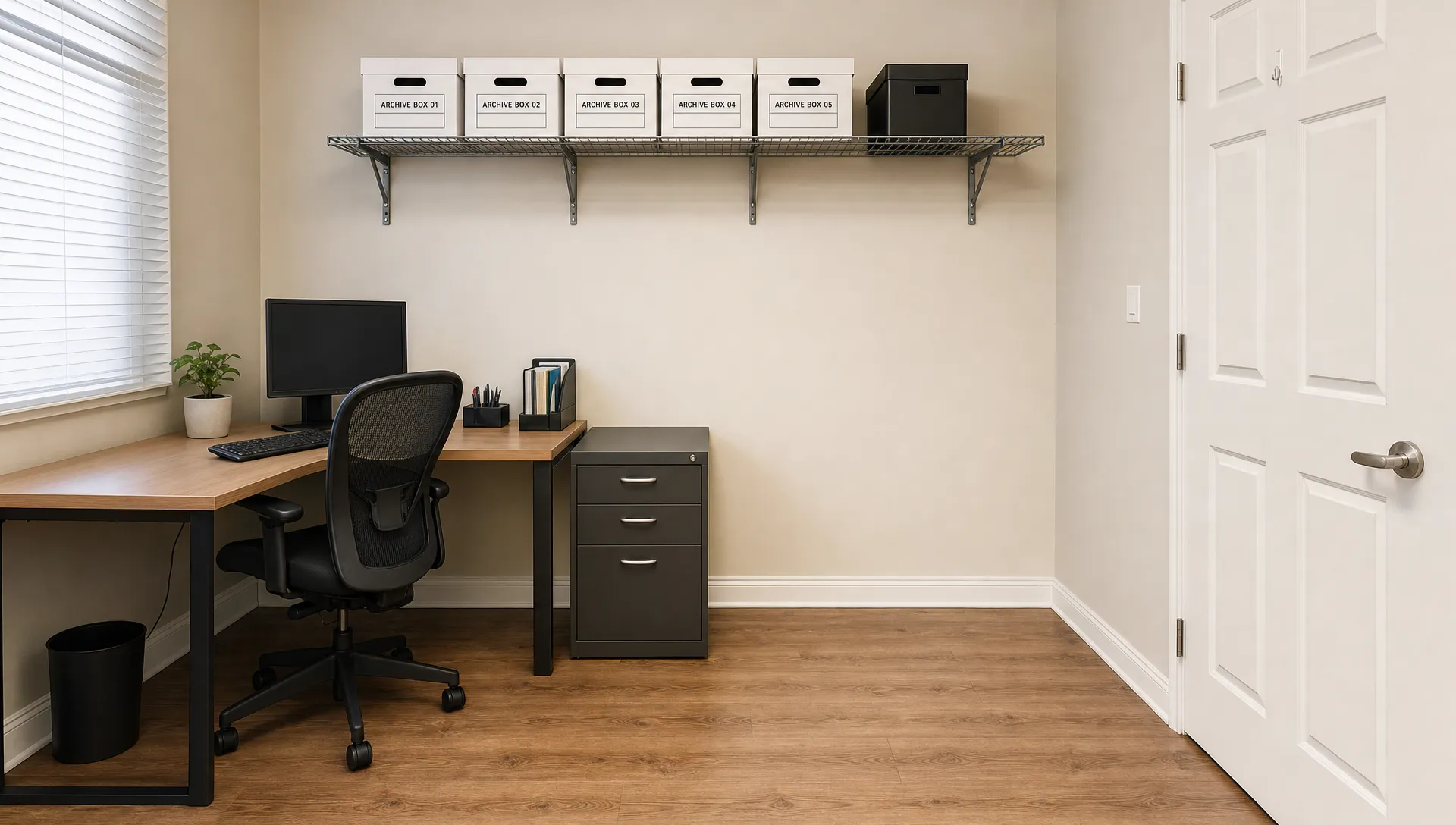
Use the easiest-to-reach position for current projects, bills awaiting action and documents you consult frequently. Keep reference material nearby, then place infrequently used records in labelled archive boxes on suitable shelving or inside a cupboard.
A small incoming tray can stop loose paper from spreading across the desktop. Give it a regular review time so it does not become another permanent pile. File documents by a system you can maintain, such as subject followed by year, rather than creating dozens of narrowly defined categories.
Labels should help retrieval without exposing sensitive information. "Household records” is more discreet on an open shelf than a label listing identity document numbers or financial details.
For digital copies, use consistent filenames, access controls and a backup separate from the device you work on. Check the scan is complete and readable before deciding whether the paper can be discarded.
Keep home office file storage manageable with a brief monthly review: clear the incoming tray, return misplaced folders and move completed work into the correct archive location.
Check document security and cabinet stability
A lock can discourage casual access, which is useful in a shared home. It does not automatically make a cabinet suitable for high-security records, nor does it establish fire or water resistance. Those protections require specific, verifiable product ratings.
Check whether the lock secures every drawer or only one compartment. Consider where spare keys will be kept and whether sensitive client paperwork needs stronger protection under your workplace’s policies.
Stability deserves equal attention, especially where children live or visit. The US Consumer Product Safety Commission’s Anchor It! campaign recommends anchoring furniture to help prevent tip-over injuries. Follow the furniture manufacturer’s installation instructions and use fixings appropriate to the wall, with qualified help where needed.
Store heavier contents lower down and avoid opening several loaded drawers at once. If a cabinet includes a drawer interlock, confirm how it operates rather than assuming one is fitted.
When selecting home office file storage on wheels, remember that castor brakes control movement but do not make the unit tip-proof. Check its load limits and stability, and never treat a drawer as a step or allow children to climb it.
Check the full purchase details before ordering in the UAE
Online photographs rarely show every clearance or installation requirement. If dimensions are incomplete, ask for the missing information before placing the order rather than estimating from the image.
Use this short purchase checklist:
- Dimensions and compatibility: Confirm external dimensions, usable internal space, folder sizes and drawer extension.
- Load limits: Check the permitted weight per shelf or drawer and any overall limit.
- Delivery access: Measure doorways, lifts and tight turns, then check whether delivery reaches your room or only a specified handover point.
- Assembly and fixing: Establish whether assembly, installation or wall anchoring is included, available separately or your responsibility.
- Returns and damage reporting: Check the applicable terms, packaging requirements and process for reporting missing parts or transit damage.
Compare the total delivered cost in AED, including any stated assembly or installation charges. A lower purchase price may not be the better option if the unit needs additional work before you can safely use it.
Before committing to home office file storage, save the specifications and delivery terms you relied on. On arrival, inspect the components, test the drawers and check the unit’s stability according to the assembly instructions before filling it.
Frequently asked questions
What is the best filing cabinet for a small home office? Choose the smallest unit that accommodates your measured paperwork, spare capacity and access requirements. A vertical cabinet can suit a narrow wall, while a mobile pedestal may work beside a desk if it leaves enough chair and leg space.
Can A4 documents go in a legal-size drawer? They may fit, but loose-paper capacity and suspension-folder compatibility are different things. Check whether the rails support your chosen folders or can be adjusted to the correct format.
Is a lockable cabinet necessary at home? It is useful for private documents in shared spaces. Match the level of protection to the contents, and do not assume a basic furniture lock provides burglary, fire or water protection.
How much spare filing capacity should I allow? Around 20% to 30% unused capacity is a practical planning allowance, not a fixed rule. Allow more if your paperwork is growing quickly, or reduce paper accumulation through regular reviews.
Can I use ordinary furniture instead of a filing cabinet? Yes, if its internal dimensions, shelf strength and access suit your folders or document boxes. Dedicated suspension filing needs compatible rails, which ordinary cupboards and sideboards may not include.
Shop with your measurements ready
Once your layout and folder sizes are settled, explore Sandhai’s UAE marketplace for furniture and stationery that suit your plan. Compare each listing’s current specifications and delivery terms. The right home office file storage should fit your paperwork, open comfortably and leave the rest of the room usable.

Comments