

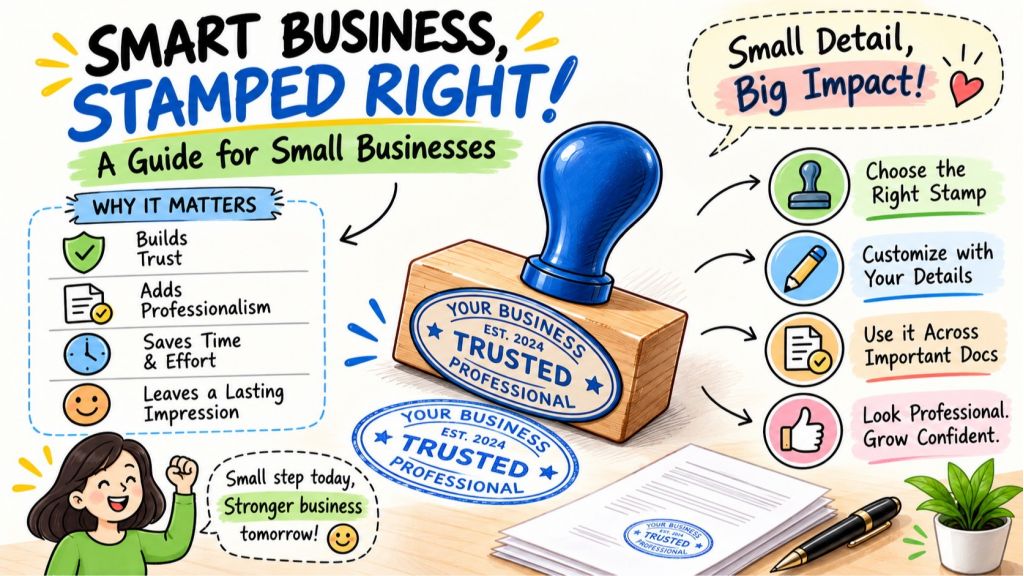
You've just received your trade license, opened a business bank account, and the first form the relationship manager slides across the desk has a box at the bottom that reads "Company Stamp." Nothing else moves until that box is filled. For thousands of small business owners across Dubai, Sharjah, and Abu Dhabi, this is the moment they realize a company stamp isn't optional. It's one of the first credibility tools your business needs, right alongside the license itself.
This guide covers everything you need to know: what a compliant UAE business stamp must legally contain, which stamp type suits your usage, price ranges starting from around AED 25, file formats your vendor will need, and the fastest ways to get one in hand. You'll also find a short section on the other office essentials that complete a professional small business setup once the stamp is sorted.
Why UAE businesses still need a company stamp
When banks and government offices expect one
Federal law doesn't require every UAE company to stamp every document, but that doesn't mean you can skip it. Banks are the most common friction point: many UAE bank forms still include a dedicated "Company Stamp" field, and specimen signature or account mandate forms often require one as part of the bank's internal process. Labor and residency paperwork, customs documents, government tenders, and tenancy agreements all regularly expect a stamped corporate document.
The Federal Tax Authority and various authority submission portals also commonly expect stamped declarations and uploaded forms. The administrative cost of not having a company chop (missed appointments, delayed submissions, returned paperwork) adds up fast. Getting one early removes that friction entirely.
Free zone rules and mainland practice
Certain free zones go further and make the corporate stamp an explicit requirement. DMCC mandates a company stamp for all licensed entities and specifies exactly what it must include: the company name in English exactly as it appears on the license, "DMCC BRANCH" if applicable, and "Dubai, UAE" as a minimum. On the UAE mainland, no single law universally requires a stamp, but the operational reality is that most companies obtain one because almost every administrative process assumes you have it.
What a compliant UAE company stamp must contain
Mandatory details your stamp can't leave out
A compliant UAE business stamp must show the company name exactly as it appears on the trade license, in both English and Arabic. The trade license number is widely required and should be treated as non-negotiable for any stamp you intend to use with banks, authorities, or free zone offices. The emirate and "UAE" are commonly included in free zone and authority templates; DMCC explicitly requires "Dubai, U.A.E.", so including these details on any stamp is strongly recommended.
Optional elements include your P.O. Box, phone number, and address. These add context but aren't mandatory. Keep the design clean: you're working with a small surface area, and fitting too much text into a 38 mm circle creates an unreadable result.
Standard shapes and sizes used across the UAE
Round stamps at 38 mm are the most common choice for official seals and the format most UAE institutions recognize as a standard company seal. Rectangular stamps are popular when there's more text to fit, with common sizes around 55 x 20 mm or 65 x 23 mm. There's no single legally mandated size, so the choice comes down to how much information you need to display clearly.
Square and oval formats are available from most stamp makers but are less common for formal company use. If your company name runs longer than 40 characters, some suppliers, including DMCC's own stamp service, will automatically produce a rectangular stamp to maintain legibility. When in doubt, go round and 38 mm: it's what most institutions expect to see.
Stamp types and what they cost in the UAE
Self-inking, rubber, and metal seal compared
Self-inking stamps are the most practical option for daily business use because they hold their own ink pad and produce clean, consistent impressions without a separate pad. Expect to pay AED 25 to AED 150 depending on size and brand, with standard options typically falling in the AED 80 to AED 120 range. Rubber stamps sit at the more affordable end, from around AED 20 to AED 120, and are still widely used for lighter-frequency stamping such as filing and internal records.
Metal embossing seals and wax seals are a step up in formality, starting around AED 290 to AED 360, and are typically reserved for notarized or premium corporate documents. For most small businesses handling daily banking forms, government paperwork, and HR documents, a quality self-inking stamp covers everything. A metal seal is worth considering later, once the core setup is in place.
Price ranges and when same-day service is worth it
Same-day or express production usually adds AED 50 to AED 200 to your order, depending on complexity and the supplier. If you have a bank appointment the next day or a government submission that can't wait, the express fee is easy to justify. Several UAE suppliers advertise aggressive turnaround times and quotes 2 to 4 hours, promise readiness within 6 hours, and Nejoom Stationery offers same-day processing with next-day delivery across all seven emirates.
For non-urgent orders, standard production with next-day collection or delivery is the more budget-friendly path. Most Dubai and Sharjah suppliers offer same-day pickup from their facility once proof is approved. For Abu Dhabi and other emirates, next-day delivery is commonly the fastest practical option, though some suppliers do advertise same-day delivery to Abu Dhabi; confirm directly with your chosen vendor before placing the order. Check your supplier's proof cut-off time (commonly mid-afternoon; some vendors specify 2:00 pm) and approve your proof before that deadline to maximize your chances of a next-day turnaround.
How to order: online generator vs. local stamp maker
File formats and design specs your vendor will need
Most UAE company stamp makers accept SVG and EPS as the preferred formats because they're scalable vector files that stay sharp at any size. PDF is the next best option for print-ready submissions. Many vendors also accept high-resolution PNG files with a transparent background, commonly 300 dpi or higher, though some suppliers require 600 dpi; a vector file is always the safer choice for physical production. Check your specific vendor's requirements before exporting.
If you're using an online generator, the tool typically handles the layout for you. You choose your shape, add ring text, input your address details and license number, upload a logo if you have one, and export a production-ready file. The output is usually SVG or high-resolution PNG, which any local stamp maker will accept. For logo submissions, always export in SVG or high-resolution PNG with a transparent background; JPG files with white backgrounds cause production problems.
Step-by-step: from trade license to stamp in hand
- Collect your trade license, exact company name in English and Arabic, and license number.
- Export your logo as SVG or high-resolution PNG with a transparent background.
- Choose shape and size based on your text volume.
- Submit your design details to your chosen supplier and select a turnaround time.
- Review and approve the digital proof before production begins.
- Collect from the facility (Dubai/Sharjah, same day) or wait for delivery (Abu Dhabi; confirm timeline with your vendor).
Never skip the proof review step. A wrong license number or a misspelled Arabic name on the stamp means starting the order again and paying for the mistake twice.
Beyond the stamp: other office essentials UAE small businesses overlook
Custom stamps and stationery that save time daily
A company stamp is just the start. Signature stamps, date stamps, and "received" or "paid" stamps handle repetitive paperwork far faster than manual signing or writing. Quality office stationery, including branded letterheads, envelopes, and notebooks, makes every client-facing interaction look more professional. These aren't luxury items; they're the everyday tools that signal your business operates with intention.
The businesses that look most professional to clients and partners aren't necessarily bigger; they're just better equipped. A consistent, stamped document set tells the other party you run a structured operation, which matters at every stage from signing vendor agreements to renewing your lease.
Acrylic display stands, suggestion boxes, and reception-area essentials
Acrylic display stands are practical for any business with a physical presence or reception area: they hold brochures, pricing cards, and product information at eye level without cluttering the desk. Suggestion boxes are useful for offices with staff or customer-facing retail setups, giving people a structured way to share feedback. These small items are easy to overlook when setting up a business, but they contribute directly to how professional your space feels to both clients and team members.
Ballot boxes, desk organizers, and display trays also fall into this category. They're functional, inexpensive, and make a visible difference in how a workspace is perceived. Getting them right the first time is faster than piecing together a setup later.
Where to source all of it without leaving home
Sourcing a business stamp, stationery, acrylic stands, and suggestion boxes from separate suppliers takes time that most small business owners don't have. Sandhai.ae brings these office essentials together in one place, with cash on delivery available as a payment option, particularly convenient for small business owners managing cash flow. Sandhai delivers across Dubai, Sharjah, and Abu Dhabi, making it a practical choice for UAE-based businesses that need to set up quickly without visiting multiple stores or chasing down separate orders.
Getting your company stamp right from the start
A company stamp is practically essential for any UAE business operating with banks, free zone authorities, or government offices. The core requirements are straightforward: company name in English and Arabic exactly as it appears on the trade license, the license number, and the emirate. Pick the right stamp type for your usage frequency, get your file specs right before you order, and use same-day suppliers when timing is tight.
Once the company stamp is sorted, filling out the rest of your office setup with the right stationery, display tools, and functional accessories makes daily operations noticeably smoother. Getting the fundamentals in order from day one means fewer interruptions, fewer reorders, and fewer apologies to the bank manager. Start with the stamp, then build from there.
Frequently asked questions about company stamps in the UAE
Do I legally need a company stamp in the UAE?
There is no single federal law that universally mandates a company stamp for all UAE businesses. However, many banks, free zones, and government portals expect stamped documents as a standard part of their processes. DMCC, for example, explicitly requires a stamp for all licensed entities. In practice, operating without one creates friction across banking, HR, and authority submissions, which makes obtaining a stamp early a sound decision for almost any business.
How fast can I get a company stamp in Dubai?
Several Dubai-based suppliers offer same-day production and same-day or next-day collection. Stampman quotes 2 to 4 hours; THREEYEM promises readiness within 6 hours. To meet a same-day turnaround, approve your digital proof before the supplier's cut-off time, which is commonly mid-afternoon. Confirm the exact deadline with your chosen vendor when placing the order.
What should a UAE company stamp include?
At minimum: your company name in English and Arabic exactly as it appears on your trade license, your trade license number, and the emirate. Free zone entities should also include "UAE." Optional additions include your P.O. Box, phone number, and address.
What size stamp is standard in the UAE?
A round stamp at 38 mm diameter is the most widely recognized format for official use. Rectangular stamps (commonly 55 x 20 mm or 65 x 23 mm) work better when the company name is long or there is more text to accommodate.

Comments