

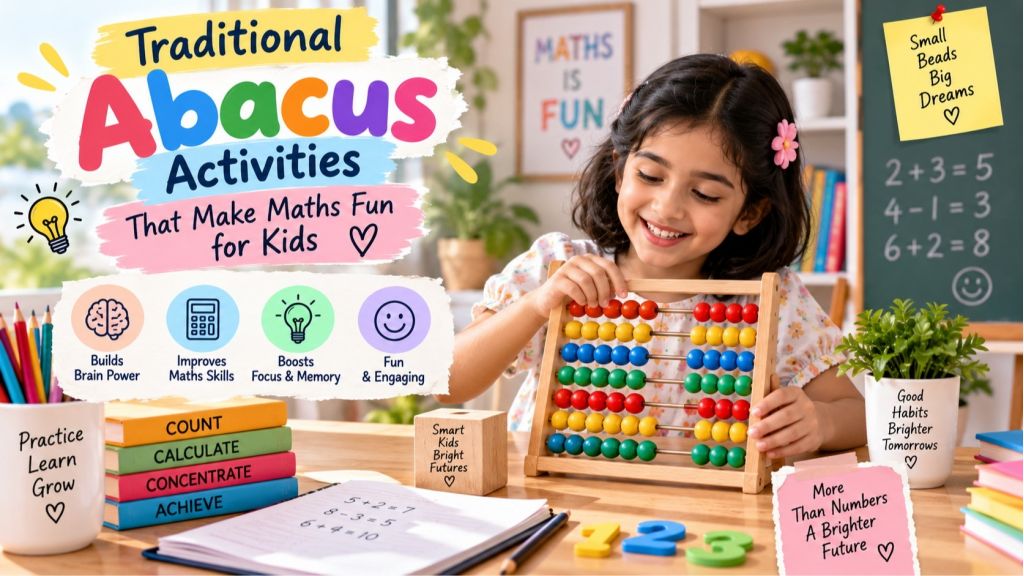
Children learn numbers more confidently when maths feels like play, not pressure. A traditional abacus gives them something simple and satisfying to move, count, group, and compare. Instead of staring at a worksheet, children can slide beads, hear numbers spoken aloud and see how quantities change in front of them.
For parents shopping for educational toys in the UAE, this makes the abacus a smart choice for home learning. It is compact, screen-free and flexible enough for nursery children practising counting as well as early primary learners working on addition, subtraction and place value.
 Why a traditional abacus still works for modern maths learning
A traditional abacus is a concrete maths tool. That means it helps children build understanding through physical objects before moving to mental calculations or written sums. This matters because many children can recite numbers before they truly understand what those numbers represent.
The Education Endowment Foundation recommends using manipulatives and visual representations to support early maths, especially when teachers and parents connect the objects clearly to mathematical ideas. In everyday language, children need to touch, move and describe numbers before abstract symbols make complete sense.
The abacus is especially useful because it shows quantity, sequence and grouping in one place. A child can see that seven is more than five, that ten can be split into six and four and that two rows of ten beads can stand for twenty. Those small discoveries build the base for faster mental arithmetic later.
It also supports fine motor control, patience and concentration. Sliding beads one by one encourages children to slow down, check their work and connect movement with meaning.
Set up the abacus before you start
A traditional abacus works best when the rules are consistent. Choose one side as the starting side and one side as the counting side. Before each activity, reset every bead to the starting side. When your child counts, they slide beads across in the same direction every time.
Start with one row only. If the abacus has multiple rows, cover the lower rows with a piece of paper or simply say, "Today we are only using the top row.” Once your child is comfortable, add a second row for making ten, then later use rows for tens and ones.
Keep sessions short. Five to ten minutes is often enough for preschoolers and younger primary children. The goal is not to finish a long lesson. The goal is to make numbers feel clear, calm and enjoyable.
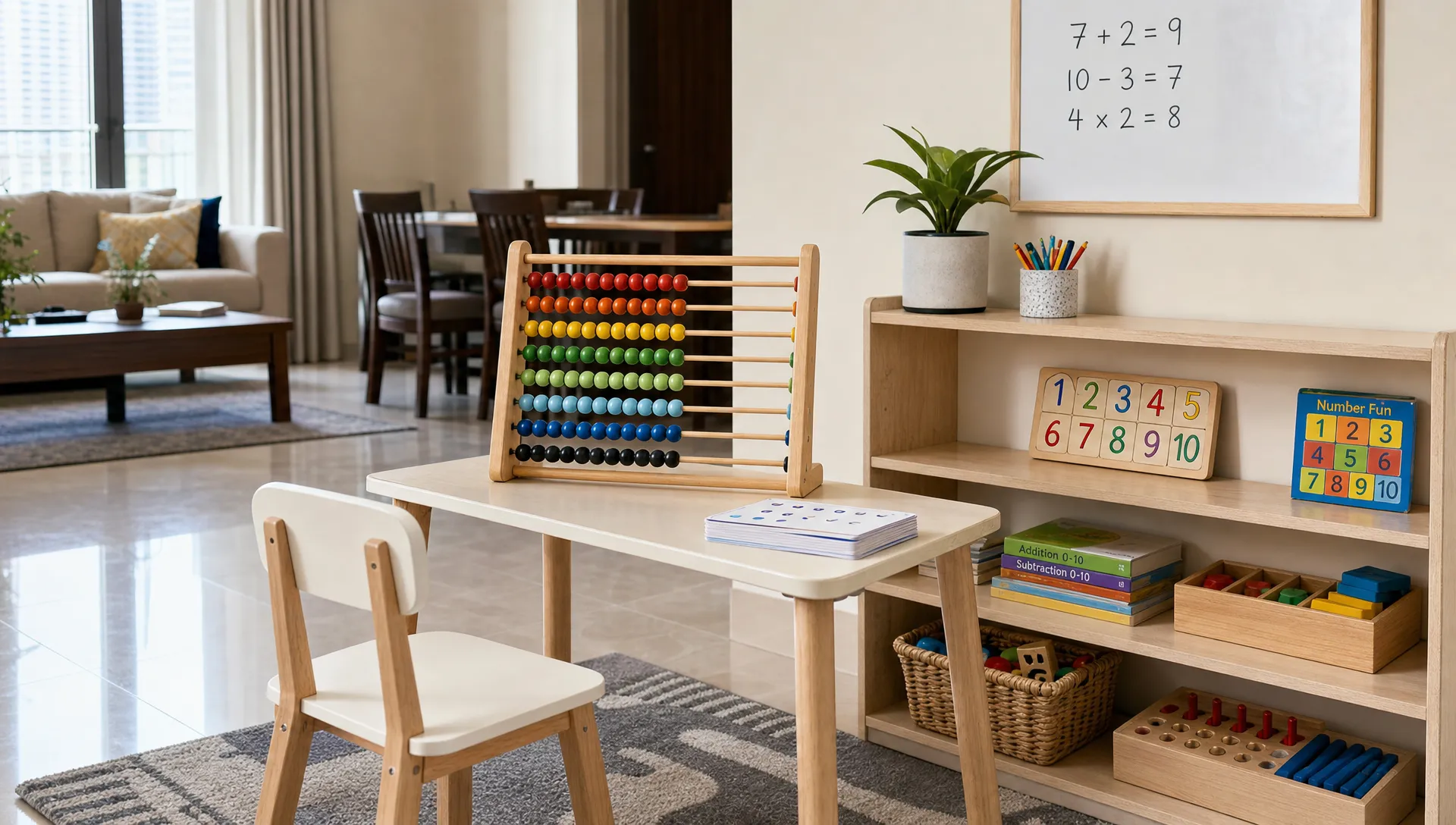
You can also build a small maths corner at home. Pairing the abacus with tactile toys helps children switch between counting, sorting and building. For example, children can create towers with Bigjigs Rainbow Wooden Building Blocks, then show the same number of beads on the abacus. For younger learners, a Shape Matching Board can support sorting and pattern talk before you move into number games.
| Age range | Best starting focus | Simple goal |
|---|---|---|
| 3 to 4 years | Counting beads one by one | Recognise quantities up to 5 or 10 |
| 5 to 6 years | Making pairs and number bonds | Understand that numbers can be split and joined |
| 7 to 8 years | Tens, ones and quick sums | Build confidence with place value and mental maths |
Traditional abacus activities kids actually enjoy
The best activities feel like games. You can repeat these often, changing the numbers as your child grows more confident.
1. Count and slide warm-up
Ask your child to slide one bead at a time while saying each number aloud. Stop at five first, then ten. Once they can count forward, reset the row and count backwards while sliding beads back to the starting side.
This simple activity builds one-to-one correspondence, which means one spoken number matches one object. That skill is more important than speed. If your child skips a number or slides two beads at once, slow the game down and count together.
2. Show me the number
Call out a number and ask your child to show it on the abacus. Start with numbers up to five, then ten, then beyond ten if they are ready. Swap roles and let your child call out numbers for you to make.
Children love catching adult mistakes, so make one deliberately from time to time. If they say, "No, that is six, not seven,” they are checking quantity rather than just guessing.
3. Make ten challenge
Slide a few beads across and ask, "How many more do we need to make ten?” If four beads are across, your child slides six more. Then say the full number bond aloud: "Four and six make ten.”
Number bonds to ten are a key building block for addition and subtraction. A traditional abacus makes them visible because the child can see the filled row and the empty space before the row is complete.
4. Shopkeeper sums
Pretend the beads are items in a small UAE grocery shop. You might say, "I bought three mangoes and two bananas. How many fruits did I buy?” Your child slides three beads, then two more, then counts the total.
Change the story to match your child’s world: dates, apples, pencils, toy cars or sweets for a family gathering. Real-life language helps children understand why addition matters.
5. Secret number detective
Make a number on the abacus and cover it with your hand for three seconds. Then reveal it and ask your child to say the number without counting every bead one by one. This supports subitising, which is the ability to recognise small quantities quickly.
For beginners, use numbers up to five. For older children, arrange beads in groups such as five and two so they learn to see seven as a structured quantity, not just a long line of beads.
6. Place value parking
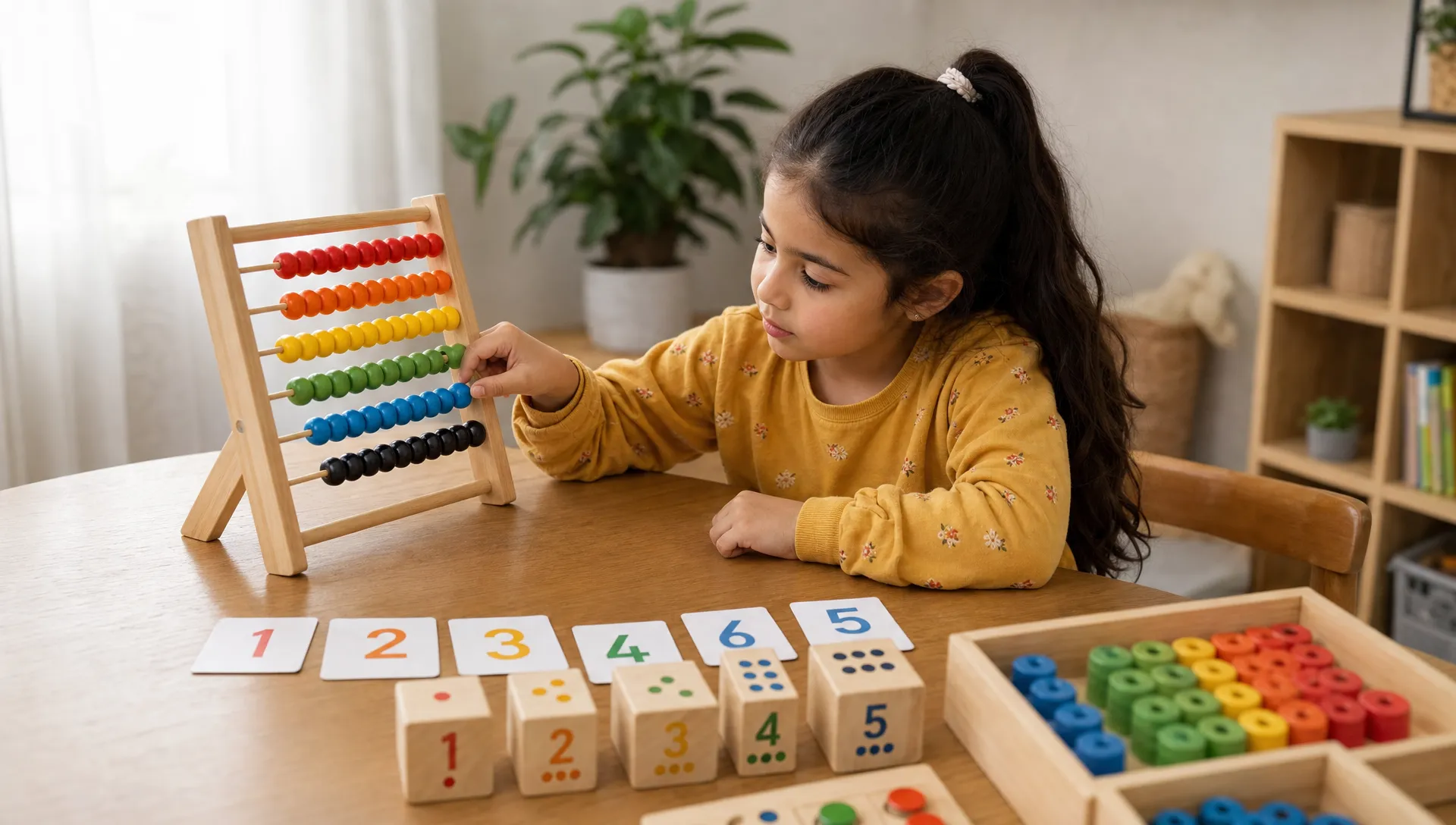
Use the top row for tens and the row below it for ones. Say a number such as 24. Your child slides two beads on the tens row and four beads on the ones row. Explain that the two tens mean twenty and the four ones mean four more.
Do not rush into big numbers. Try 11, 12, 15, 20, 21 and 25 first. Children often confuse the order of digits, so the physical rows help them see why 24 and 42 are not the same.
7. Odd and even bead paths
Slide beads in pairs and ask your child what happens when a number has no bead left alone. Two, four, six and eight can be made from pairs, so they are even. Three, five, seven and nine always have one bead without a partner, so they are odd.
You can turn this into a quick sorting game. Call out a number and let your child decide whether it belongs in the odd or even group after making it on the abacus.
8. Skip-counting rhythm game
Use the abacus to count in twos, fives or tens. Slide beads in groups and clap after each group. For counting in twos, slide two beads and say "two,” slide two more and say "four,” then continue.
Rhythm helps children remember number sequences without turning the activity into memorisation only. Once they are confident, ask them to predict the next number before they slide the next group.
9. Board game maths breaks
Board games are a natural way to practise counting, turn-taking and simple addition. After every turn, ask your child to show their dice roll on the abacus before moving their counter. A classic like Traditional Snakes & Ladders works well because children count spaces, compare positions and experience numbers as part of play.
Keep the maths light. If your child is focused on winning, ask only one abacus question per round. The aim is to connect numbers to fun, not interrupt the game too often.
10. Number and letter label hunt
For children who are learning both early literacy and numeracy, make simple labels with numbers and words. Write "three,” "five” or "ten” on paper, then ask your child to make that quantity on the abacus.
If your child enjoys alphabet play, follow the maths session with the abc Puzzle (lowercase)) so they can switch from number symbols to letter shapes. This keeps learning varied and prevents one skill from feeling like a long drill.
Make each activity easier or harder
The same activity can work for different ages if you adjust the numbers, language and speed.
For younger children, use small numbers and lots of storytelling. Instead of asking, "What is 4 plus 3?” say, "Four birds sat on a wall and three more came. How many birds are there now?” Let them move the beads slowly and count aloud.
For older children, ask them to predict before sliding the beads. If the sum is 8 plus 5, they might say, "I know 8 needs 2 to make 10, then 3 more makes 13.” The abacus then becomes a way to prove the strategy.
For children who find maths stressful, remove timed challenges. Speed can come later. Accuracy, confidence and willingness to try are more valuable at the start.
Common mistakes to avoid
Parents do not need to teach like a school teacher for abacus activities to work. A few simple habits make the experience smoother.
- Changing the bead direction every time can confuse children, so keep the starting side and counting side the same.
- Moving too quickly into written sums can make the abacus feel like extra work rather than a helpful tool.
- Correcting every mistake immediately can reduce confidence, so ask your child to check the beads first.
- Using numbers that are too large too soon can hide the main concept, especially with place value.
A good rule is to stop while your child is still interested. Ending after one successful game makes it more likely they will want to use the traditional abacus again tomorrow.
Frequently Asked Questions
What age is best for a traditional abacus? Many children can start simple bead counting from around age 3, with adult guidance. Addition, subtraction and place value activities usually suit children from around 5 years and older, depending on readiness.
Can an abacus help if my child dislikes maths worksheets? Yes. The abacus changes maths from a flat page into a hands-on activity. It can reduce pressure because children can move, test and correct their thinking before writing an answer.
How long should kids practise each day? Short sessions work best. Five to ten minutes of focused play with a traditional abacus is usually more effective than a long session that becomes tiring.
Should children count every bead or learn faster strategies? Start with counting every bead, then gently introduce grouping. Over time, children can see five and three as eight, or ten and four as fourteen, without counting from one each time.
Is the abacus only for addition and subtraction? No. It can also support skip counting, number bonds, odd and even numbers, place value, pattern recognition and early mental arithmetic.
Build a playful maths corner at home
A traditional abacus is most powerful when it becomes part of everyday play. Keep it near blocks, puzzles, board games and storybooks so your child sees numbers as something useful and familiar.
If you are creating a learning shelf for your child, explore educational toys, home essentials and family-friendly shopping options on Sandhai.ae. With a few well-chosen tools and simple daily games, maths can become a subject your child feels ready to enjoy.

Comments