

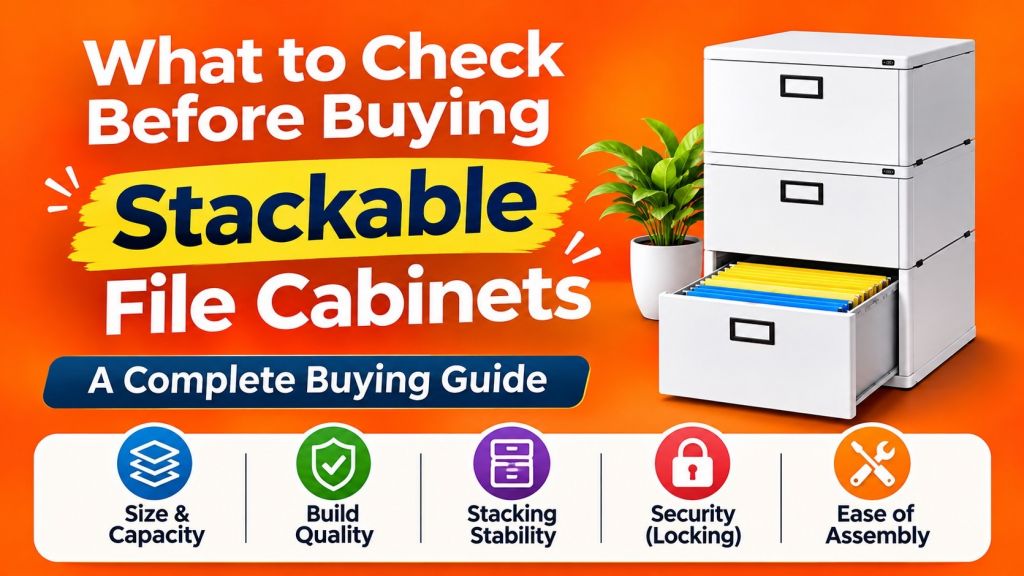
Buying stackable file cabinets can save floor space, but only if the units are designed to work together. Matching dimensions or a flat top do not prove that one cabinet can safely support another. Before ordering, check the manufacturer’s stacking instructions, usable drawer dimensions, load limits and installation requirements.
For UAE online shoppers, delivery details matter too. A compact-looking cabinet may arrive assembled, require separate connecting hardware or carry return conditions that make a sizing mistake expensive. This checklist helps you compare the specifications that matter before paying.
 Decide whether you need a cabinet or a desk organiser
Start with what you need to store. Hanging folders, bulky box files and loose correspondence require different storage arrangements. Closed drawers are useful for keeping paperwork out of sight, while frequently handled documents may be easier to manage in open trays.
For incoming and outgoing paperwork, a two-tier mesh organiser may be sufficient. If you separate documents into incoming, action and completed stages, a three-tier mesh tray provides another sorting level without requiring a floor-standing cabinet.
Choose a cabinet when you need greater enclosed capacity, compatible hanging-file storage or restricted access. Do not treat desktop trays, archive boxes and drawer cabinets as interchangeable simply because a listing calls them "file organisers”.
Confirm that stackable file cabinets are designed to stack
Look for explicit manufacturer approval for the exact model and configuration. Product photographs showing two units together are not enough. Neither are descriptions such as "modular”, "space-saving” or "flat-top”.
The instructions should identify compatible units, the maximum permitted stack height and the required connection method. Depending on the design, this might involve interlocking features, brackets or a dedicated base. Confirm whether those components are supplied or sold separately.
Ask whether different drawer sizes or cabinet widths can be combined. Units from the same brand may still belong to incompatible systems. Also check whether the approved arrangement changes when castors, feet or a plinth are fitted.
If the seller cannot provide instructions or written confirmation of the stacking limits, choose another model or use the units separately. There is no universal safe number of cabinets to stack.
Measure the files, not just the cabinet
Check usable drawer space and folder compatibility
External dimensions tell you whether a unit fits the room. Internal dimensions tell you whether it can hold your documents. When comparing stackable file cabinets, ask for usable drawer width, depth and height rather than relying on the overall cabinet measurements.
These common paper sizes provide a starting point:
| Paper format | Sheet dimensions | What to verify |
|---|---|---|
| A4 | 210 × 297 mm | Clearance for folders, tabs and any hanging-file frame |
| US Letter | 215.9 × 279.4 mm | Explicit Letter-size compatibility, especially for hanging files |
| US Legal | 215.9 × 355.6 mm | Adequate depth or a supported alternative filing orientation |
| Foolscap folders | Dimensions vary by product | The dimensions of your actual folders and their suspension fittings |
Paper fit does not guarantee folder fit. Hanging files need compatible rails, and their hooks extend beyond the paper itself. Ask whether rails are included and whether files run front-to-back or side-to-side.
A rigid closed box file also needs more clearance than loose sheets. Measure its closed dimensions, including the spine and fittings. For accessible upright storage, a MAXI magazine file is another format to compare, rather than assuming every binder needs a drawer.
Allow room to open drawers and reach the top
Measure the intended location with drawers fully extended, not just closed. Include handles, wall skirting, nearby doors and the space needed to stand comfortably while retrieving documents.
Check the combined installed height, including the base and any connecting components. The highest drawer should be usable without standing on a chair or pulling down on its handle for support.
If the cabinet will sit beneath a desk, account for the desktop supports and legroom. For a recessed location, confirm that you can still access installation points and remove drawers for maintenance if the instructions require it.
Separate drawer capacity from stacking capacity
A drawer’s stated load capacity is not the same as the weight a lower cabinet can support. For stackable file cabinets, you need the relevant limits for individual drawers, each unit and the complete assembled stack.
Ask whether the published stacking limit includes the weight of stored contents. A statement that a cabinet supports another empty unit does not establish that it supports a fully loaded one. Likewise, a top-surface load rating does not automatically authorise stacking.
Paper becomes heavy as files accumulate. Plan around the documents you expect to keep, including folders and binders, rather than how light the drawer feels when empty. Leave enough room to retrieve files without forcing them into place.
Keep heavier contents lower down, following the manufacturer’s loading instructions. Do not exceed a rating because a drawer still closes or because the cabinet appears sturdy. Visible strength is not a substitute for a documented load limit.
Check stability, connections and anti-tip protection
Opening a loaded drawer shifts weight forward. Stacking adds height, so stability deserves more attention than a quick push against an empty display unit.
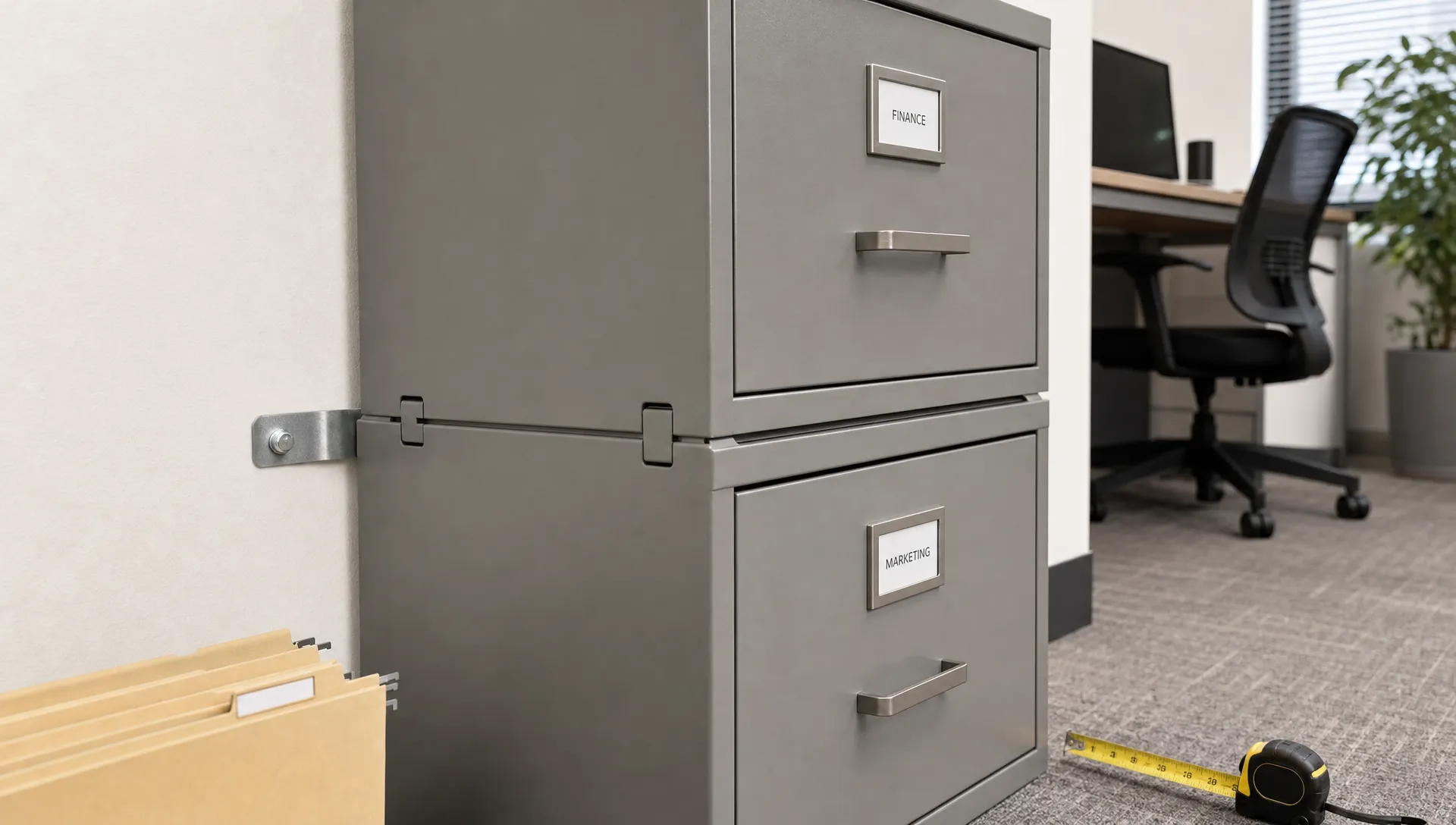
Safe use of stackable file cabinets depends on the complete installation: the approved base, correct connectors, suitable loading and any required wall restraint. Brackets joining two units together do not necessarily prevent the entire stack from tipping.
Look for an anti-tip drawer interlock where offered. This mechanism limits simultaneous drawer opening, but it does not replace anchoring when anchoring is required. Unless the instructions specify otherwise, open only one drawer at a time and never let children climb on handles or drawers.
The US Consumer Product Safety Commission’s Anchor It! guidance explains why securing furniture matters, particularly in homes with children. Follow the cabinet manufacturer’s instructions and use fixings appropriate for the wall material. If you are unsure, arrange qualified installation and confirm any permissions needed in rented premises.
Castors require a separate check. Locking wheels do not automatically make a tall stack safe. Use a mobile configuration only when explicitly approved, and follow instructions for unloading or dismantling before relocation.
Compare materials, drawer runners and finish
Steel, plastic and wood-based panels can all suit document storage, but the material name alone says little about performance. Construction, reinforcement and the manufacturer’s load ratings are more useful comparison points.
For steel units, inspect panel rigidity, edge finishing and coating quality. With plastic units, check the stacking connections and whether the instructions limit loading or placement near heat. For wood-based panels, examine edge sealing, joints and any signs of swelling or damage.
Drawer movement matters during everyday use. Ask how far the drawer extends and whether rear files remain accessible. Check for drawer stops, replaceable runners and handles that are securely attached.
Placement affects durability too. Avoid locations exposed to water, persistent condensation or direct heat unless the product is specifically suitable for those conditions. In a UAE home office, an indoor, dry location is a better starting point than assuming an enclosed balcony offers equivalent protection.
Understand what the lock actually protects
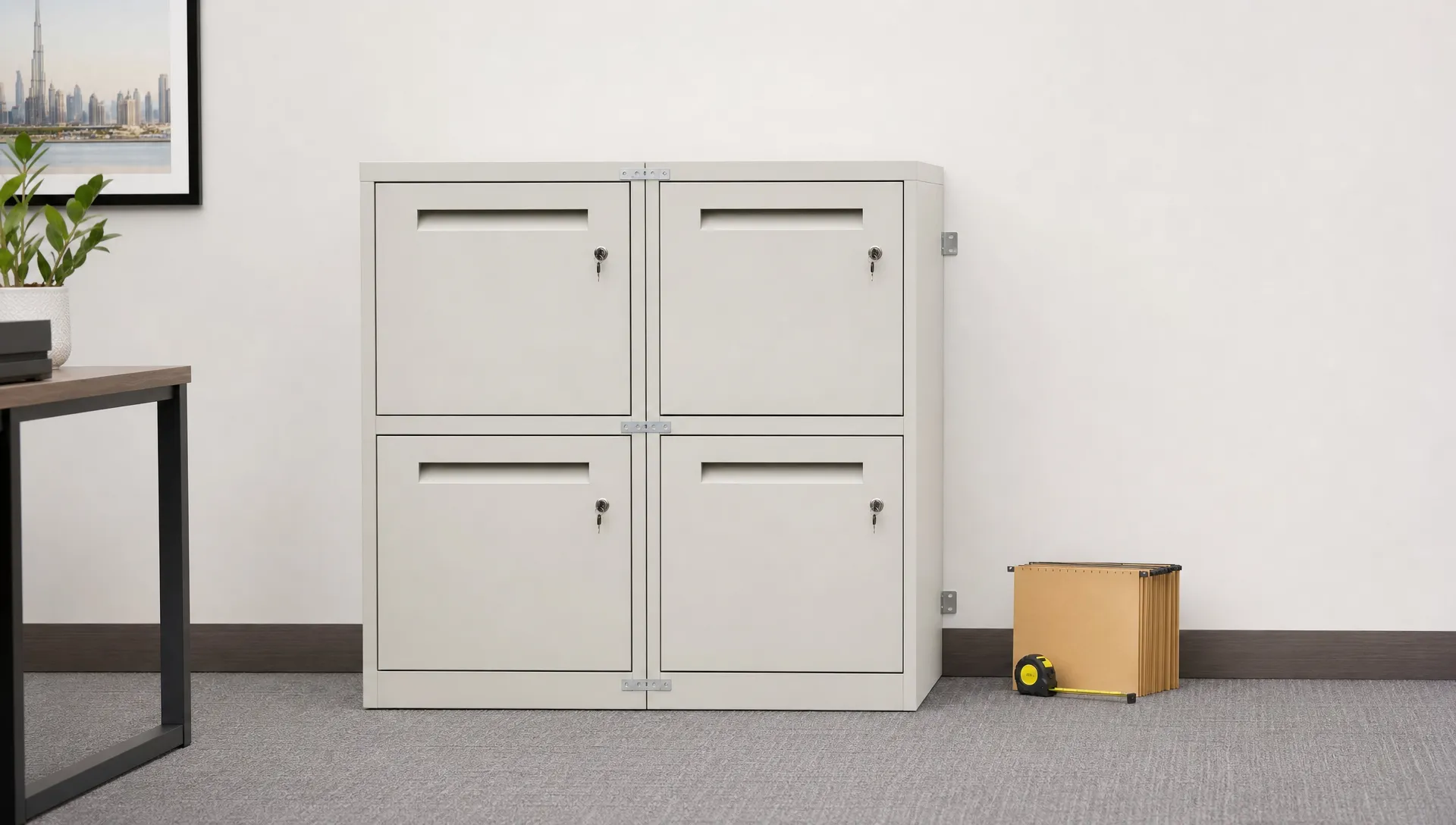
A lock on stackable file cabinets can discourage casual access, but it does not make them safes. Check whether the lock secures every drawer, one drawer or only an outer door. Separate modules may require separate keys.
Ask how many keys are supplied and whether replacements are available. For shared offices, decide who will hold spare keys and whether different users need separate access. A cabinet that everyone can unlock may not suit confidential personnel records.
Lockable, fire-resistant and water-resistant are different claims. If protection against fire or water is essential, request a relevant independent test rating and read its scope. Ordinary metal construction is not proof of fire protection.
For business documents, also check your organisation’s storage and retention requirements. The cabinet should support those procedures rather than being treated as a complete information-security solution.
Compare the full UAE purchase and delivery terms
Before ordering stackable file cabinets online, compare the installed cost rather than just the displayed unit price. Two offers are not equivalent if one includes the necessary base and connectors while the other does not.
| Purchase detail | What to confirm before payment |
|---|---|
| Complete configuration | Number of units, base, connectors, rails, feet or approved castors |
| Total price | VAT treatment, delivery charges and any assembly or installation fees |
| Delivery access | Coverage for your address, lift access, stairs and delivery to the intended room |
| Assembly | Whether the order arrives assembled, flat-packed or requiring specialist installation |
| Warranty | Duration, covered components, exclusions and the party handling claims |
| Returns | Deadlines, packaging requirements, collection fees and conditions after assembly |
| Damage reporting | Inspection process, reporting deadline and required photographs |
For apartments and offices, measure lift doors, corridors and entryways. Confirm any building delivery slots or service-lift requirements before arranging arrival.
When the order arrives, check the model numbers, supplied hardware, panels and drawer operation before loading documents. Photograph damage and retain packaging until you have checked the applicable return conditions. Do not assemble or load a visibly damaged unit without obtaining guidance from the seller.
Send the seller one clear specification request
If a listing is incomplete, request the missing details together. This is more useful than asking only whether the cabinet is "strong” or "good for office use”.
Ask the seller to confirm:
- The manufacturer-approved stacking arrangement and maximum height.
- Usable drawer dimensions and supported hanging-file formats.
- Per-drawer, per-unit and complete-stack load limits.
- Required connectors, base and anti-tip installation method.
- The complete delivered price, assembly arrangements, warranty and return conditions.
Keep the reply with your order confirmation. If an essential answer remains unclear, do not assume the most favourable interpretation. A documented specification makes it easier to compare products and identify a mismatch when the order arrives.
Frequently asked questions
Can any filing cabinet be stacked? No. Only stack units explicitly designed and approved for that configuration. A flat top, matching footprint or sturdy appearance does not establish that stacking is safe.
How many stackable file cabinets can I put together? Follow the limit for the exact model, base and installation arrangement. There is no universal maximum, and adding wall restraints does not authorise a taller stack than the manufacturer permits.
Will an A4 drawer also hold Legal-size documents? Not necessarily. Legal paper is longer, and folder hardware requires additional clearance. Check usable dimensions, filing orientation and explicit compatibility rather than relying on the drawer label.
Can I put stacked cabinets on wheels? Only if the manufacturer approves that complete mobile arrangement. Castor load ratings and wheel locks alone do not establish that a stacked cabinet is stable.
Should I choose a central lock or separate locks? A central lock may simplify access, while separate locks can help divide storage between users. Confirm exactly which drawers each lock secures and how replacement keys are obtained.
Buy against a checklist, not a product photograph
Choose a cabinet only after confirming file fit, approved stacking, safe installation and the complete purchase terms. Missing specifications are a reason to ask questions before ordering, not after delivery.
As you compare office storage and everyday essentials on Sandhai, distinguish desktop organisers from cabinets designed for stacking. Check each listing’s specifications, availability and seller terms against the storage arrangement you actually need.

Comments