

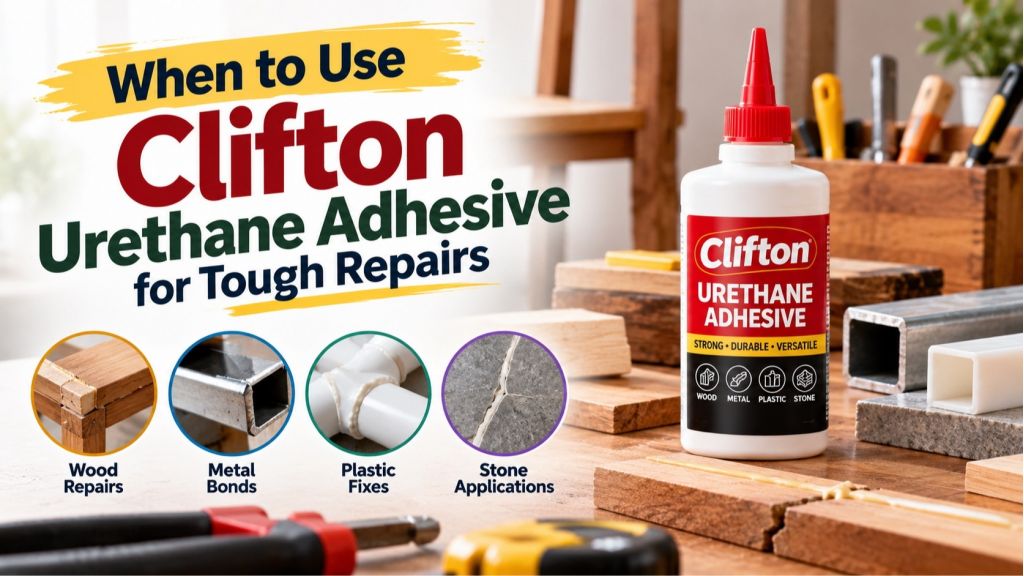
A tough repair needs more than a glue labelled "strong”. It needs an adhesive that suits the material, stays bonded under the expected movement and can tolerate the conditions the repaired item will face. For certain flexible, coated-fabric repairs, Clifton urethane adhesive is a suitable option. It is not, however, a universal fix for every plastic, rubber surface or damaged household item.
Before buying, identify the material and check the instructions for the exact adhesive formulation. That small step can prevent a patch from peeling away or an unsuitable solvent from damaging the surface.
When Clifton urethane adhesive suits a tough repair
Clifton LA 4123 is a solvent-based adhesive used for compatible urethane- and PVC-coated fabrics, including certain inflatable repairs. Its suitability depends on the coating, patch material and application instructions, not simply whether an item looks like plastic.
The most promising repair is usually a small, accessible area where a compatible patch can overlap sound material. Separating structural seams, badly degraded fabric and damaged valve attachments need a different assessment.
| Repair situation | Is it a suitable starting point? | What to check first |
|---|---|---|
| Small puncture in compatible urethane-coated fabric | Potentially | Item manufacturer's repair guidance and patch compatibility |
| Tear in PVC-coated inflatable fabric | Potentially | Approval for the exact coating and adhesive formulation |
| CSM or Hypalon-coated fabric | Do not assume compatibility | Whether a different adhesive system is specified |
| Paper, card or a school craft project | Usually unnecessary | A suitable white craft glue |
| Structural seam or valve failure | Not a routine DIY patch | Manufacturer advice or professional repair |
Identify the coating, not just the underlying fabric
An inflatable may contain a woven textile beneath a waterproof coating. The adhesive contacts that coating, so knowing only that the underlying fabric is polyester or nylon is not enough.
Use clifton urethane adhesive only when the current product instructions and the item's repair guidance support the materials involved. "Vinyl”, "rubber” and "synthetic fabric” are often used loosely in product descriptions and do not establish compatibility.
Likewise, a urethane-coated inflatable is not automatically equivalent to a moulded TPU phone case, footwear component or foam cushion. If the material is uncertain, ask the item's manufacturer before applying solvent-based adhesive. A hidden-area test may reveal surface damage, but it cannot prove long-term bond strength.
Choose it for compatible flexible patches, not every demanding job
A patch on an inflatable flexes as the fabric folds, changes shape or moves during use. The adhesive must suit that movement as well as the surfaces being joined. This makes a compatible coated-fabric adhesive more relevant than choosing a rigid glue solely because its packaging promises high strength.
Adhesive cannot restore fabric that is brittle, delaminating or extensively worn. Nor does a watertight patch necessarily restore the original load-bearing strength. Repairs involving lifting, restraint, personal flotation or other safety-critical functions should follow the manufacturer's requirements.
When another adhesive is the better choice
Choosing clifton urethane adhesive for an ordinary craft task adds complexity without necessarily improving the result. Match the product to the job instead of treating specialist repair glue as an upgrade for every application.
For everyday paper and card projects, Fevicol 200g White Glue School Adhesive MultiPurpose Glue is a more relevant product to consider. Follow its label for supported materials. White school glue should not be treated as a substitute for an adhesive specified for inflatable repairs.
For decorative textile work, Fevicryl Fabric Glue 80ml belongs to a different adhesive category. Check whether its instructions cover your fabric and embellishments, especially if the finished item will be washed. Craft fabric bonding and airtight coated-fabric patching are different requirements.
A separating shoe sole also calls for a footwear-specific assessment. Italo Shoe-Fix 17ml is a shoe-repair product to investigate, with suitability determined by its instructions and the sole materials. Do not assume that an inflatable adhesive is appropriate for every shoe construction.
For temporary holding or covering during a non-critical household repair, Polar Bear Blue Duct Tape may be relevant. Tape is not a substitute for a manufacturer-approved inflatable patch. Keep it away from the future bonding area where possible, since residue can complicate preparation.
Prepare the repair before opening the adhesive
Most useful repair work happens before the surfaces are joined. Establish what is damaged, whether the surrounding material is sound and whether you can work safely under the conditions specified on the label.
Inspect the damage and confirm the repair method
Before applying Clifton urethane adhesive, inspect more than the visible puncture. Look for coating separation, nearby abrasion, previous repair residue, and damage extending into a seam. A patch needs a stable surface around the defect, not just enough space to conceal it.
Deflate an inflatable before preparation and bonding, following its repair guidance. Decide whether the damage is accessible enough for an approved exterior patch or whether the manufacturer calls for another method.
Check the adhesive's condition, shelf-life guidance, and storage history too. If its appearance or consistency has changed, ask the supplier whether it remains usable rather than trying to revive it with an improvised solvent.
Clean safely and let the surface dry
Dust, oil, moisture and old adhesive can interfere with contact between the patch and coating. Use only the cleaning method specified for the item and adhesive. Household cleaners may leave a film, while an unsuitable solvent may attack the coating.
Consult the product's safety data sheet for ventilation, protective equipment and handling requirements. Solvent vapours can present health and fire hazards, so keep the work away from flames, smoking, sparks and other ignition sources. An ordinary dust mask is not solvent-vapour protection.
In the UAE, a hot balcony or parked vehicle is a poor place to store or apply adhesive. Work within the labelled temperature limits and use a suitably ventilated workspace. Air conditioning alone does not establish adequate ventilation.
Prepare a compatible patch and trial-fit it
The patch should use material approved for the repair and extend onto undamaged coating by the overlap specified in the repair instructions. Rounded corners avoid sharp points that can catch and begin peeling, but they do not compensate for insufficient overlap.
Trial-fit the patch before using Clifton urethane adhesive so you can check its position, coverage and access for applying pressure. Avoid placing marks or tape residue on the bonding surfaces.
Do not aggressively sand a thin coating. Abrasion is appropriate only when the relevant instructions require it and specify a method. Removing the coating may expose the underlying textile and create another problem instead of improving adhesion.
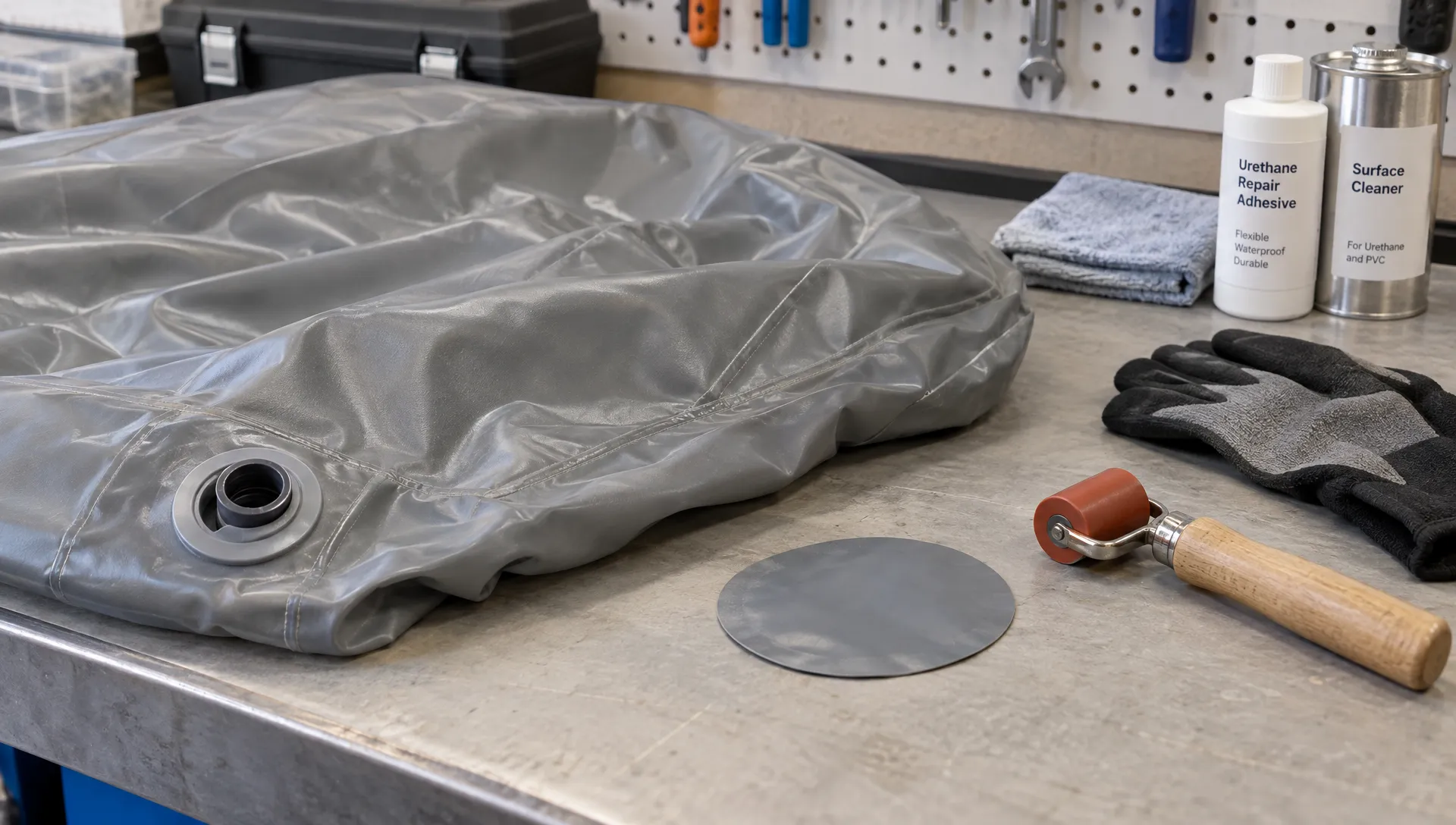
Apply, join and cure according to the exact instructions
There is no reliable universal recipe for every Clifton product, coating and working environment. Keep the current application directions beside you, including any requirements for surface preparation, coat count, joining time and full cure.
A one-part urethane repair adhesive is also not interchangeable with expanding polyurethane construction glue. Do not add an accelerator, hardener or thinner unless the instructions for that exact product explicitly permit it and specify how to use it.
Follow the specified coating and joining sequence
Some solvent-based repair systems require adhesive on both surfaces, controlled drying between coats and joining within a defined window. Follow the actual sequence rather than relying on a general glue tutorial.
When working with clifton urethane adhesive, a thicker application is not automatically stronger. Excess adhesive can interfere with the specified drying process and make a consistent bond harder to achieve.
Arrange the patch, tools and work area before you start coating. If the instructed joining window is missed, follow the documented recovery method or contact the supplier. Adding extra solvent or applying unapproved heat is not a dependable shortcut.
Apply firm, even pressure
Once the prepared surfaces are ready to join, alignment and pressure matter. Position the patch carefully, avoiding wrinkles and trapped air. Use the roller or pressure method specified in the repair instructions to establish contact across the bonding area.
Pay attention to the edges, where lifting can begin. Do not assume that pressing only the centre has bonded the entire patch.
If the patch shifts, wrinkles or fails to make contact, stop and check the permitted correction method. A neat-looking patch can still conceal poorly bonded areas underneath.
Allow full cure before inflation or use
A surface that feels dry is not necessarily fully cured. Follow the stated cure time and any instructions about temperature, humidity or staged handling. Keep the repair free from premature loading, folding or water exposure as directed.
After the required cure, inspect the patch and use the item's approved leak-testing procedure. For a suitable inflatable, that may involve a permitted soap-solution test to identify escaping air. Follow its pressure limits and do not overinflate it to "prove” the patch is strong.
A successful initial leak test confirms only what the test checks. It does not establish structural strength, long-term durability or suitability for a safety-critical use.
Recognise a failed bond before relying on it
If a repair made with clifton urethane adhesive begins lifting, adding glue around the edge may hide the symptom without fixing the cause. Poor material compatibility, contamination, incorrect joining conditions and inadequate cure are all possibilities.
An edge that peels deserves inspection before the item returns to service. Bubbles or wrinkles may indicate incomplete contact, while softened or distorted coating can suggest damage from an unsuitable preparation method. Stop using the item if the repair is unreliable.
Document the material, adhesive formulation, preparation steps and working conditions when asking the supplier for help. These details are more useful than describing the glue as "not strong enough”. Where the original material is failing, replacement or professional repair may be the better option.
Frequently asked questions
Can I use it on any PVC item? No. PVC products differ in formulation, surface treatment and construction. Check compatibility with the particular item, patch material and adhesive instructions rather than relying on the PVC name alone.
Is Clifton urethane adhesive suitable for Hypalon or CSM? Do not assume it is. CSM-coated fabrics commonly require a different adhesive system. Identify the coating and follow the item's specified repair method.
How long should I wait before inflating the repaired item? Follow the full cure and inflation instructions for the exact adhesive and item. Surface dryness is not a reliable substitute for the stated waiting period.
Can white glue or duct tape replace a proper inflatable patch? Not as an equivalent repair. White school glue serves different applications, while tape does not establish the compatibility, airtightness or durability required by an approved patch system.
Shop for the repair you actually need
Start with the material and repair requirements, then compare suitable products. You can explore Sandhai's online marketplace for everyday craft and repair supplies, checking each listing's intended uses before ordering. For specialist coated-fabric repairs, confirm the exact adhesive specification and repair guidance rather than choosing by brand name alone.

Comments